


What’s New at Wildlands
Human History of Wildlands: A Q&A with Skip Stuck
What past lives have Wildlands Trust’s conservation areas lived?
Wildlands volunteer Skip Stuck will follow every clue. Two years ago, Skip launched “Human History of Wildlands,” a blog series that explores the cultural legacies of the lands that Wildlands protects. Sixteen articles later, we asked Skip to reflect on his work so far.
What past lives have Wildlands Trust’s conservation areas lived? Some clues linger on the landscape. Others collect dust in the annals of local historical societies—or survive only in the memories of past caretakers.
Wildlands volunteer Skip Stuck will follow every clue. Two years ago, Skip launched “Human History of Wildlands,” a blog series that explores the cultural legacies of the lands that Wildlands protects. Sixteen articles later, we asked Skip to reflect on his work so far.
Wildlands: Why did you start this project?
Skip: 2026 marks my 10th year as a Wildlands Trust volunteer. When I started, I was 67, recently retired, and happy to help Wildlands’ stewardship department with trail work and carpentry. I still am. But at 77, neither my strength nor my stamina is what it once was. I love the Trust’s community-focused mission and impact, so I asked myself how I could still contribute once my days of lugging benches into the woods were over.
While leading group hikes for Wildlands, I became intrigued by the trail names, old foundations, and stone walls I came across. The Wildlands website provides great descriptions of each preserve’s "natural history," of the forests, fields, and fauna that hikers enjoy on our trails. But my general knowledge of “human history” told me that, at one point or another, people have lived or worked on nearly every acre of our regional landscape. Our “wildlands” may look untouched today, but they would surely look different if not for millennia of encounters with human hands.
Simply put, I started writing this series to explore the impact of humans on nature. As a volunteer hike leader, I also wanted to add some historical perspective to what hikers were seeing on the trails.
How has this project changed the way you think about local history?
The history many of us learned in school was written by European men. From their perspective, anything that wasn’t mowed down or built up was wilderness, and history started in 1620. The whole story is much more complicated—and harder to find. Only by researching Indigenous oral histories, local archaeology, and the observations of the earliest European explorers did I begin to realize how much we don’t know. In some places, ancient shell middens and fish weirs provide the only remaining evidence of human stories we will never fully know.
Even if every artifact and memory throughout history had been perfectly preserved, one objective “truth” would remain difficult (if not impossible) to locate. Every story is tinted by the experiences and biases of the interpreter. Read one colonial and one Indigenous account of King Philip’s War, and you will be shocked that they describe the same event.
I was also struck by how much of what we observe in nature today can be explained by historical human use. This prompts some difficult questions for Wildlands, none larger than the very definition of “preservation.” When should we repair damage done by years of human abuse? When should we simply "let nature take its course”? When should we allow a hayfield to return to a forest, or a cranberry bog to a swamp? And what should we do about the invasive plants that we’ve spread across the globe?
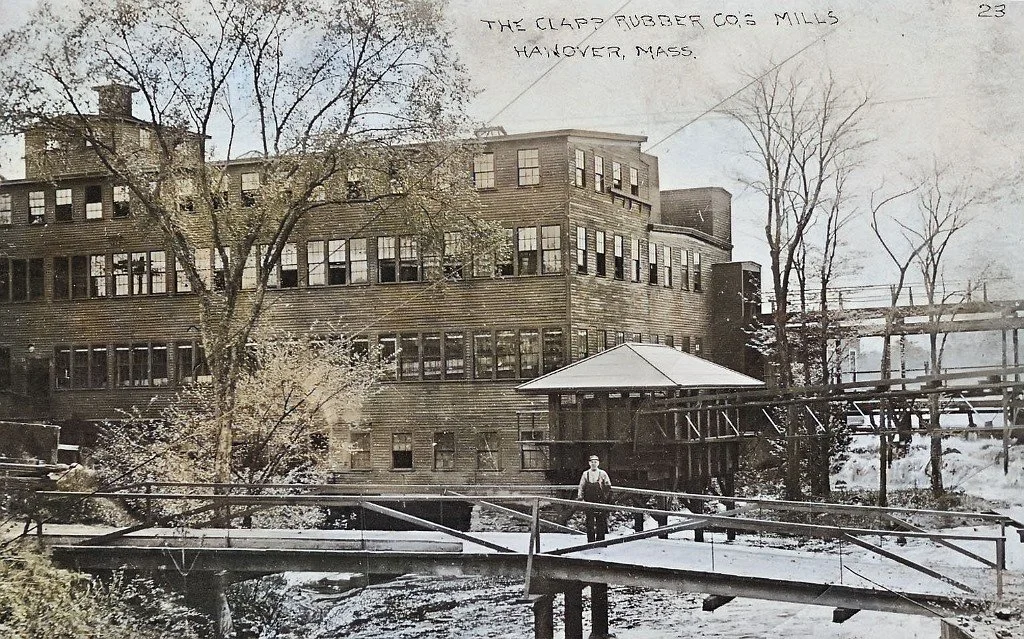
The banks of the Indian Head River in Pembroke, Hanover, and Hanson were once a hotbed of industrial development, including the Clapp Rubber Mill (pictured above). Today, the area supports the scenic Indian Head River Trail, including Wildlands’ Tucker Preserve. The dam that fueled the mill is still intact (pictured below), but the mill itself is gone, save for scattered remains in the forest. Revisit Skip’s history of the Indian Head River here.
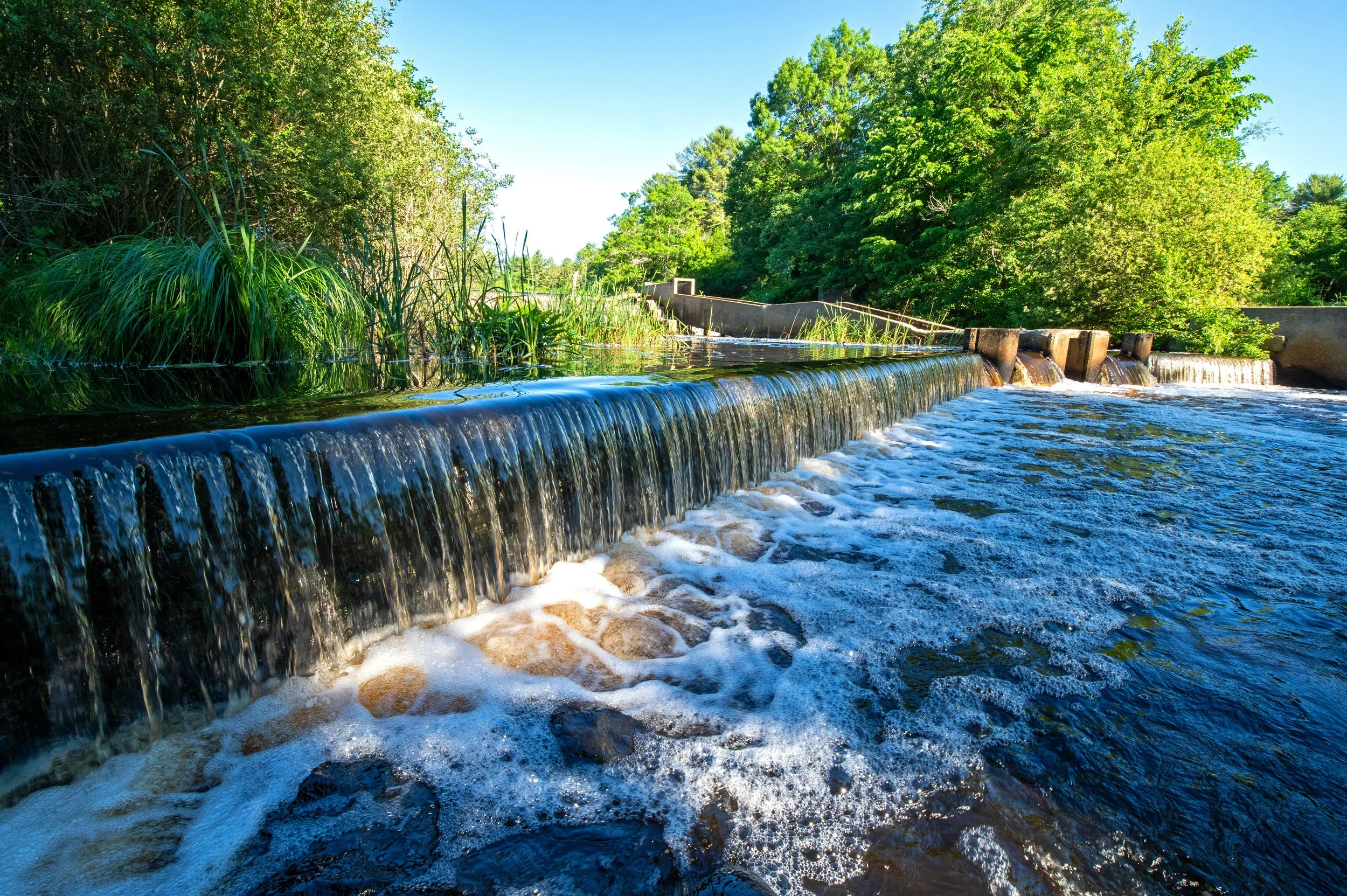
Photo by Rob MacDonald.
What patterns have you observed across these preserve histories?
Across every property I’ve researched, one pattern has held true: what happens to land hinges on its utility to people. Humans have always valued land based on its ability to support their survival and prosperity. When land couldn’t help them, they changed it. Tribes burned underbrush to improve travel, food, and safety. Settlers cleared forests and dammed rivers to create grist- and sawmills. As times changed, farms replaced forests, factories replaced farms, and cities replaced towns. When changes in population, technology, and industry ended the usefulness of land, everything returned to forest. Even today, when more people appreciate nature’s intrinsic value, many preservation efforts must still be justified by their benefits to drinking water, scenic vistas, and other human assets.
What has been most difficult about writing this series?
Earlier, I suggested that uncovering a truthful and objective history might be impossible. However, its impossibility does not diminish the value of the search. Let's return to King Philip's War. If you want to learn about the conflict, you might start with written primary sources. Yet those sources would almost certainly reflect only the perspectives of white, male Puritans or Pilgrims. You might widen your search to include information from Indigenous sources, but very little is written, and oral traditions are harder to access. One might visit the battle sites, but even archaeological evidence can yield vastly different interpretations.
So why look for the truth if you can't find it? I would argue that the act of searching, of listening to contrary points of view and seeing the world through the eyes of another, teaches us about human fallibility—and therefore the need for humility. Studying history can't assure us of the facts. But it can absolutely help us learn about each other.
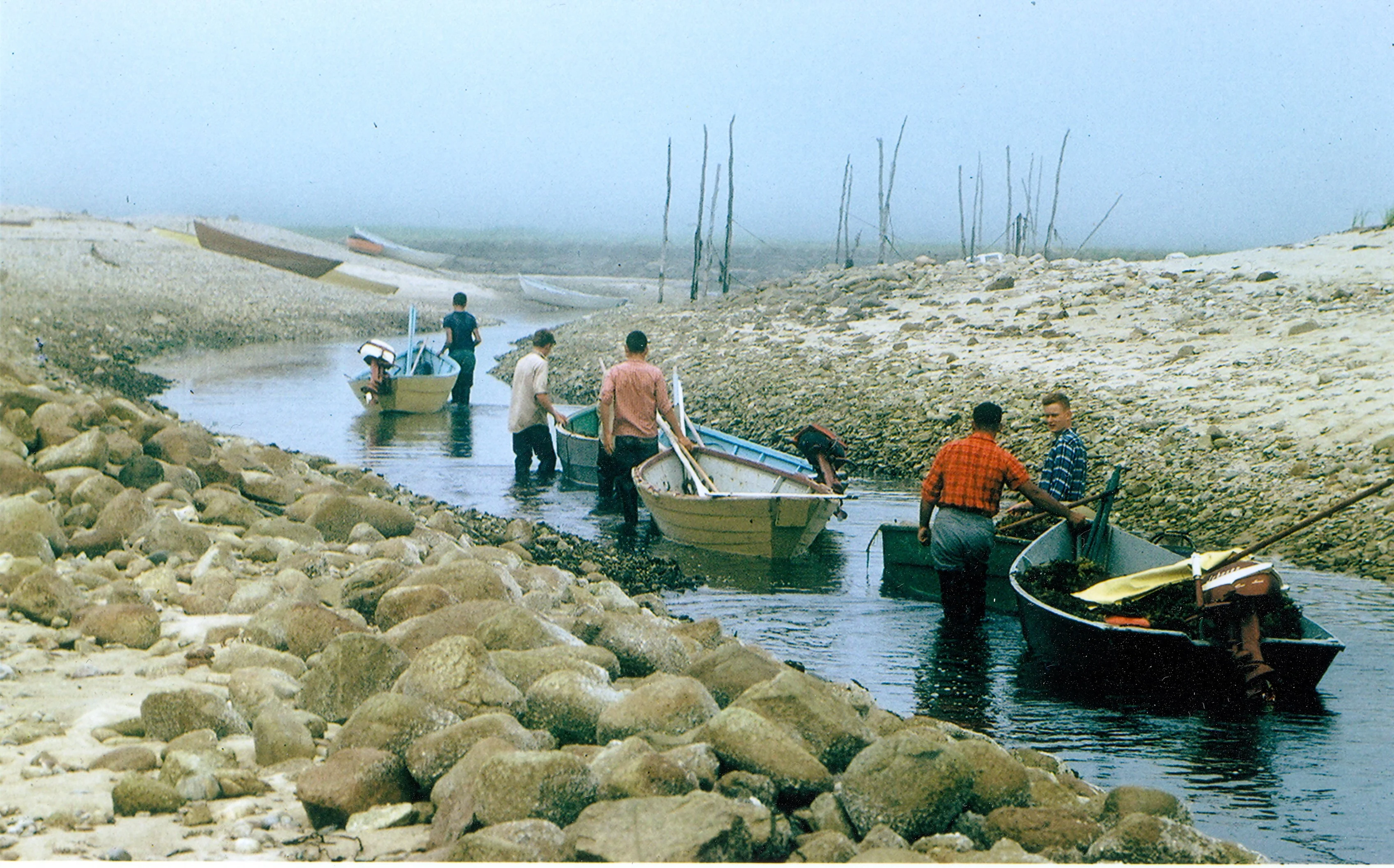
Skip’s first article in the series retraced the history of Shifting Lots Preserve in Plymouth, including the once-vibrant mossing industry in Ellisville Harbor. Photo from 1969, courtesy of Roger Janson, via Friends of Ellisville Marsh.
If readers could take away one thing from your series, what would you want it to be?
To take good care of a piece of land, you need to know its past. Throughout history, humans have caused widespread environmental damage. It’s a sobering fact with a silver lining: humans have the power to change the environment for the worse, so they also have the power to change it for the better. To do so, we need to understand how we’ve historically abused that power. Only then can we chart a new path forward.
How and why should readers get involved with local history?
You can help us find answers to our many unresolved questions—and to many more questions we haven’t yet thought to ask. The more people who participate in local history research, the more diverse sources we can uncover, and the more complete our history becomes. You don’t have to be an academic. Photos, maps, family stories, and personal memories can all be extremely valuable and paint a more colorful picture of the past.
Not long ago, I wrote a history of Willow Brook Farm in Pembroke. There was plenty of written information about the area, but I knew my account needed more photos to come to life. We published the piece, along with a plea for readers to lend their insight. To my pleasant surprise, two longtime residents of the historic farm property honored our request. The Pelleys met us at Wildlands’ headquarters, their arms and minds brimming with historical photos, documents, and stories that we published as an addendum to the initial piece. Many of the other entries in this series have relied greatly on interviews with family members, prior owners, neighbors, and others.
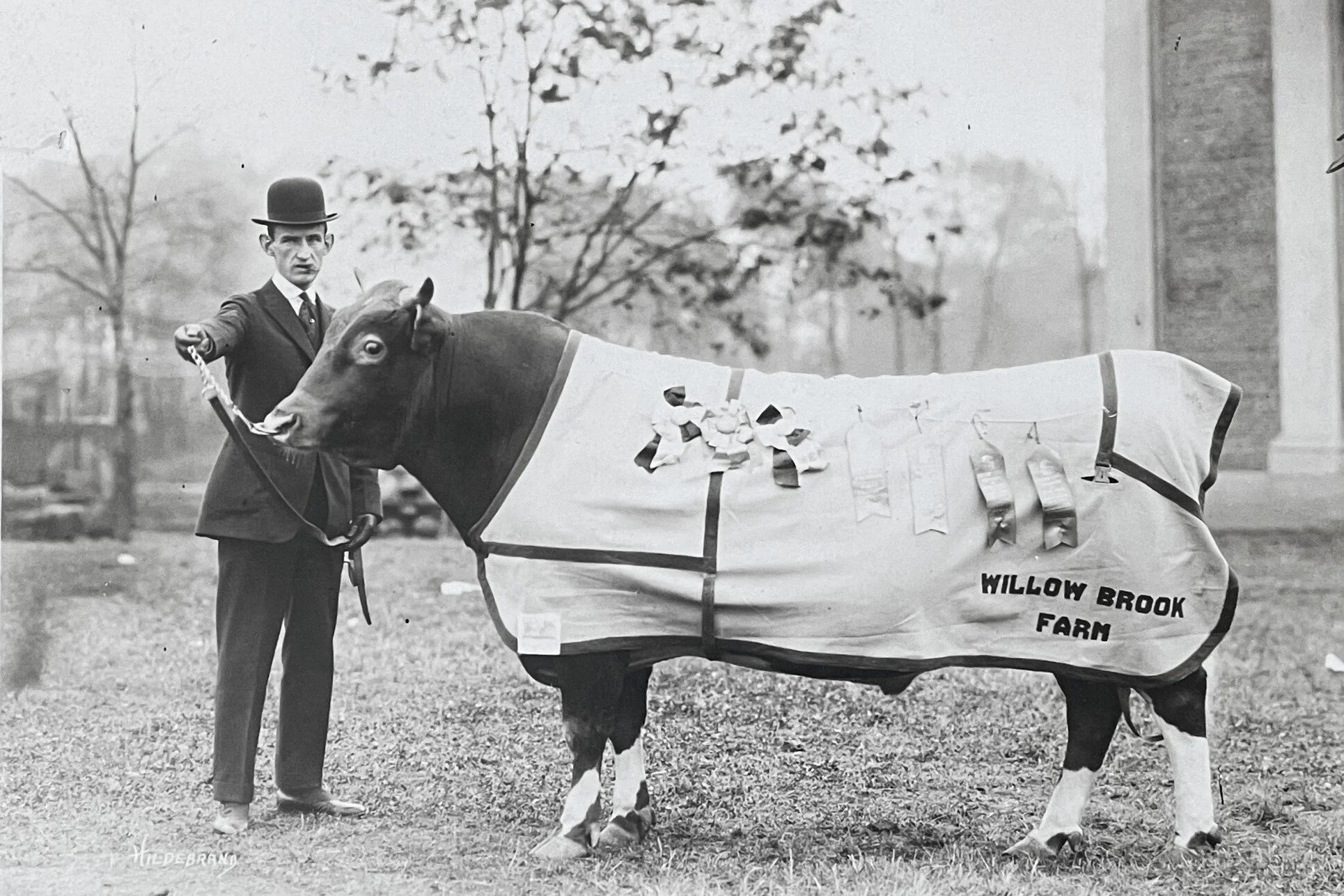
Andrew and Ann Dee Pelley, neighbors of Willow Brook Farm, shared many historical records with us, including this photo of a Guernsey cattle from Willow Brook Farm that won 1st Prize and Grand Champion at a show in Springfield in October 1917. Photo courtesy of the Pembroke Historical Society.
You can also provide feedback on past and future entries in the series by commenting below an article or sending an email to communications@wildlandstrust.org. I try my best to get my facts straight, but I always knew I’d make mistakes. I’ve received and incorporated corrections before, and I expect and welcome corrections again. If you've enjoyed these histories, I guarantee that your willingness to share information and feedback will make them even better.
Human History of Wildlands: Articles So Far
Pudding Hill Reservation, Marshfield
Old Field Pond Preserve, Bourne
Hoyt-Hall Preserve, Marshfield
Cow Tent Hill Preserve, Duxbury
Brockton Audubon Preserve & Stone Farm Conservation Area, Brockton
Delano Memorial Forest & Rounseville II Preserve, Rochester
Halfway Pond Conservation Area, Plymouth
Crystal Spring Preserve, Plainville
Tucker Preserve & Indian Head River Trail; Pembroke, Hanover & Hanson
Stewart/Person Preserve, Kingston
Wildlands Learns, Reflects, Bonds at Staff Retreat
To end January, Wildlands’ full-time employees participated in a staff retreat in Portland, Maine. Over three days, we seized the rare opportunity to step away from our day-to-day tasks, reflect on the organization’s vision and values, and help guide strategy for the next several years of Wildlands’ work.
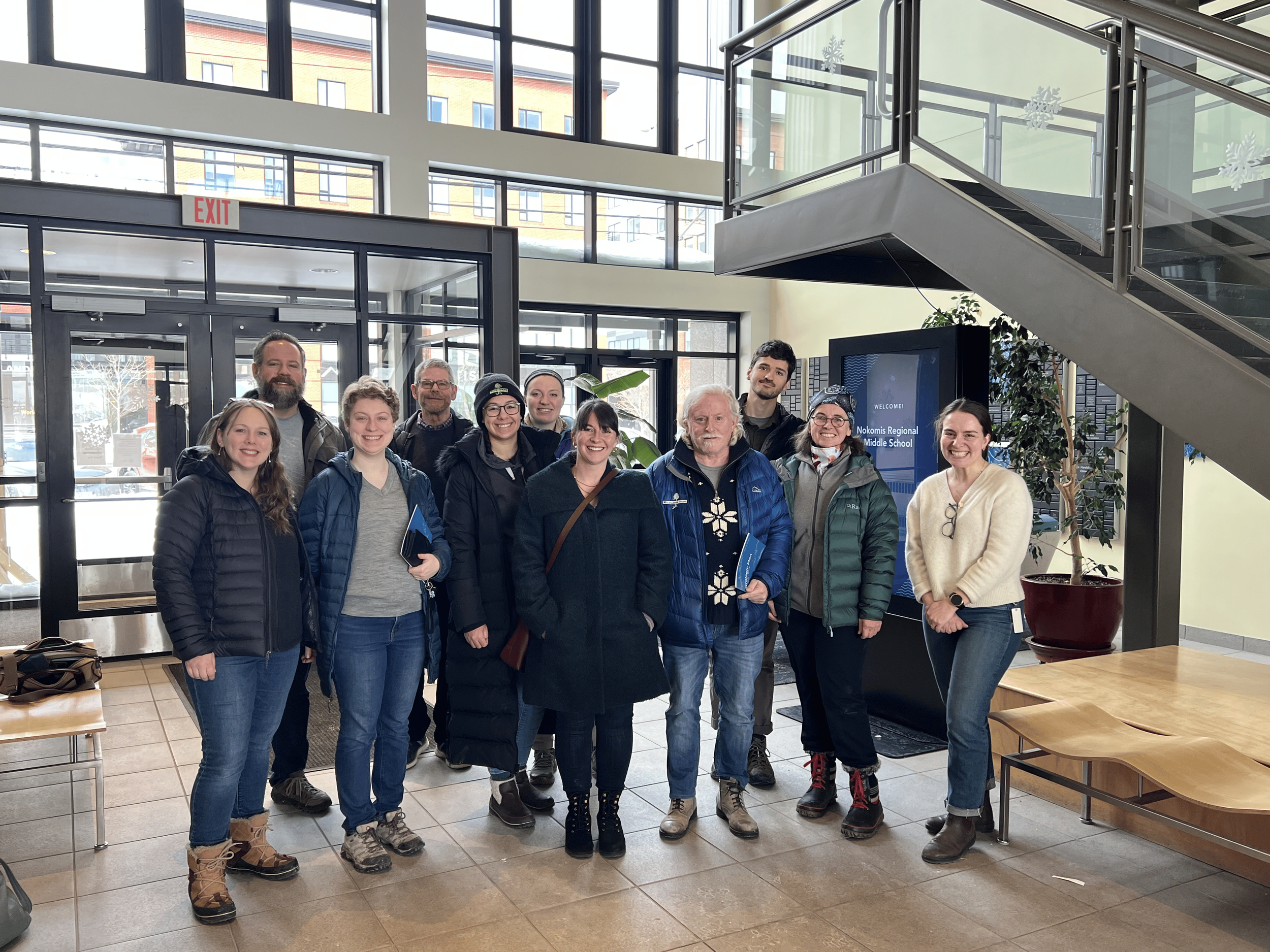
Wildlands staff at the Gulf of Maine Research Institute in Portland, Maine.
To end January, Wildlands’ full-time employees participated in a staff retreat in Portland, Maine. Over three days, we seized the rare opportunity to step away from our day-to-day tasks, reflect on the organization’s vision and values, and help guide strategy for the next several years of Wildlands’ work.
On the way north, we stopped for lunch and conversation with Greenbelt, our sister land trust on the North Shore. Wildlands staff was grateful for the chance to share successes, challenges, and lessons learned with colleagues advancing similar work at a similar scale. We thank President Chris LaPointe and the rest of the Greenbelt staff for hosting us at their gorgeous headquarters in Essex.
The next day, executive advisor Phillip Milburn met us in Portland to facilitate a collaborative discussion around Wildlands’ vision. Wildlands’ staff and board are currently developing our next strategic plan, which will be anchored by a renewed commitment to serving communities across the region. We thank Phillip for his expert guidance, which will help us advance our work with even greater purpose and clarity.
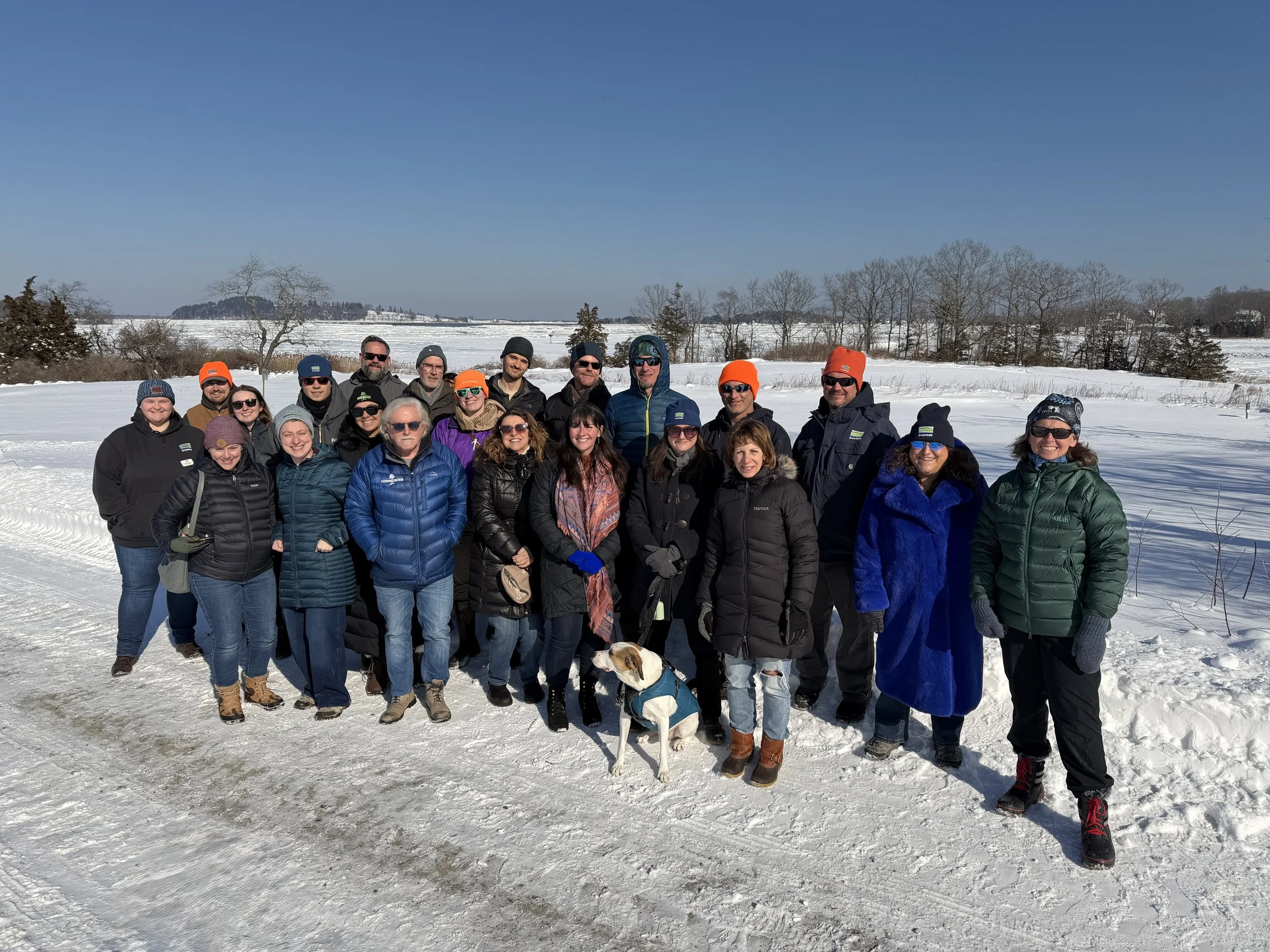
Staff members from Wildlands and Greenbelt gathered at Cox Reservation in Essex.
On our final day in Portland, we stopped by the Gulf of Maine Research Institute for a guided tour with Associate Director of Development Maeve McNell. We were impressed and inspired by the institute’s innovative work at the intersection of economic and ecological well-being. We even came away with some new contacts and ideas for future collaboration. We thank GMRI for its hospitality.
Throughout the retreat, there was also plenty of time for the staff to explore Portland and enjoy each other’s company. Shared meals and excursions built camaraderie that will pay dividends in our work.
After an invigorating few days, we are glad to be home. Now comes the hard (yet rewarding) part: translating our new ideas and connections into ever-greater impact on the remarkable people and places of Southeastern Massachusetts.
“We’re a small organization with a big responsibility in the region,” Wildlands Chief of Staff Rachel Bruce said. “It’s important for our staff to be exposed to the work of other inspiring groups and individuals in New England, and for us to grow together as colleagues so our collaborative work back home can continue with greater strength and purpose.”
Winter Resilience: Nature’s Diverse Adaptations to a Snowy Landscape
By Justin Cifello
One of the first epiphanies I recall having about the natural world was the revelation that trees don’t die in the fall. It’s an easy convenience of language to refer to the dead trees of winter, but they are, of course, very much alive. It was quite the paradigm shift to no longer think of winter as a time of death, but instead as a time of survival. The cold, seemingly inert wood bides its time, rations its water, and nurtures next year’s buds. The flowers and leaves that will raise our spirits this spring already exist, wrapped tightly in protective scales. As winter wanes, the careful eye can see their gradual transformation. A heartening sight well before the first daffodils emerge.
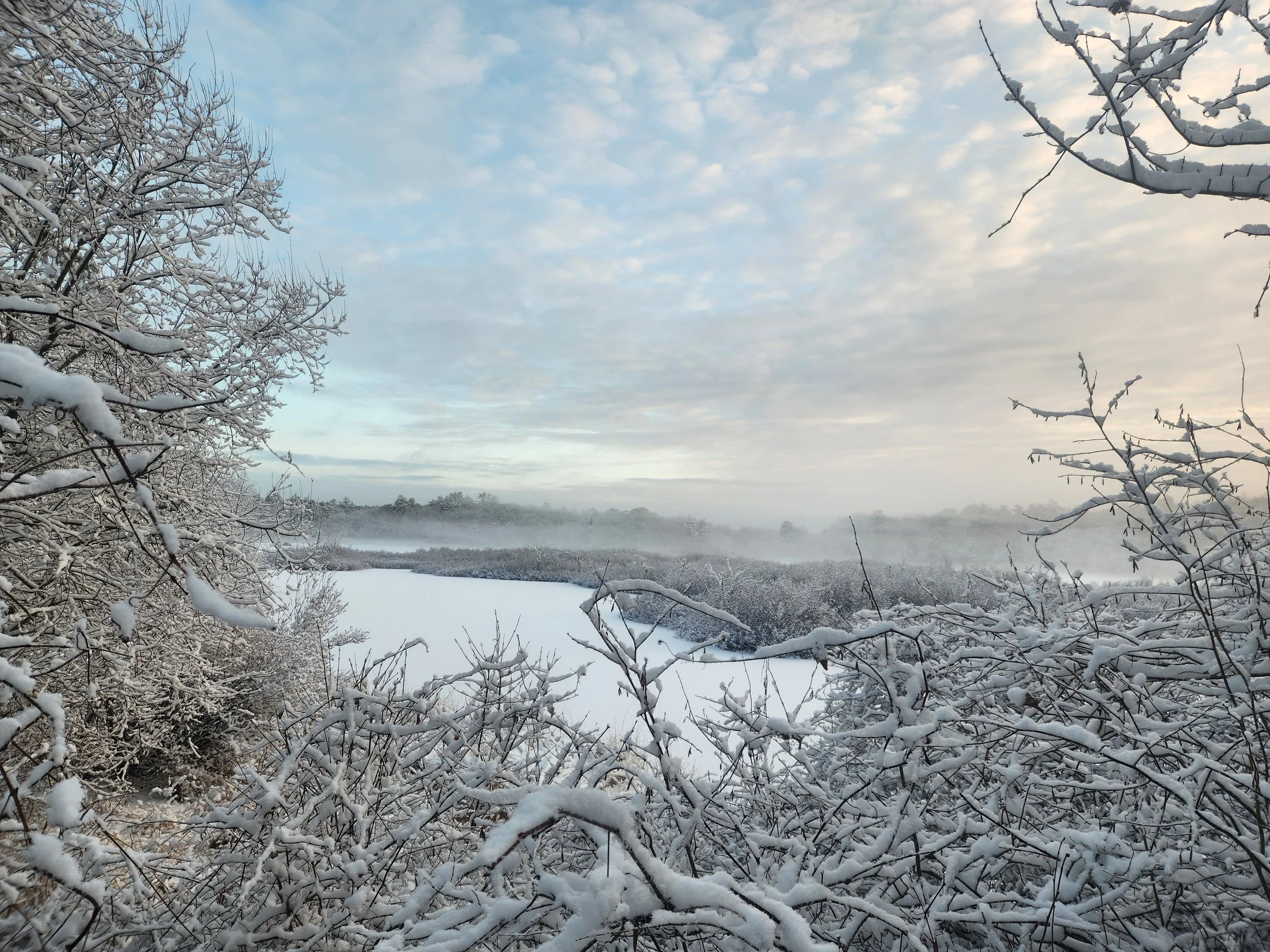
Goat Pasture Pond at Old Field Pond Preserve in Bourne. Photo by Justin Cifello.
By Justin Cifello
Justin is a farmer and naturalist at Bay End Farm in Bourne and a volunteer for Wildlands Trust. Get to know Justin (and all our Volunteer Hike Leaders) here.
One of the first epiphanies I recall having about the natural world was the revelation that trees don’t die in the fall. It’s an easy convenience of language to refer to the dead trees of winter, but they are, of course, very much alive. It was quite the paradigm shift to no longer think of winter as a time of death, but instead as a time of survival. The cold, seemingly inert wood bides its time, rations its water, and nurtures next year’s buds. The flowers and leaves that will raise our spirits this spring already exist, wrapped tightly in protective scales. As winter wanes, the careful eye can see their gradual transformation. A heartening sight well before the first daffodils emerge.
Despite all the difficulties that snow and ice present, nature is pretty good at finding utility in an obstacle. Under the snow, in the subnivean zone, small animals can forage, safely hidden from visual predators. Snow insulates the earth, keeping it around 32 degrees—still cold, but much warmer than exposed ground. Look for the tunnels made by mice, voles, and other creatures as the snow melts. [1]
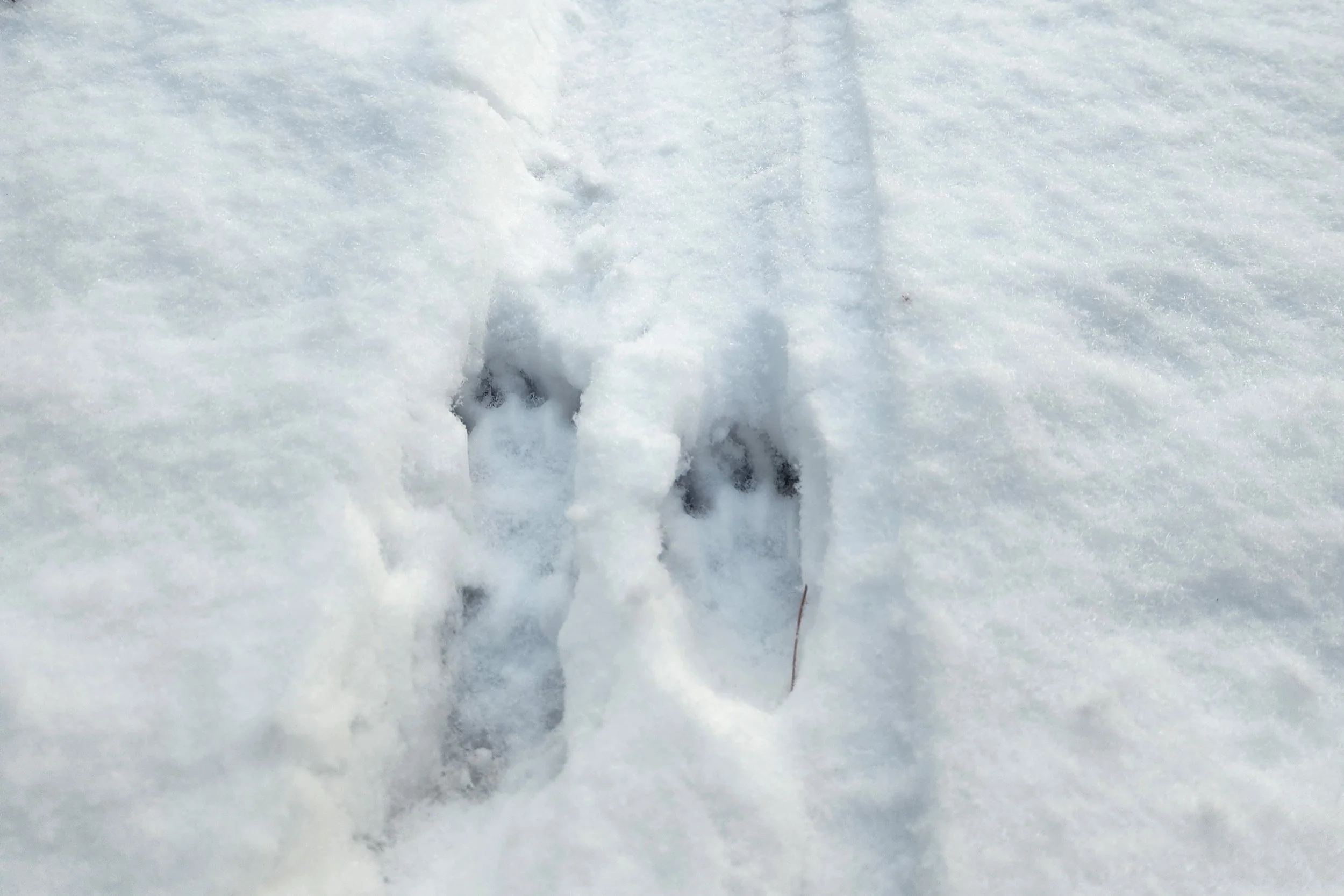
River otter tracks. Photo by Justin Cifello.
Similarly, sheets of ice help ponds retain their heat and protect fish from eagles and herons. It is even possible to see turtles swimming below the ice. Reptiles and amphibians have a more flexible form of hibernation called brumation, allowing them to wake, drink water, and bask occasionally in the winter. Unable to reach the surface for air, they extract oxygen from the water via cloacal breathing—that is, through their butts. This only works when water is rich in oxygen, far from guaranteed when ice seals off the water below from the atmosphere above. To circumvent this issue, some turtles forgo the need for fresh oxygen entirely by using the calcium from their shells to safely tap stored energy in their muscles. [2]
Under a foot of snow, the landscape becomes a whole new arena for predators and prey. Who survives depends on who adapts. Creatures of habit find themselves vulnerable to more flexible, opportunistic hunters. Foxes walking on top of the snow can reach bushes once out of reach. When branches are weighed down by snow, windows open in the canopy, giving small hawks better access in dense brush. Deer sink in deep snow and instead prefer to hunker down in sheltered places, making them vulnerable to the lighter coyotes who, with their wide paws, can walk on top of the snow. [3]
Snow facilitates movement for a typically sedentary group: plants. Some trees, like birches and pines, release their seeds in winter. Birch seeds look a bit like birds; look for these “flocks” scattered on the snow. The smooth surface grants windblown seeds easy travel, skimming across now buried obstacles. Protected from a watery grave by the ice, seeds that land on ponds are safely blown to the shore, a phenomenon observed by Thoreau in his “Faith in a Seed.” [4][5]
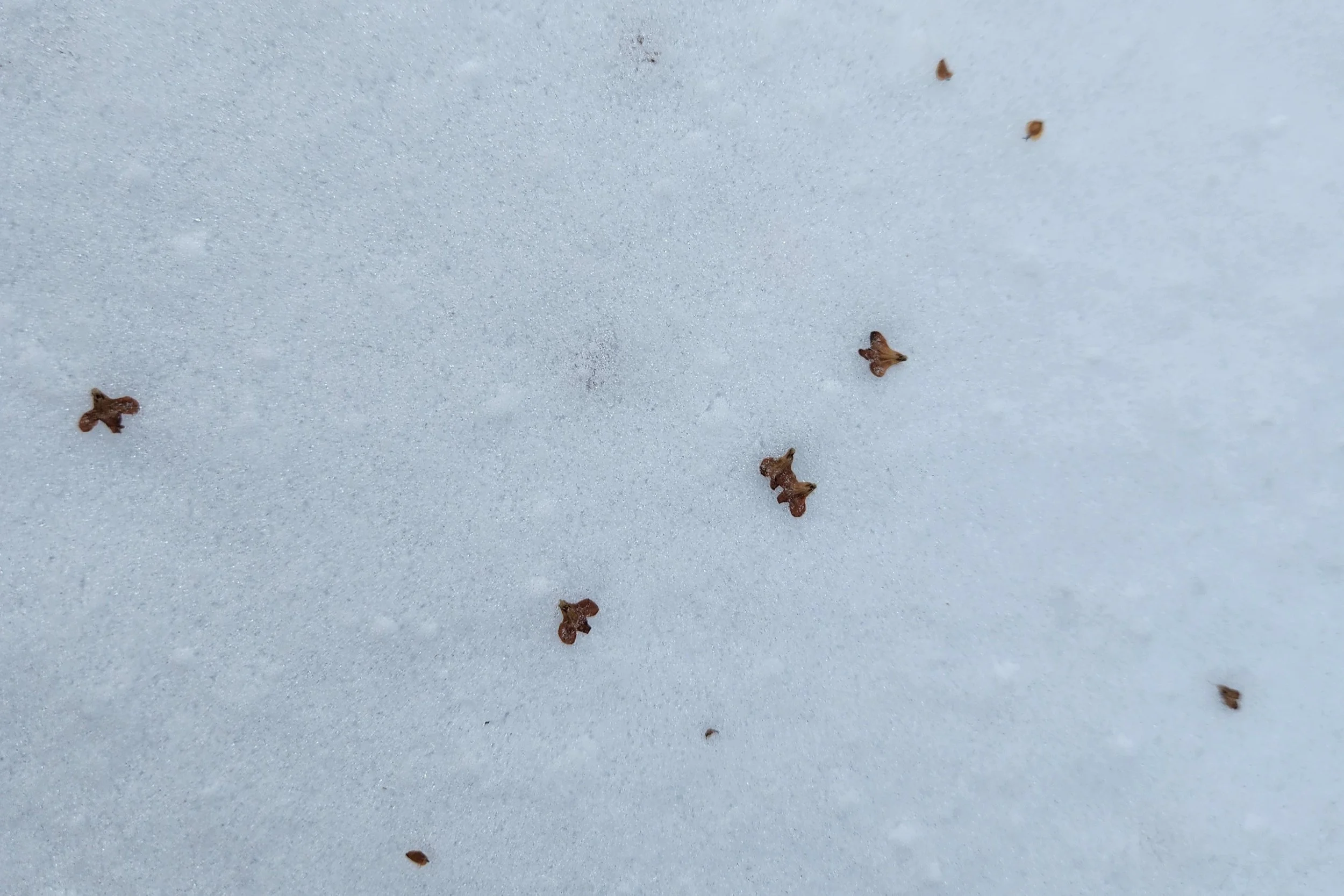
A “flock” of birch seeds on the snow. Photo by Justin Cifello.
Most substances condense when they freeze, but water expands. Just as this means trouble for the pipes in your home, it also puts trees at risk of damage during dramatic temperature swings in winter. Trees have various strategies to account for this expansion and contraction of water in their limbs. Dark-colored trees heat up faster, so they tend to have craggy bark that can safely shrink and swell without splitting. Lighter-colored trees, meanwhile, can afford thinner bark, as seen on beeches and maples. The high sugar content in sap lowers its freezing point, acting as a natural antifreeze. [6]
Winter is a time of paradoxes. Undoubtedly still a hardship for us and for wildlife, it is not without its benefits. With no mosquitoes and fewer ticks, we can access places out of reach in the summer, even if slowed by snow. Without foliage, we can see farther and better observe the glacial topography. As much as the snow conceals, it reveals the busyness of animals, their stealth betrayed by their roving tracks. Life quietly reveals its dazzling resilience, offering inspiration as we await the melting of ice.
Works Cited
1. The Subnivean Zone: dnr.illinois.gov/education/atoz/winterinillinois/subniveanzone.html
2. Turtles: www.oriannesociety.org/faces-of-the-forest/winterwoodturtles/?v=f69b47f43ce4
3. Deer and Coyotes: www.forestsociety.org/blog-post/something-wild-fragile-balance-deer-and-coyotes-late-winter
4. Thoreau, “Faith in a Seed”: archive.org/stream/FaithInASeed-English-Thoreau/thoreau_djvu.txt
5. Thoreau, “The Succession of Forest Trees”: monadnock.net/thoreau/trees.html
6. Trees: extension.psu.edu/silent-survivors-the-winter-life-of-tree
Year in Review: What We Protected in 2025
Plus: What You Read in 2025 — Top Stories from Wildlands E-News
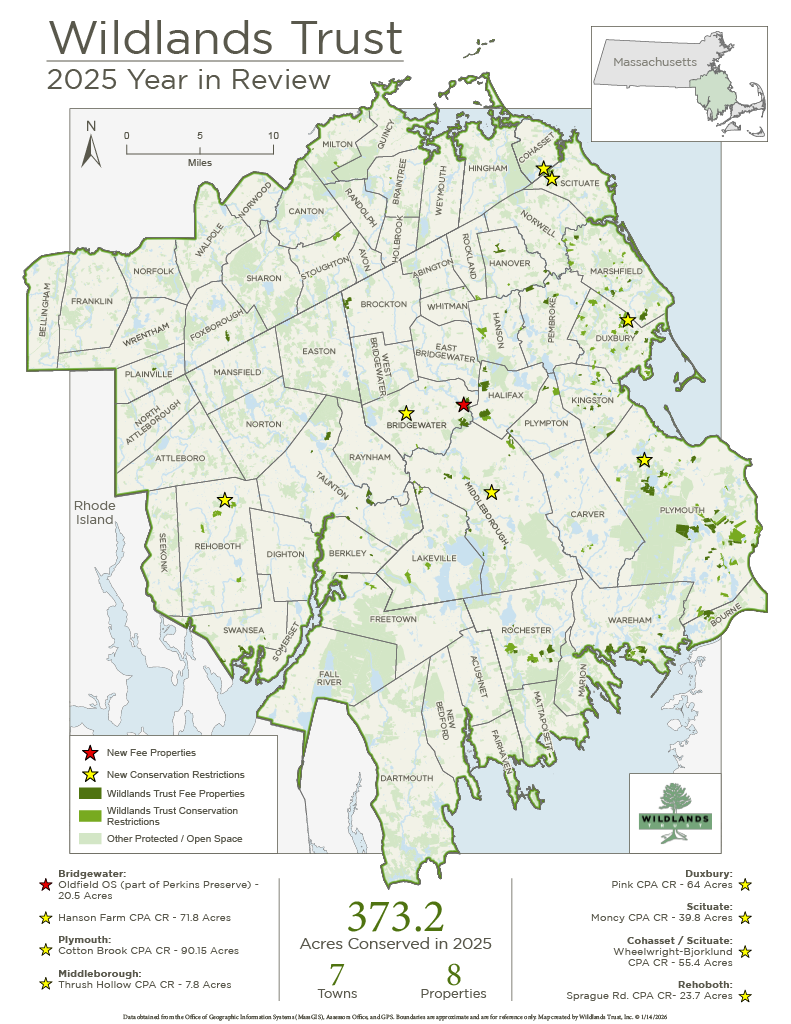
Wildlands’ 2025 land protection projects. Click the map to view a full PDF.
New Year’s Reflections from the Land Protection Office
By Scott MacFaden, Director of Land Protection
Helping CPA Towns Turn Investment into Impact
We completed five new Community Preservation Act (CPA) Conservation Restrictions (CRs) in 2025: the Hanson Farm CR in Bridgewater, the Cotton Brook Preserve CR in Plymouth, the Thrush Hollow CR in Middleborough, the Pink CR in Duxbury, and the Sprague Road CR in Rehoboth. Although these CRs are in different communities and protect different types of habitats, the connecting thread between them is that they all represent locally driven land conservation projects enabled in large part by CPA funds. A quarter-century after it became law, the CPA remains an invaluable asset to community-driven land preservation.

Hanson Farm in Bridgewater.
Saving Farmland
The Hanson Farm CPA CR in Bridgewater was the highlight of the year for farmland protection projects. We now co-hold a CR with the Town of Bridgewater on the 72-acre Hanson Farm, the last working farm of scale in Bridgewater and regionally beloved for its ice cream stand and farm store. The CR will forever ensure the protection of this last bastion of Bridgewater’s agricultural heritage.
Conserving Land in New Towns
We continued to expand our geographic footprint by adding two new communities to our portfolio through the acceptance of two CPA CRs previously held by the Maxwell Conservation Trust in Scituate and Cohasset. Collectively protecting 96 acres in the West End neighborhood, primarily in Scituate but including a small portion in Cohasset, these CRs encompass a variety of landscapes and habitat features, including scenic woodlands and vernal pools.
Founded in 1997, the all-volunteer and locally based Maxwell Conservation Trust prioritized protecting land in the West End neighborhood and worked closely with the Town of Scituate to successfully complete multiple projects in that area, including the two properties protected by these CRs. Similar to several all-volunteer land trusts Wildlands has worked with, the Maxwell Conservation Trust eventually determined it could no longer continue as an active organization and sought a qualified successor to accept an assignment of its CRs before shutting down its operations. Learn more here.
Looking Ahead to 2026
We’re excited about several new farmland projects that are either underway or in the early stages of preparation. In the former category, we’re working with the Friends of Holly Hill Farm and the Town of Cohasset toward completing a CR on a currently unprotected portion of that farm. If all goes as anticipated, the CR will be completed by early summer. In the latter category, a project that would achieve a permanent preservation outcome for Hornstra Farms in Whitman is in the planning stages.
Best of E-News: What Inspired You in 2025
When people are informed, connected, and inspired to protect the nature around them, the entire region benefits. That is what Wildlands E-News is all about. Below are five of the most-read E-News articles from 2025.
Curious about a particular aspect of our work or our region’s natural resources? Tell us in the comments below, and we might explore your question in a future newsletter!
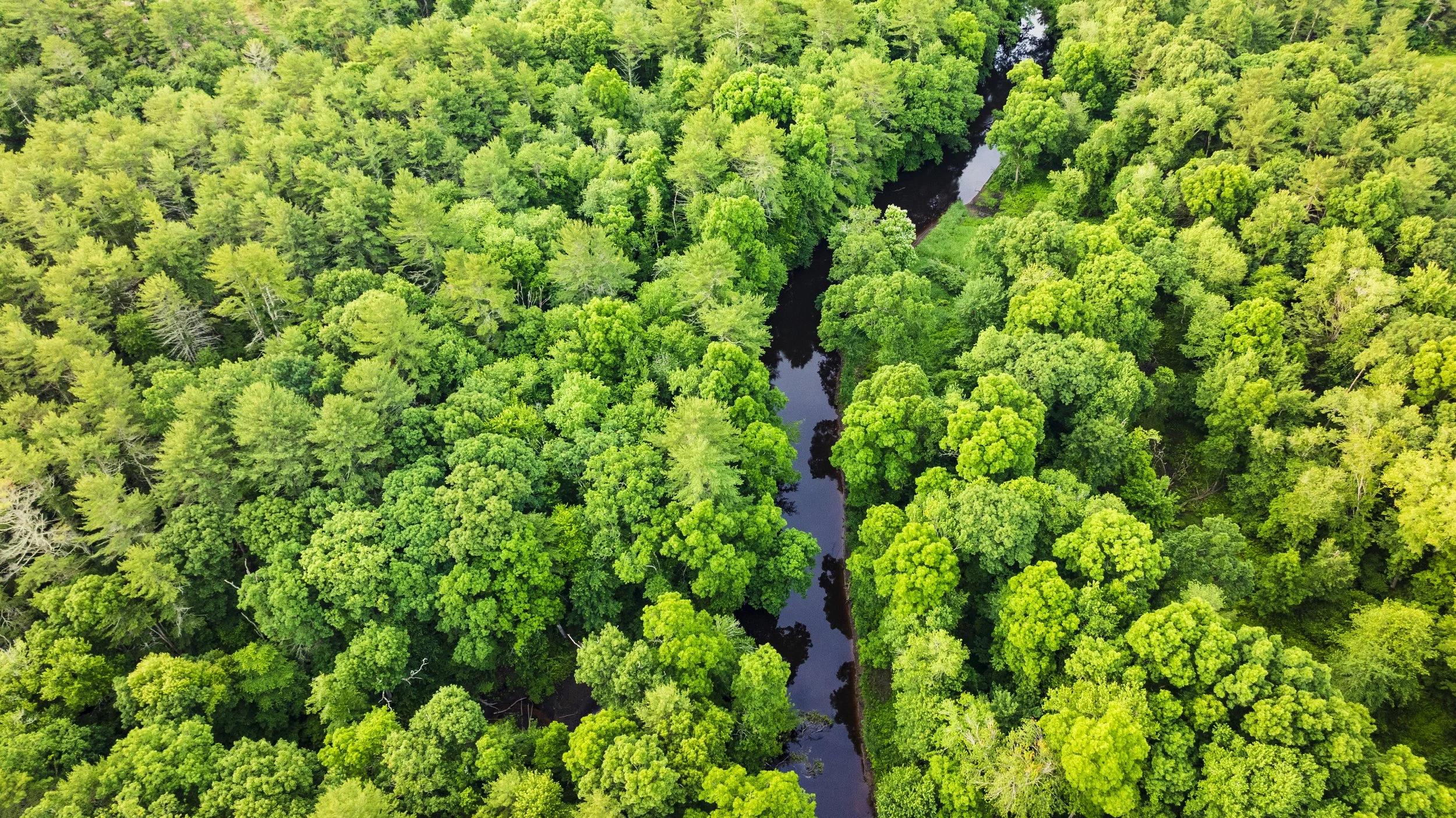
Taunton River at Wyman North Fork Conservation Area in Bridgewater.
1. Human History of Wildlands: The Taunton River Watershed
Key Volunteer Skip Stuck continued his popular series in 2025, spotlighting the human history hidden beneath the foliage of Wildlands’ most beloved preserves. In this most-viewed article of 2025, Skip broadens his focus to an entire region—the Taunton River watershed, where Wildlands has prioritized land protection for decades due to its unique ecological and cultural heritage.
2. Land Protection Update: Duxbury, Scituate, Cohasset
Scott MacFaden recounted Wildlands’ recent land protection victories, including a Conservation Restriction (CR) next to O’Neil Farm in Duxbury and two CRs in Scituate and Cohasset, Wildlands’ first-ever acquisitions in those towns.
Wildlands members receive exclusive updates from our land protection office through their complimentary subscription to our biannual print newsletter, Wildlands News. Become a member today at wildlandstrust.org/membership.
3. White Pine: A Common Tree’s Uncommon History
In his Wildlands E-News debut, local farmer, naturalist, and volunteer hike leader Justin Cifello shines a light on a somehow overlooked giant of our forests—the white pine. From their symbolism in Indigenous and colonial cultures to the surprising reason behind their occasional deformity, Justin traces a history that places the white pine at the center of our region’s social and ecological identity.
4. Welcoming New Staff
We said hello to four new staff members in 2025. Rebecca Cushing joined us in January as one of two new Land Stewards. Callahan Coughlin joined us in February as the second. Already, Rebecca and Callahan have earned new titles to reflect their increasing responsibility: Rebecca is now our Stewardship & Volunteer Coordinator, while Callahan is our Stewardship & Training Coordinator.
In May, we welcomed Rob Kluin as our new Donor Relations Manager. Rob succeeds Sue Chamberlain, who retired after 12 years at Wildlands. In August, Jason Risberg came aboard as our first-ever GIS Manager, giving a major boost to our mapping and analysis capabilities.
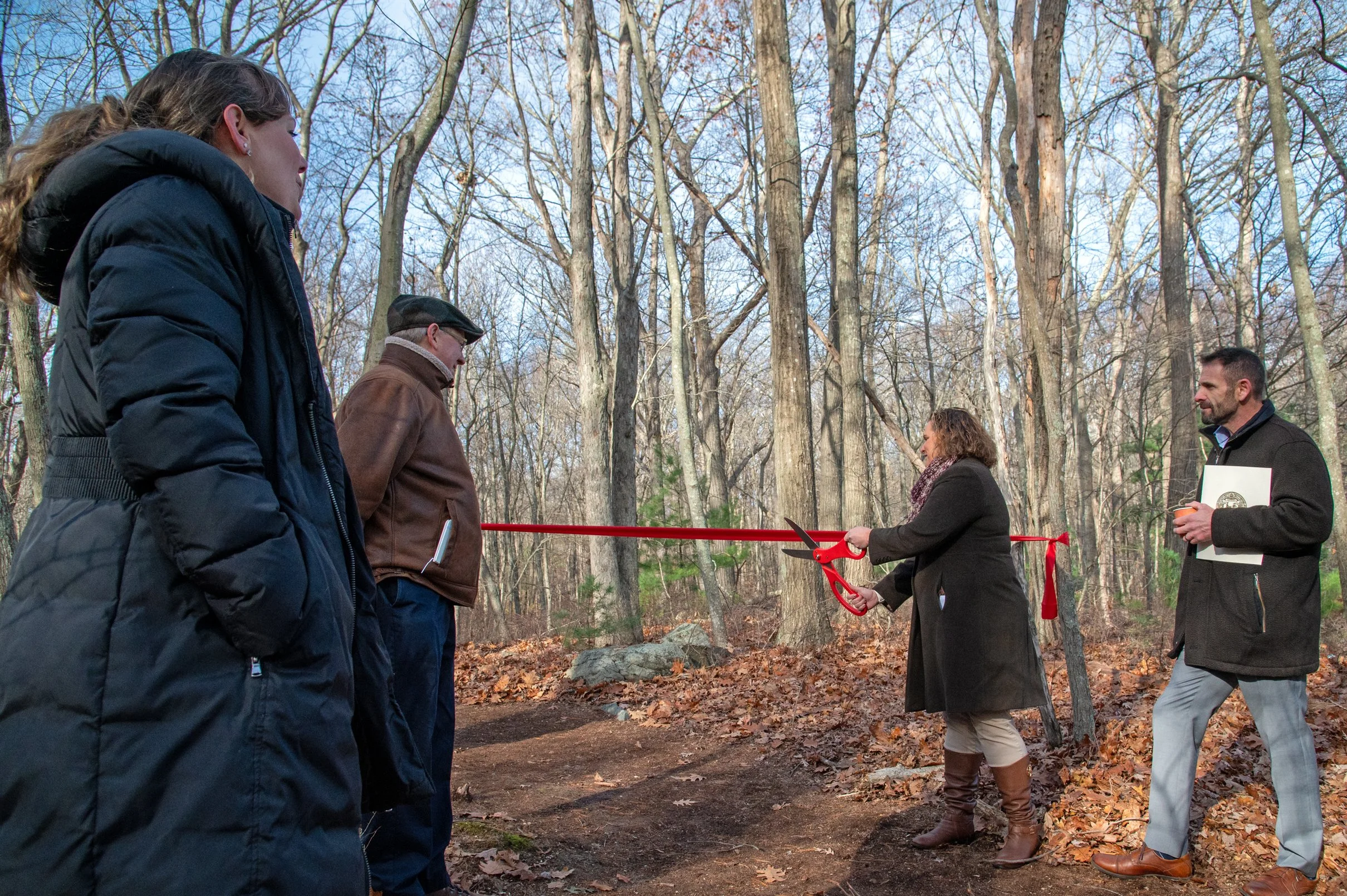
Town of Avon Select Board Member Shannon Coffey cuts the ceremonial ribbon to open Fieldstone Preserve.
5. Fieldstone Preserve Gives Avon & Brockton Residents New Place to Enjoy Nature
In November, Fieldstone Preserve opened to the public, providing Avon, Brockton, and surrounding communities with new access to nature in the region’s densest urban landscape. The 30-acre woodland features 0.7 miles of trails that connect to D.W. Field Park. The Town of Avon acquired the property in 2024 with funds from a state grant and a private foundation, secured by Wildlands Trust. The grand opening ceremony brought together public officials and nonprofit leaders working collaboratively to improve the area via the D.W. Field Park Initiative.
Human History of Wildlands: Pudding Hill Reservation
As with many of the properties featured in this “Human History of Wildlands” series, the present-day tranquility of the area belies the long human impact on the land in and around Pudding Hill Reservation. Like Hoyt-Hall Preserve and Phillips Farm Preserve, other Wildlands properties in Marshfield, this land has been in constant use for generations, including Native Americans for thousands of years and European settlers over the last four centuries. With human habitation comes change.
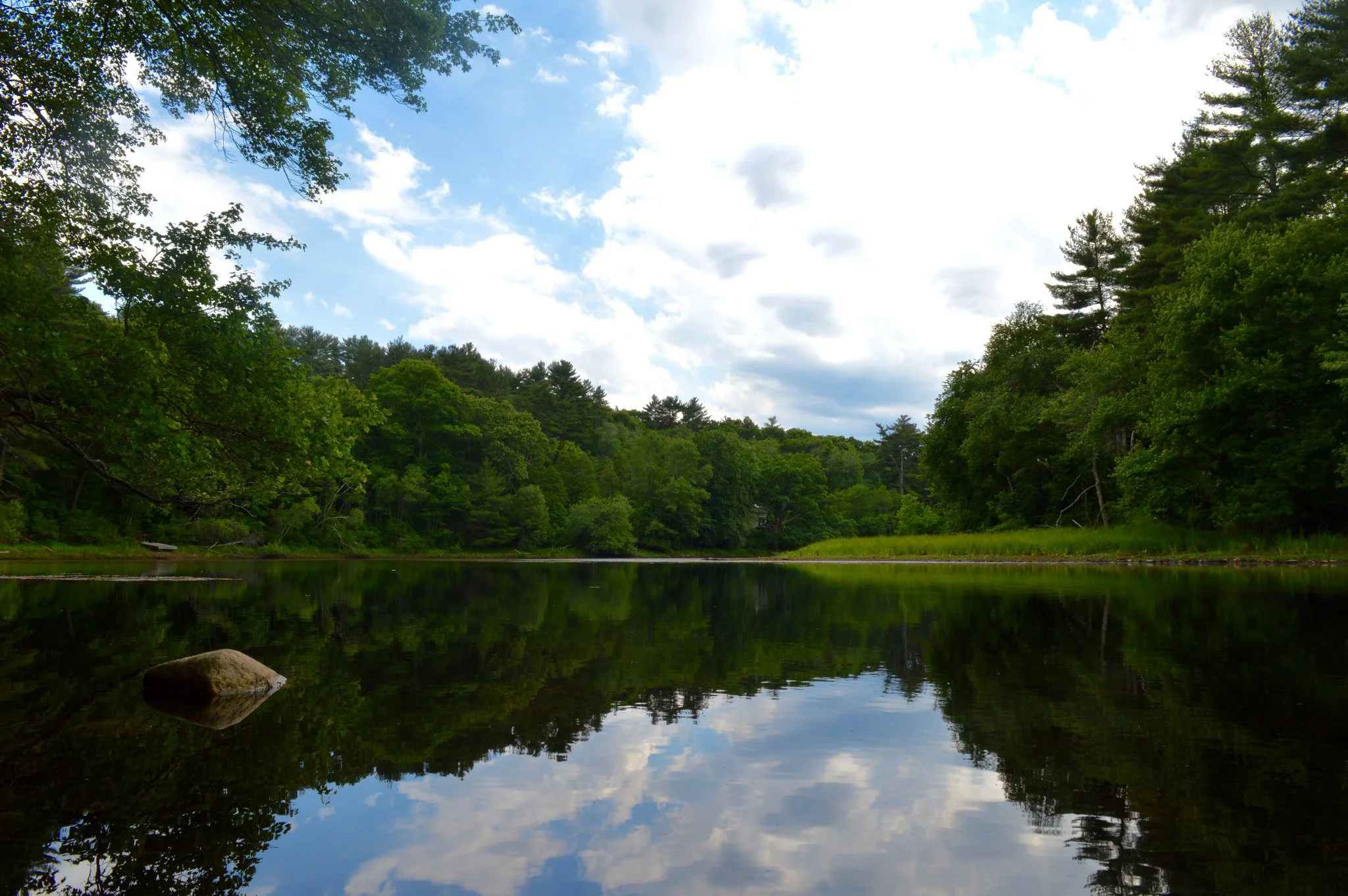
Chandler’s Pond at Pudding Hill Reservation in Marshfield.
By Skip Stuck, Key Volunteer
Pudding Hill Reservation in Marshfield was donated to Wildlands Trust in 1991 by Elizabeth Bradford. Though relatively small at 37 acres, the preserve has a varied terrain, including an upland ridge, frontage on Chandler’s Pond (from which a bubbling brook becomes the South River), and the 128-foot Pudding Hill itself. A mowed 0.4-mile trail provides easy access to the preserve from the parking area on Pudding Hill Lane. Today, Pudding Hill Reservation offers visitors a relaxing sanctuary just minutes from Marshfield Center.
As with many of the properties featured in this “Human History of Wildlands” series, the present-day tranquility of the area belies the long human impact on the land in and around Pudding Hill Reservation. Like Hoyt-Hall Preserve and Phillips Farm Preserve, other Wildlands properties in Marshfield, this land has been in constant use for generations, including Native Americans for thousands of years and European settlers over the last four centuries. With human habitation comes change.
The North and South Rivers have always been heavily utilized by Native people, including the Massachusett Tribe, for hunting, fishing, and shell fishing, and as water highways for transport and trade throughout Southeastern Massachusetts.
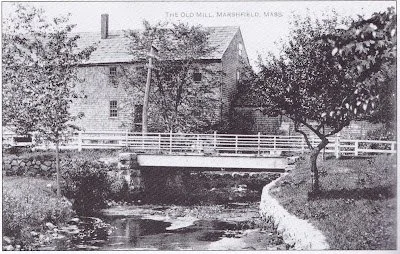
Marshfield’s first gristmill, founded in 1654 by William Ford and Josiah Winslow. Photo circa 1940. The site is now Veterans Memorial Park, directly adjacent to Pudding Hill Reservation. Via North and South Rivers Watershed Association.
After 1620, Pilgrims from the Plymouth Colony were quick to see these benefits. Settlers began to arrive in Marshfield before 1640. As you will remember from other installments of this series, one of the first orders of business in areas with flowing water was the building of mills—especially gristmills. With this goal in mind, Samuel Baker, John Adams, and James Pitney purchased the Pudding Hill property along the South River. By 1659, Samuel Baker's gristmill was up and running, made possible by the damming of the South River to create Chandler’s Pond. Other dams and mills followed in 1706 and 1771.
But bigger things were on the horizon. In 1810, as the Industrial Revolution was beginning, waterpower was once again instrumental in the establishment of the Marshfield Cotton and Woolen Manufacturing Company. A network of support enterprises helped the company thrive through the first half of the 19th century. Leavitt Delano's blacksmith shop and Elijah Ames' carpentry shop, among others, produced barrels, tools, and other necessities. Other factories produced textile dyes. Farming was largely replaced by factory work, which necessitated housing, boarding houses, a store, and a school.
However, the second half of the 19th century was the time of "Manifest Destiny," and throughout New England, the opening of the American West drove a significant emigration of local farmers to the Great Plains and beyond. In addition, larger manufacturing cities such as Brockton, Lowell, and Lawrence drew workers away from the smaller towns. The Cotton and Woolen Company closed in 1860, but later Gilbert West purchased the water rights to the property and ran a saw and gristmill until the 1920s.
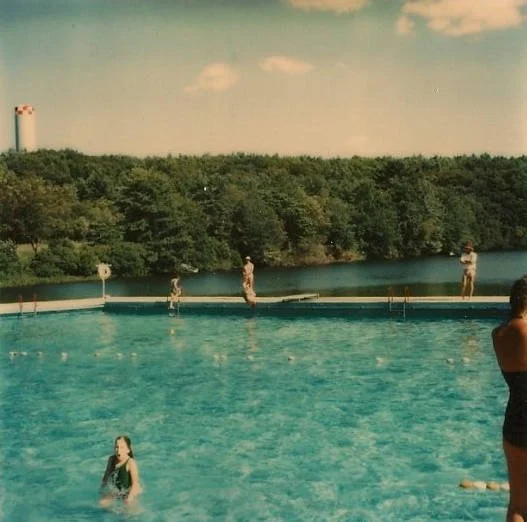
Camp Milbrook campers swimming in Chandler’s Pond in 1967. Via UMass Boston, Joseph P. Healey Library.
Marshfield was gradually becoming the seaside vacation and bedroom community of today. In the 1920s, Pudding Hill and Chandler’s Pond became the summer home of the Bradford family. In the 1950s, the Bradfords moved in full-time. In an interview, Elizabeth Bradford, a direct descendant of Plymouth Colony governor William Bradford, relates the history of Pudding Hill as a quiet, peaceful refuge—not just for her family, but for many others. From about 1938 to 1985, Pudding Hill was the location of Camp Milbrook, a summer camp that served hundreds of children over its lifetime. It also gained local fame as a training camp and teaching clinic for the Boston Celtics, where coach Red Auerbach and stars like Larry Bird, Kevin McHale, and Robert Parish taught basketball fundamentals to summer campers.
After the camp closed, the Bradfords started thinking about what would happen to the property they loved. Housing and other development was erasing much of the historic farmlands and woodlands in town, and Elizabeth Bradford was committed to saving Pudding Hill and preserving its beauty. In 1991, she donated it to Wildlands Trust. Today, it is a popular destination for hikers, bird watchers, and nature lovers who use its trails and open space for all the outdoor activities that Ms. Bradford intended. It will remain as such forever under Wildlands’ stewardship.
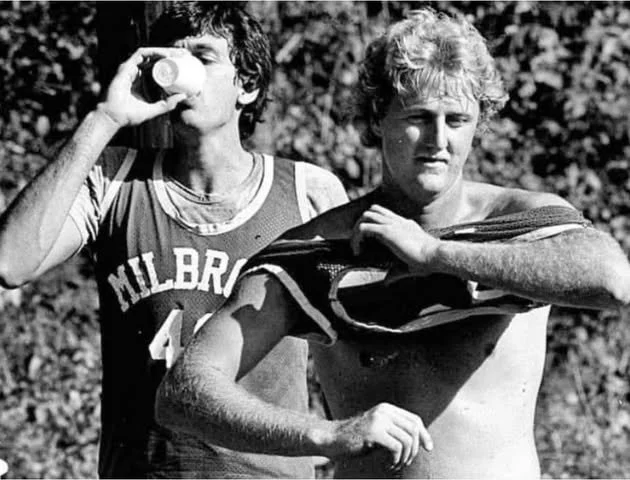
Kevin McHale and Larry Bird at Camp Milbrook. Video: Red Auerbach instructs kids at Camp Milbrook in Marshfield in 1974. Source: GBH Archives.
We hope you will take advantage of what Wildlands Trust offers in Marshfield and throughout Southeastern Massachusetts. Please come and visit. To learn more, look over the following resources used in researching this article:
The Power of Water: Milling and Manufacturing in the North River Valley by Kezia Bacon, NSRWA, April 2008.
An excellent piece that delves more deeply into the history and stories of the entire North and South River watershed, including several other areas that Wildlands preserves, such as Hoyt-Hall Preserve, Cushman, Preserve, Willow Brook Farm, Tucker Preserve/Indian Head River Trail, Phillips Farm Preserve, and Cow Tent Hill Preserve. I thank Ms. Bacon for writing it and hope you will enjoy reading it.
Marshfield: A Town of Villages 1640 - 1990, by Cynthia Hagar Krussel and Betty Magoun Bates, Historical Research Asociates,1990.
Interview of Elizabeth Bradford, by Kezia Baker, WaterWatch (the newsletter of the North and South Rivers Watershed Association), Sep. 1993.
North and South Rivers Watershed Association website: www.nsrwa.org.
Pudding Hill Reservation, Wildlands Trust: wildlandstrust.org/pudding-hill-reservation.
As always, a special thanks to Thomas Patti for editing this piece.