
What past lives have Wildlands Trust’s conservation areas lived? Some clues linger on the landscape. Others collect dust in the annals of local historical societies—or survive only in the memories of past caretakers.
Wildlands volunteer Skip Stuck will follow every clue. Two years ago, Skip launched “Human History of Wildlands,” a blog series that explores the cultural legacies of the lands that Wildlands protects. Sixteen articles later, we asked Skip to reflect on his work so far.
Wildlands: Why did you start this project?
Skip: 2026 marks my 10th year as a Wildlands Trust volunteer. When I started, I was 67, recently retired, and happy to help Wildlands’ stewardship department with trail work and carpentry. I still am. But at 77, neither my strength nor my stamina is what it once was. I love the Trust’s community-focused mission and impact, so I asked myself how I could still contribute once my days of lugging benches into the woods were over.
While leading group hikes for Wildlands, I became intrigued by the trail names, old foundations, and stone walls I came across. The Wildlands website provides great descriptions of each preserve’s "natural history," of the forests, fields, and fauna that hikers enjoy on our trails. But my general knowledge of “human history” told me that, at one point or another, people have lived or worked on nearly every acre of our regional landscape. Our “wildlands” may look untouched today, but they would surely look different if not for millennia of encounters with human hands.
Simply put, I started writing this series to explore the impact of humans on nature. As a volunteer hike leader, I also wanted to add some historical perspective to what hikers were seeing on the trails.
How has this project changed the way you think about local history?
The history many of us learned in school was written by European men. From their perspective, anything that wasn’t mowed down or built up was wilderness, and history started in 1620. The whole story is much more complicated—and harder to find. Only by researching Indigenous oral histories, local archaeology, and the observations of the earliest European explorers did I begin to realize how much we don’t know. In some places, ancient shell middens and fish weirs provide the only remaining evidence of human stories we will never fully know.
Even if every artifact and memory throughout history had been perfectly preserved, one objective “truth” would remain difficult (if not impossible) to locate. Every story is tinted by the experiences and biases of the interpreter. Read one colonial and one Indigenous account of King Philip’s War, and you will be shocked that they describe the same event.
I was also struck by how much of what we observe in nature today can be explained by historical human use. This prompts some difficult questions for Wildlands, none larger than the very definition of “preservation.” When should we repair damage done by years of human abuse? When should we simply "let nature take its course”? When should we allow a hayfield to return to a forest, or a cranberry bog to a swamp? And what should we do about the invasive plants that we’ve spread across the globe?
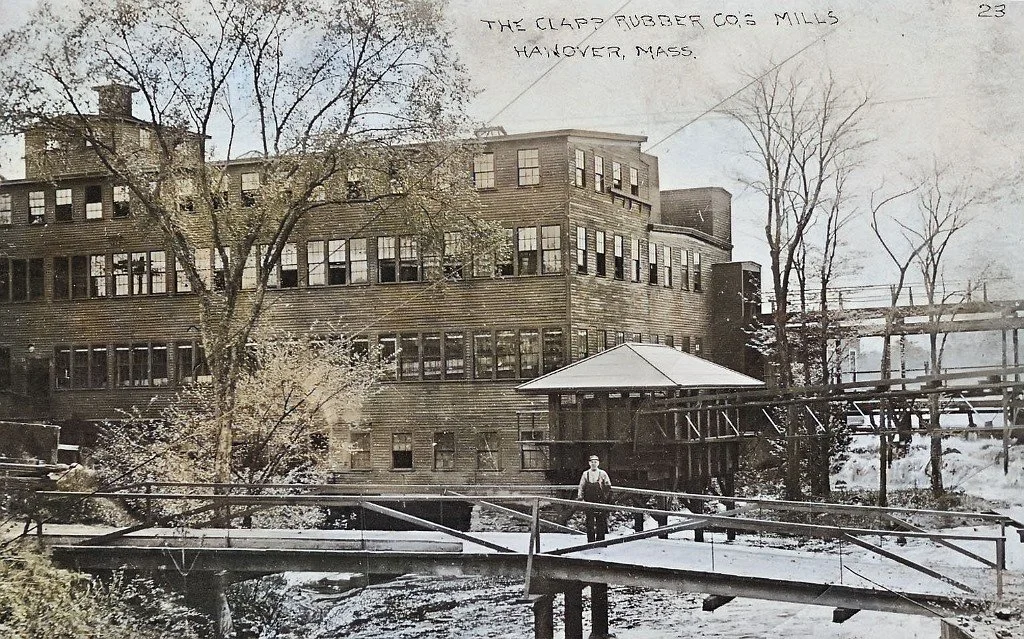
The banks of the Indian Head River in Pembroke, Hanover, and Hanson were once a hotbed of industrial development, including the Clapp Rubber Mill (pictured above). Today, the area supports the scenic Indian Head River Trail, including Wildlands’ Tucker Preserve. The dam that fueled the mill is still intact (pictured below), but the mill itself is gone, save for scattered remains in the forest. Revisit Skip’s history of the Indian Head River here.
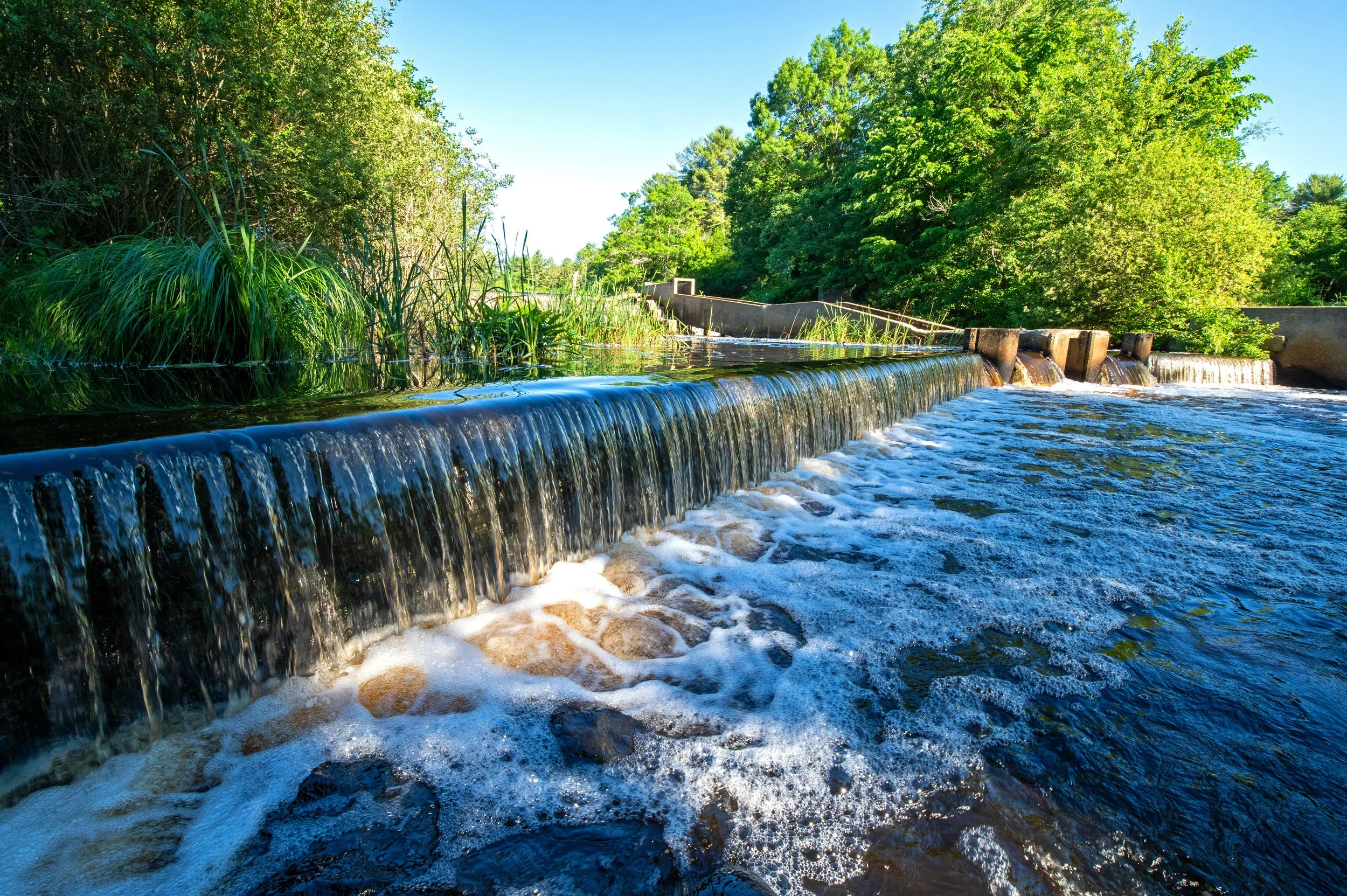
Photo by Rob MacDonald.
What patterns have you observed across these preserve histories?
Across every property I’ve researched, one pattern has held true: what happens to land hinges on its utility to people. Humans have always valued land based on its ability to support their survival and prosperity. When land couldn’t help them, they changed it. Tribes burned underbrush to improve travel, food, and safety. Settlers cleared forests and dammed rivers to create grist- and sawmills. As times changed, farms replaced forests, factories replaced farms, and cities replaced towns. When changes in population, technology, and industry ended the usefulness of land, everything returned to forest. Even today, when more people appreciate nature’s intrinsic value, many preservation efforts must still be justified by their benefits to drinking water, scenic vistas, and other human assets.
What has been most difficult about writing this series?
Earlier, I suggested that uncovering a truthful and objective history might be impossible. However, its impossibility does not diminish the value of the search. Let's return to King Philip's War. If you want to learn about the conflict, you might start with written primary sources. Yet those sources would almost certainly reflect only the perspectives of white, male Puritans or Pilgrims. You might widen your search to include information from Indigenous sources, but very little is written, and oral traditions are harder to access. One might visit the battle sites, but even archaeological evidence can yield vastly different interpretations.
So why look for the truth if you can't find it? I would argue that the act of searching, of listening to contrary points of view and seeing the world through the eyes of another, teaches us about human fallibility—and therefore the need for humility. Studying history can't assure us of the facts. But it can absolutely help us learn about each other.
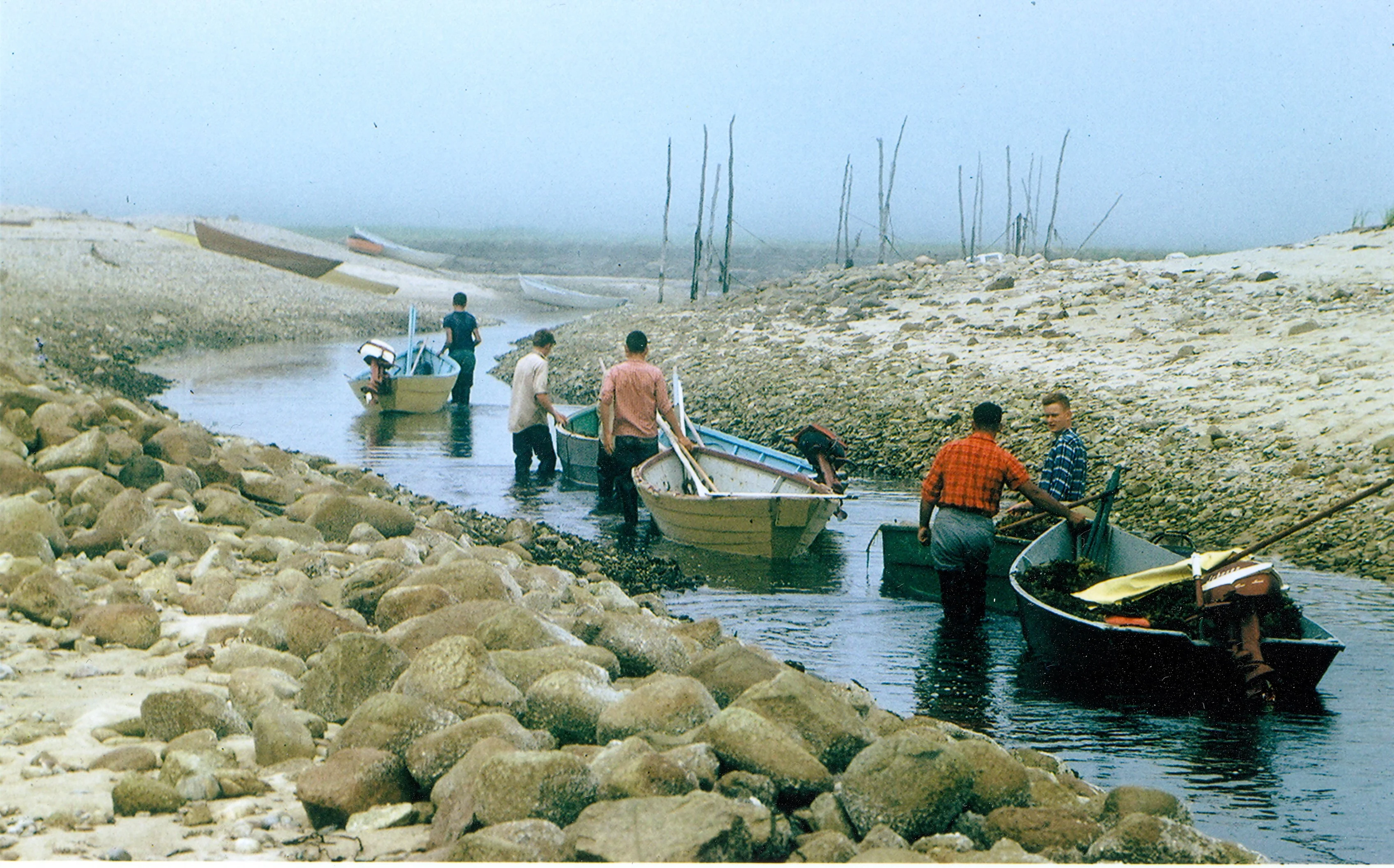
Skip’s first article in the series retraced the history of Shifting Lots Preserve in Plymouth, including the once-vibrant mossing industry in Ellisville Harbor. Photo from 1969, courtesy of Roger Janson, via Friends of Ellisville Marsh.
If readers could take away one thing from your series, what would you want it to be?
To take good care of a piece of land, you need to know its past. Throughout history, humans have caused widespread environmental damage. It’s a sobering fact with a silver lining: humans have the power to change the environment for the worse, so they also have the power to change it for the better. To do so, we need to understand how we’ve historically abused that power. Only then can we chart a new path forward.
How and why should readers get involved with local history?
You can help us find answers to our many unresolved questions—and to many more questions we haven’t yet thought to ask. The more people who participate in local history research, the more diverse sources we can uncover, and the more complete our history becomes. You don’t have to be an academic. Photos, maps, family stories, and personal memories can all be extremely valuable and paint a more colorful picture of the past.
Not long ago, I wrote a history of Willow Brook Farm in Pembroke. There was plenty of written information about the area, but I knew my account needed more photos to come to life. We published the piece, along with a plea for readers to lend their insight. To my pleasant surprise, two longtime residents of the historic farm property honored our request. The Pelleys met us at Wildlands’ headquarters, their arms and minds brimming with historical photos, documents, and stories that we published as an addendum to the initial piece. Many of the other entries in this series have relied greatly on interviews with family members, prior owners, neighbors, and others.
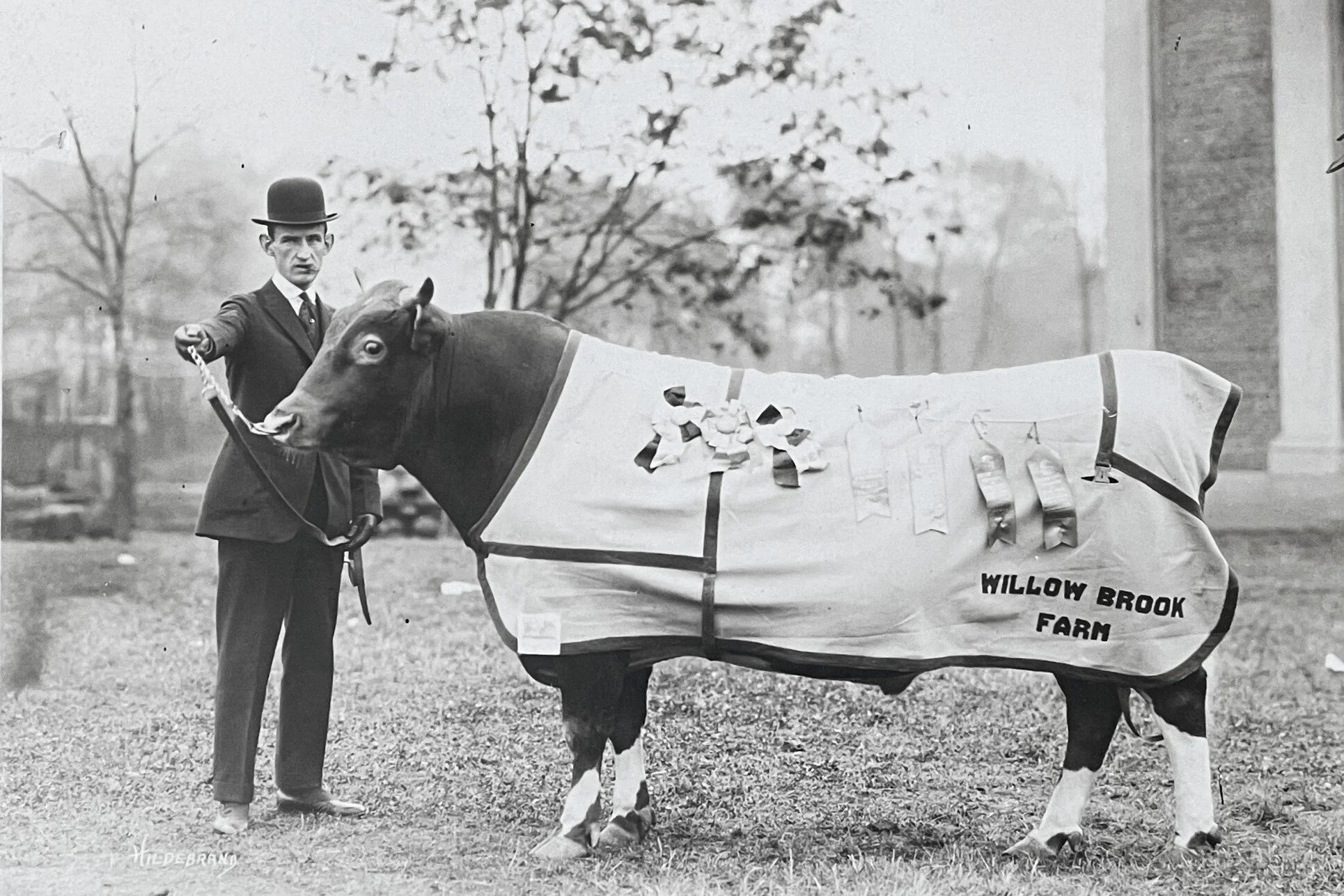
Andrew and Ann Dee Pelley, neighbors of Willow Brook Farm, shared many historical records with us, including this photo of a Guernsey cattle from Willow Brook Farm that won 1st Prize and Grand Champion at a show in Springfield in October 1917. Photo courtesy of the Pembroke Historical Society.
You can also provide feedback on past and future entries in the series by commenting below an article or sending an email to communications@wildlandstrust.org. I try my best to get my facts straight, but I always knew I’d make mistakes. I’ve received and incorporated corrections before, and I expect and welcome corrections again. If you've enjoyed these histories, I guarantee that your willingness to share information and feedback will make them even better.
Human History of Wildlands: Articles So Far
Pudding Hill Reservation, Marshfield
Old Field Pond Preserve, Bourne
Hoyt-Hall Preserve, Marshfield
Cow Tent Hill Preserve, Duxbury
Brockton Audubon Preserve & Stone Farm Conservation Area, Brockton
Delano Memorial Forest & Rounseville II Preserve, Rochester
Halfway Pond Conservation Area, Plymouth
Crystal Spring Preserve, Plainville
Tucker Preserve & Indian Head River Trail; Pembroke, Hanover & Hanson
Stewart/Person Preserve, Kingston