
The Nature of Farming
How eco-conscious farms balance food production and environmental stewardship
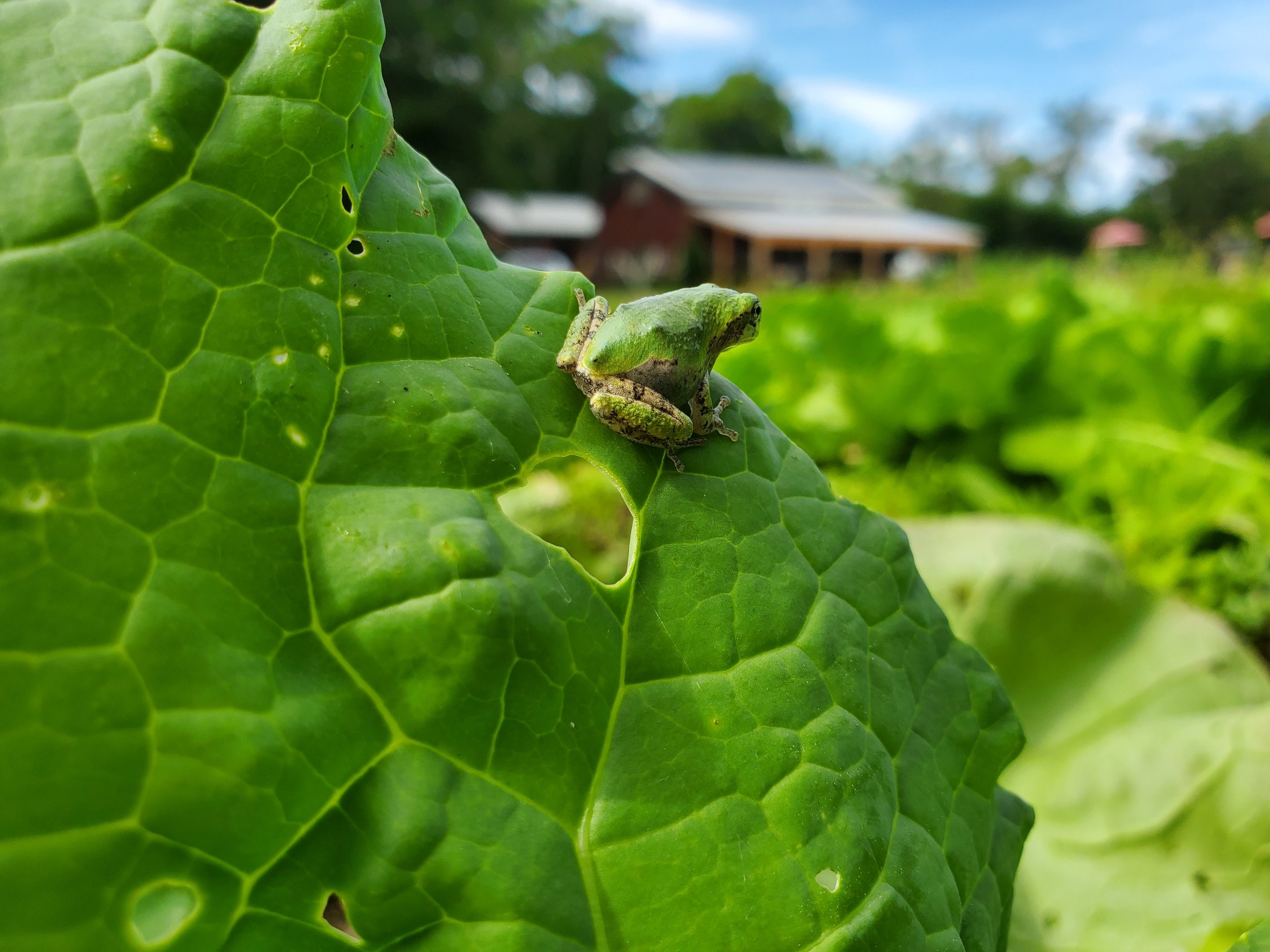
Eastern gray treefrog on sen-po-sai, an Asian green.
By Justin Cifello
Agriculture itself is not a distinctly human invention. Ants herd aphids and cultivate fungi. Beavers turn forests into wetlands full of their favorite plants. The line between artificial and natural is a blurry one. It is a philosophical conundrum I won’t be solving here, but which has given me much to ponder in my years as a both a farmer and naturalist.
This will be my 18th year of farming at Bay End Farm in Buzzards Bay, which abuts Wildlands Trust's Old Field Pond Preserve. We are an organic farm, but we still need to be aware of our impact on the local ecology. Even organic fertilizers run the risk of downstream effects like eutrophication, so they must be deployed carefully. More is not always better; overfeeding a crop can make it vulnerable to pests, and over-application of one element can prevent the plant from uptaking another. Yearly soil tests help us tailor the minimal blend of nutrients that will meet a given crop’s needs. The fertilizers themselves are largely agricultural byproducts, which release their nutrients slowly. Some are locally sourced, like fish emulsion from New Bedford, spent grain from breweries, and even seaweed from beach associations. [1]
We want the fertility we apply to stay in the soil. Bare earth is vulnerable to weathering, so we blanket empty fields in cover crops. These plants are never harvested; their sole job is to hold on to nutrients. By planting a mix of cover crops, a more complex network of roots can form, better shielding the soil against winter erosion. They give fungi and other microbes a place to live, keeping the soil community healthy. Cover crops also help prevent weeds from germinating. [2]
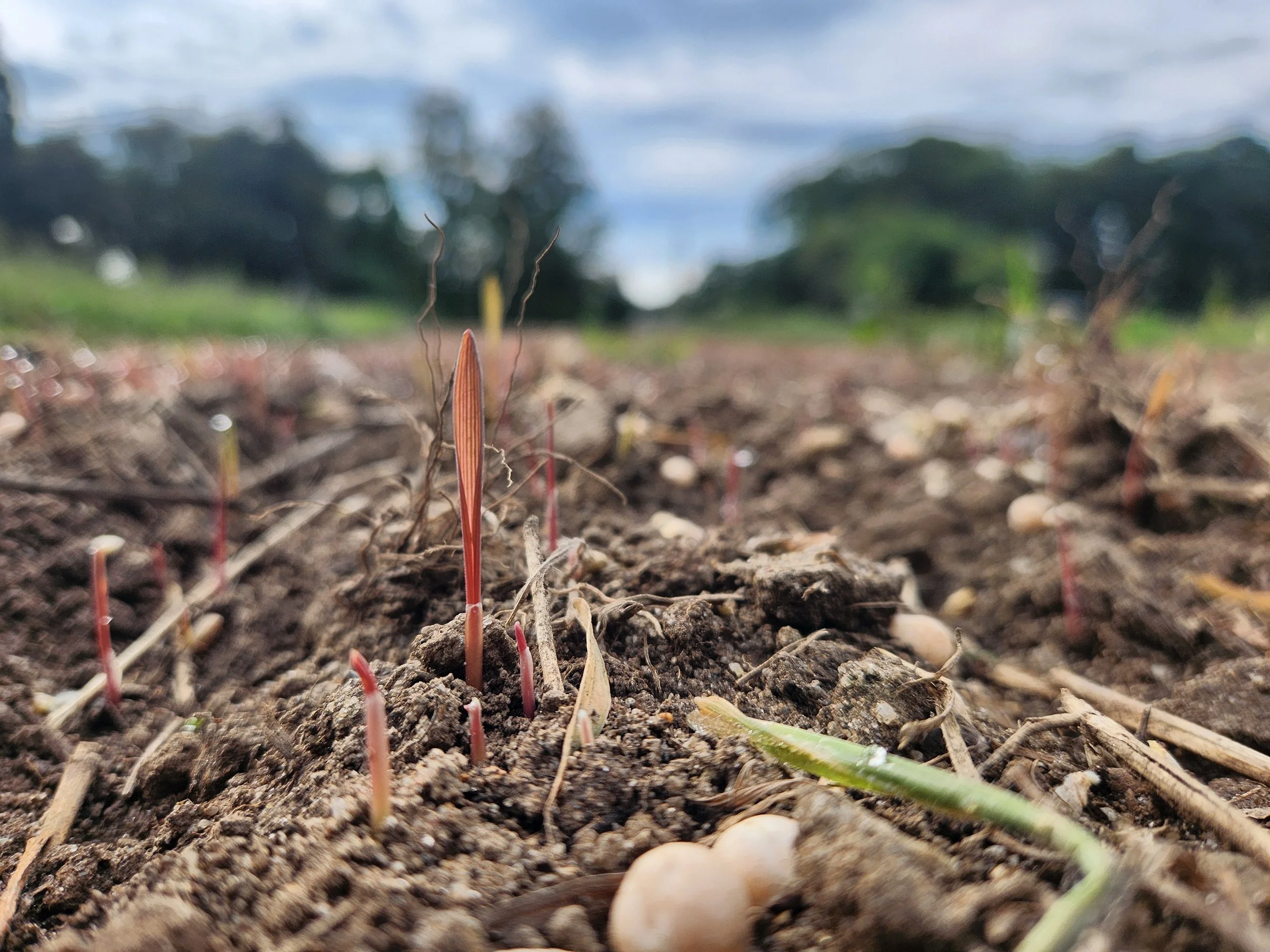
Winter rye germinates alongside field peas, both used as cover crops to protect the soil.
Soil depletion is also mitigated through crop rotation. By varying the crops we plant in each plot, we allow soil to maintain a balance of nutrients over time. The rotation includes leaving a field fallow for a season, so it can recover fertility and provide wildlife habitat. Crop rotation also prevents pests and diseases from establishing, as most are specialized to one family of vegetables. We grow different families of crops, as well as different varieties within each family. Diversity helps us not put all our eggs in one basket.
Despite our best preventative efforts, there will be pests. The pesticides available to organic farms are those that have been proven to break down quickly into safer compounds. Applied with a backpack sprayer, pesticides can be targeted carefully. We intentionally avoid applying pesticides during active times for pollinators, as well as windy or rainy days when spray may drift or run off. There are certainly more effective pest-eliminating products out there, but since we didn’t put all our eggs in one basket, we can accept some losses. [3]
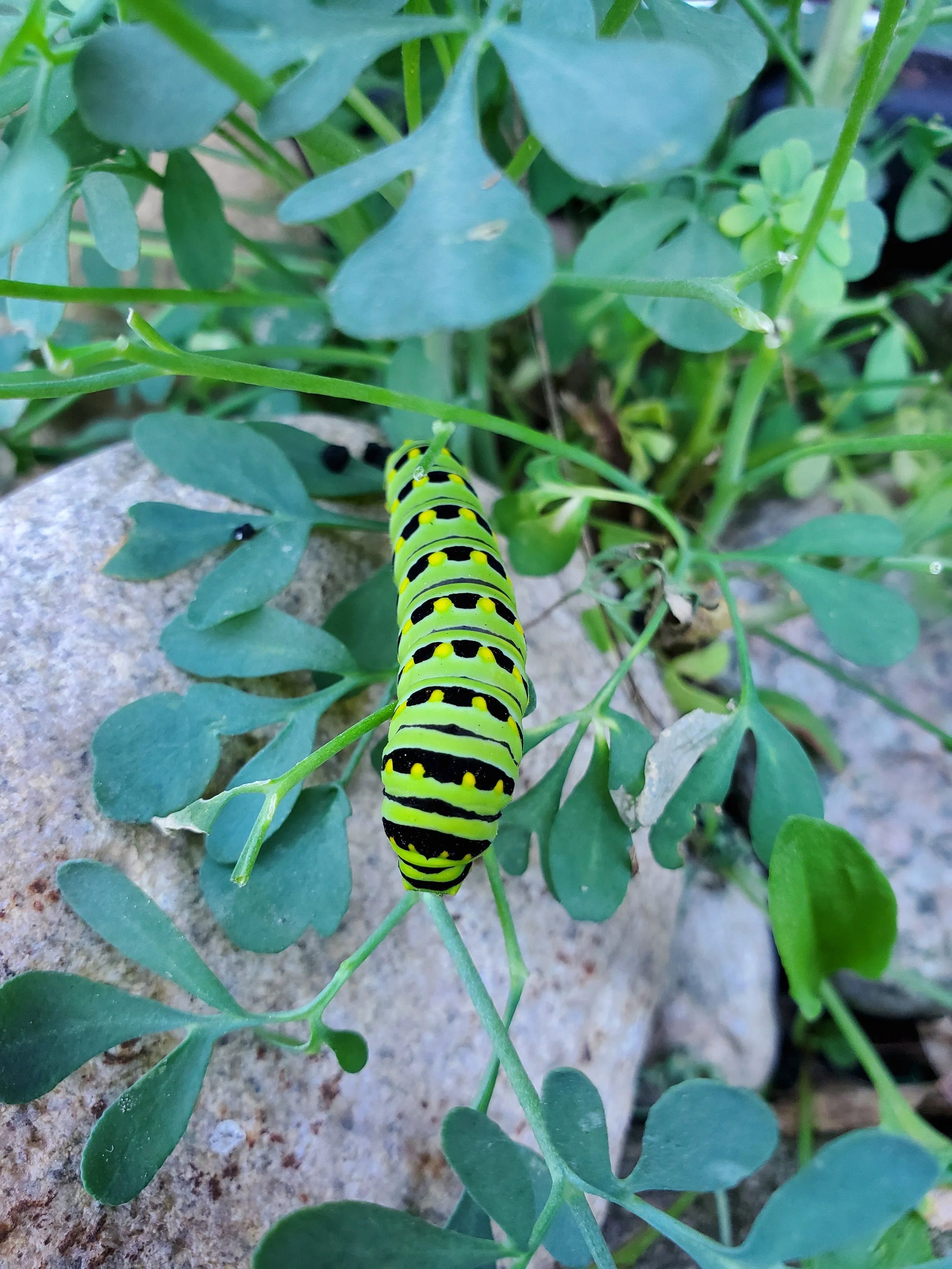
Swallowtail caterpillar on rue. Though they largely eat members of the carrot family, they rarely eat enough to be a problem. We don't eat the carrot greens, anyway.
Many farms maintain woodlots and fields that are never planted. As vital as forests are, grasslands are important, too. Abandoned farmland has largely regrown into forests or been developed, causing a decline in open habitat. These areas host a number of species, particularly ground-nesting birds. With full sunlight, they also support a suite of wildflowers, which in turn feed specialized insects and pollinators. The monarch butterfly is perhaps the most famous of these. While the adult can be seen feeding from any garden flower, the caterpillars can only survive on milkweed, which grows only in grassland habitats. [4]
Biodiversity is, of course, worth protecting for its own sake, but wildlife does a lot for us, too. Bumblebees, with their vibrating clumsiness, are fantastic tomato pollinators. Ladybugs and their otherworldly larvae are voracious aphid eaters. Highly specialized braconid wasps seek out tomato hornworms to feed their young. Wildlife encounters are also deeply fulfilling, from the mundane, daily sight of a handsome toad to the rare glimpse of a fisher. The bright orange of a spring peeper in the leafy greens is, to me, like a canary in the coalmine. I take comfort in seeing these creatures thrive—hopefully a sign that we have been good neighbors.
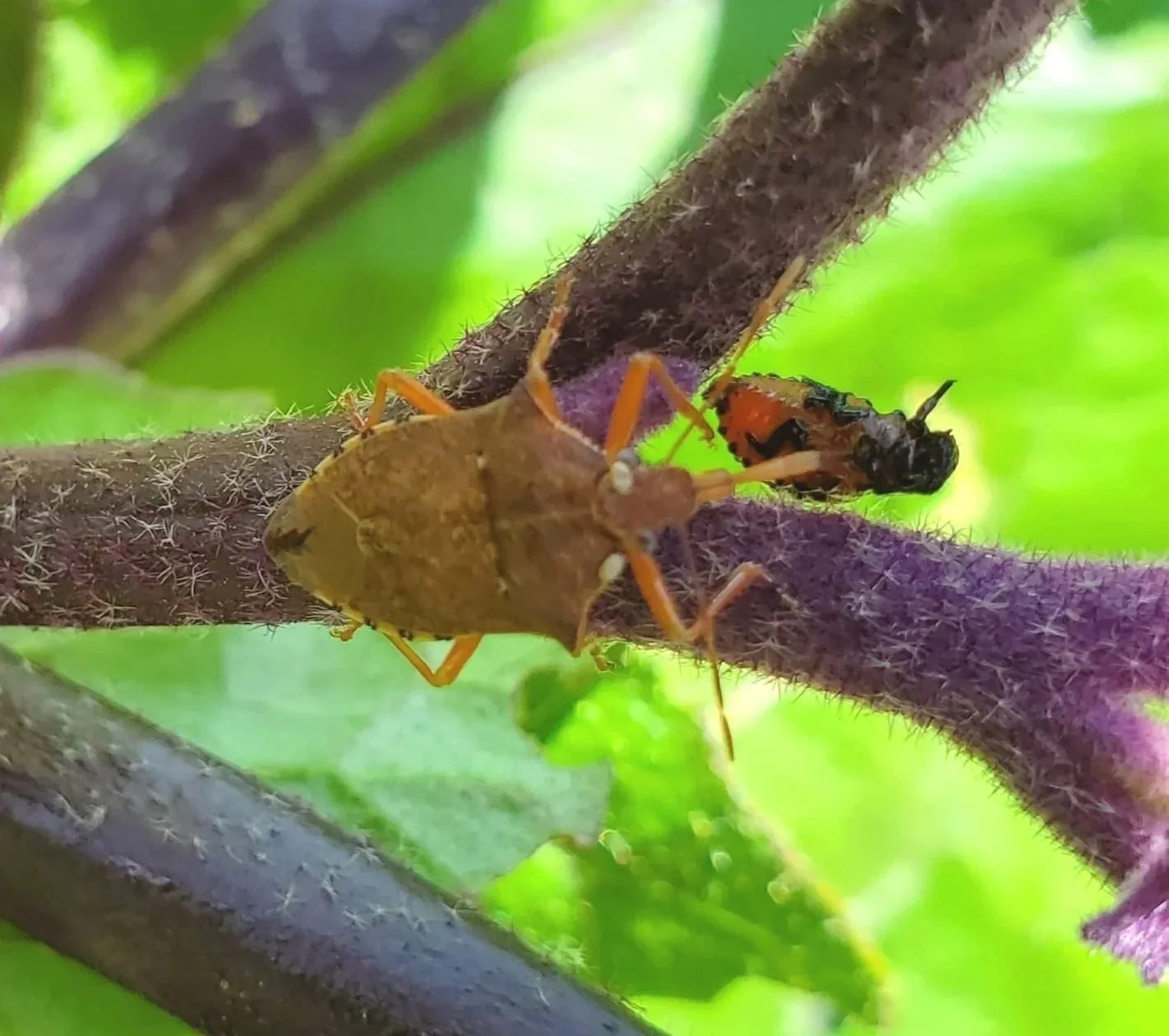
A soldier bug with its quarry, a potato beetle larva. We appreciate the assistance with one of our worst pests.
Further Reading:
1. Eutrophication: oceanservice.noaa.gov/facts/eutrophication.html
2. Cover Crops: sare.org/resources/cover-crops/
3. Organic Pesticides and Certification: npic.orst.edu/ingred/organic.html
4. Grassland Conservation: massaudubon.org/our-work/birds-wildlife/bird-conservation-research/grassland-birds