


What’s New at Wildlands
Human History of Wildlands: Great River Preserve
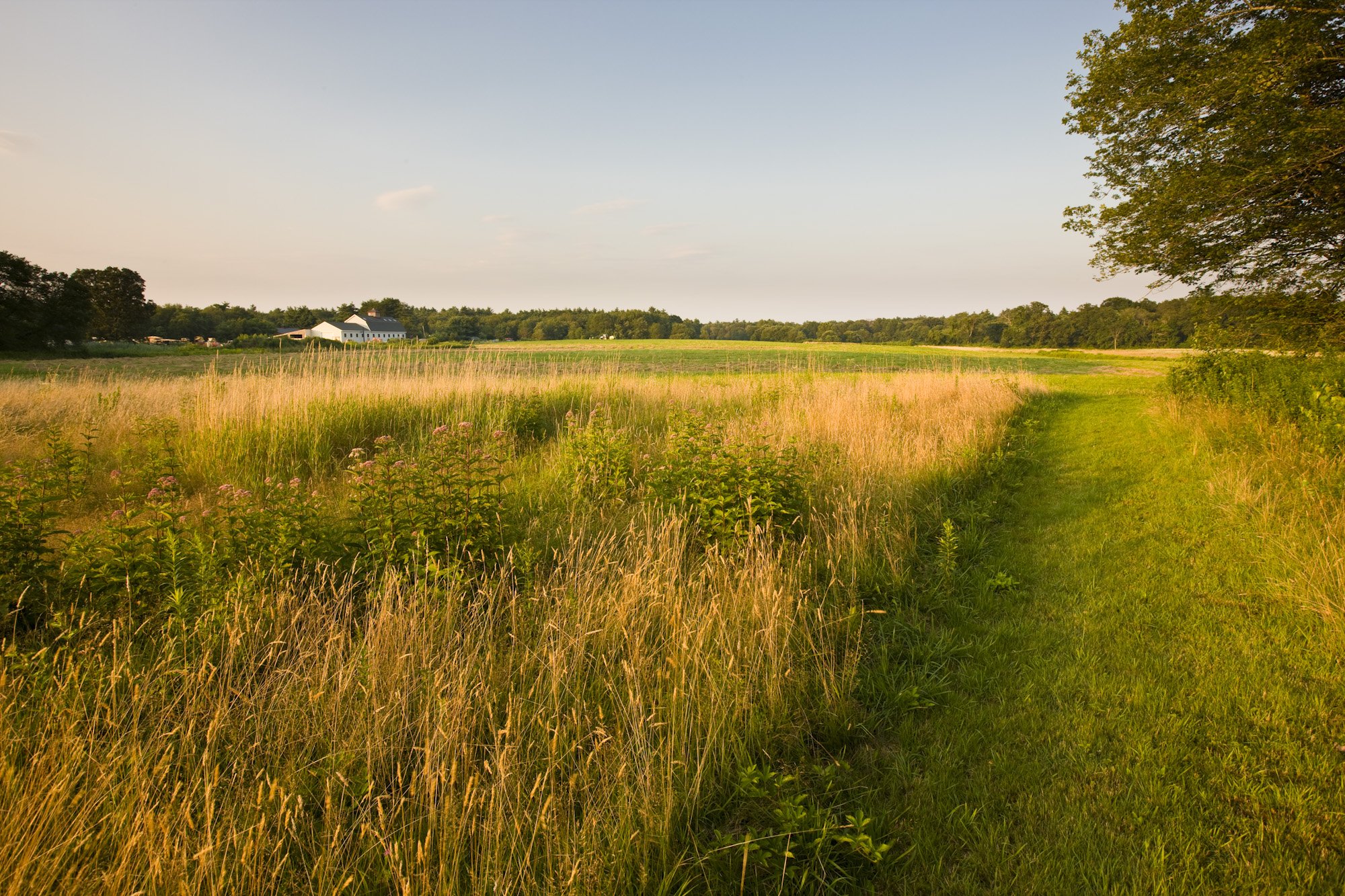
Great River Preserve in Bridgewater. Photo by Jerry Monkman.
By Skip Stuck, Key Volunteer
Throughout this "Human History of Wildlands" series, I've highlighted a wide range of ways that Native Americans, European settlers, and others have utilized and altered the Southeastern Massachusetts landscape, from clearing forests for farms to damming rivers for factories. Few parcels in our region have looked any one way for long. So, when Wildlands Trust undertakes responsibility for a new preserve, it often confronts a difficult question: Which version of the land’s history do we preserve or restore?
Great River Preserve in Bridgewater offers a unique example of a very different kind of history.
The preserve sits near the headwaters of the Taunton River. If you read our April 2024 history of the Taunton River watershed, you might remember that the retreat of the last glaciers around 12,000 years ago left this area covered in sandy soil and mud—not the rocks and boulders so prevalent elsewhere in Southeastern Massachusetts. Much later, the Taunton River's slow current would prove unsuitable for the hydropower generation that elsewhere fueled mills and factories. The land has thus continued to support high-quality forests and farms for generations.
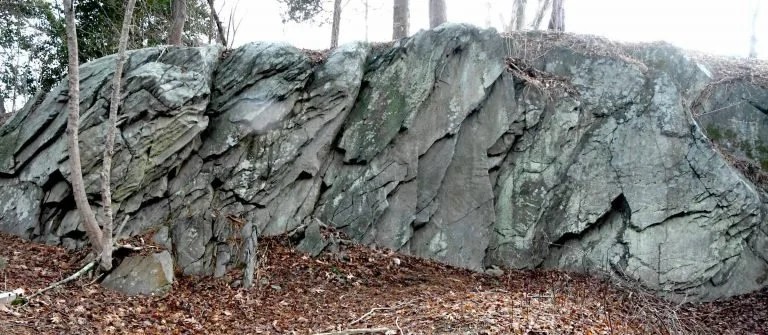
Sachem Rock. Source: Sowams Early History
Early History
In 1647, a group of settlers known as the "Conihassett Partners" (derived from the Wampanoag name for a section of present-day Scituate) decided to expand their land holdings beyond the coast and obtained the first land grant for a large inland area. In 1649, at a place called Sachem Rock (close to today's Great River Preserve), the Wampanoag sachem Massasoit met with colonists including Miles Standish. There, Standish purchased 14 square miles of land that came to be known as Old Bridgewater. The purchase price included "7 coats, 9 hatchets, 8 hoes, 20 knives, 4 moose skins, and 10 and 1/2 yards of cotton." This is believed to be the first signed agreement in North America between the colonists and Native people.
Soon, colonists settled in the area, and Old Bridgewater split into four Bridgewaters—East, West, North (now Brockton), and Bridgewater proper. One of the earliest farms was Sachem Rock Farm in East Bridgewater, established in 1665. As the area grew, present-day Auburn Street became a main thoroughfare. In 1790, the Auburn Street Bridge, eventually known as the Covington Bridge, was built, connecting Bridgewater with Halifax to the east and Middleboro to the south. This bridge operated for over 200 years through multiple replacements and repairs until 1995, when it was finally dismantled.
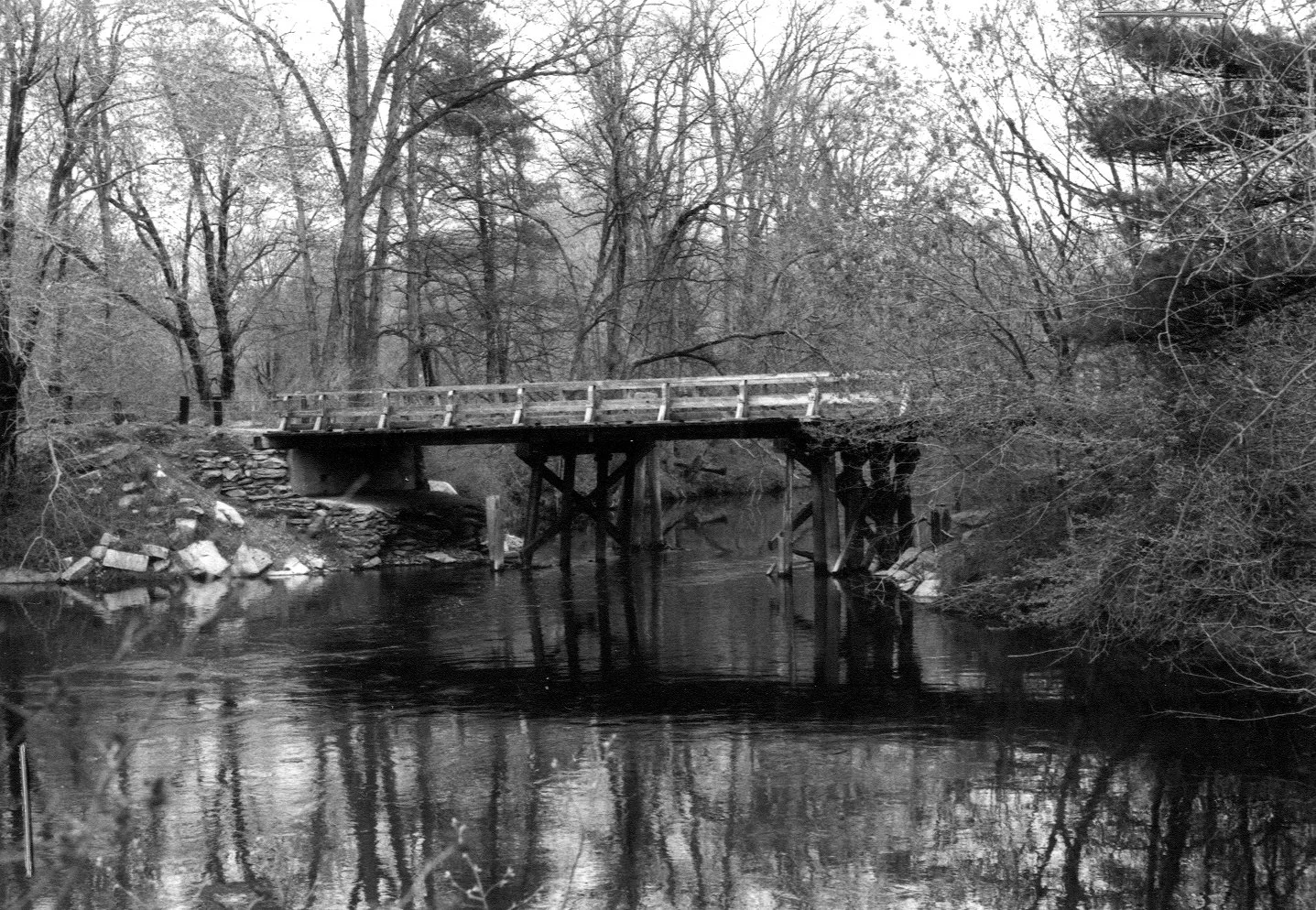
Auburn Street Bridge, 1981. Source: Recollecting Nemasket
In 1770, a Cape-style house that came to be known as the Leonard–Jackson House was built on a large farm on Auburn Street. This house has been in continuous use since, owned by the Leonard, Jackson, Brooks, and Belchunas families, among others, before ending up with the Lehtola family from 1945 to the present day.
From the late 1600s until the early 2000s, the land of Great River Preserve was in continuous use as a farm, pasturing cattle and horses and producing corn and hay. Unlike almost every other property in the region, this land likely looked in the 1700s much the same as it does today.
Protecting the Land
Owners Peter and Rita Lehtola were concerned that as they phased out farming activities, the land could be divided, developed, and changed forever. Then, Wildlands Trust Board Chair Howard Randall approached the Lehtolas with an idea of how it could be preserved. In 2008, the Lehtola family agreed to sell 230 acres of the property to MassWildlife and Wildlands Trust. Of those acres, 125 became Great River Preserve, while the remainder augmented MassWildlife’s Taunton River Wildlife Management Area, which today totals 349 acres. To make the agreement possible, Wildlands’ Board of Directors agreed to change a longstanding "no hunting" policy on their properties and allow hunting at Great River in a carefully regulated manner. This marked an important public-private collaboration, and a blueprint for future preservation efforts.
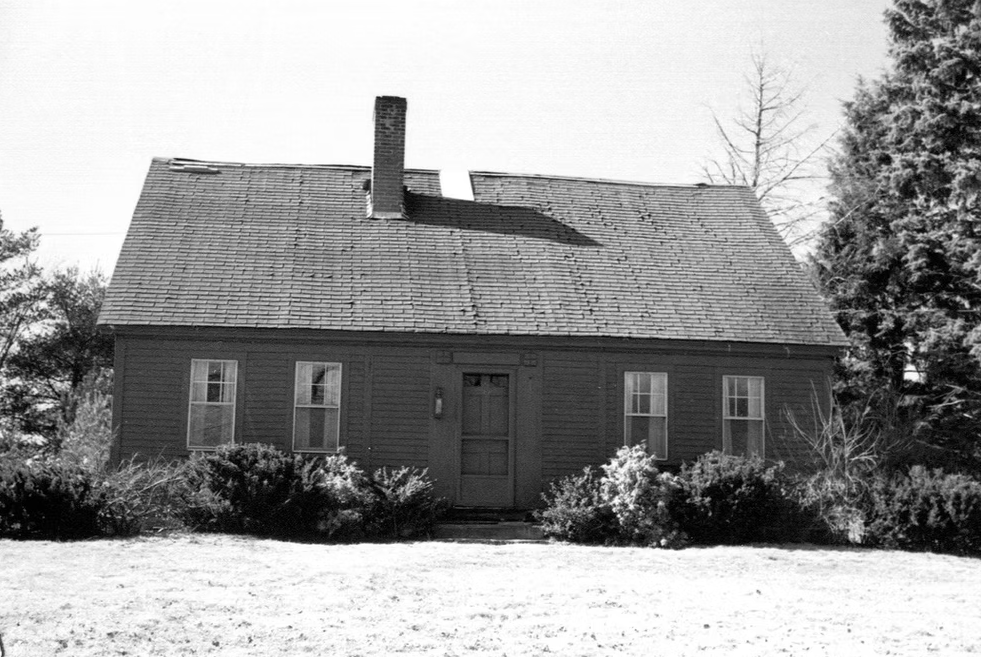
Leonard–Jackson House, 1984. Source: Bridgewater Archive
The protection project forever secured the future of a 1,400-acre open space corridor along 1.5 miles of the Taunton River. Since the acquisition, Wildlands has worked diligently to keep the fields hayed and forests healthy, so that the land’s character can persist at a time when farms of all kinds are going out of business and being swallowed up by development.
We hope you will visit Great River Preserve and seize the rare opportunity to see what farmers and settlers saw for 300 years.
A special thanks to the Lehtola family, without whose insights and recollections this piece would not have been possible. And as always, thanks to Thomas Patti, Wildlands’ Communications Coordinator.
Resources
“Leonard-Jackson House,” Bridgewater Archive. bridgewaterarchive.com/locations/houses/13
“Sachem’s Rock where Ousamequin traded with Myles Standish for Satucket lands in 1649.” Sowam’s Early History. sowamsearlyhistory.org/sachems-rock-where-osamequin-traded-with-myles-standish-for-satucket-lands-in-1649/
“Auburn Street Bridge,” Recollecting Nemasket. nemasket.blogspot.com/2013/03/auburn-street-bridge.html
East Bridgewater Library: eastbridgewaterlibrary.org
“Human History of Wildlands: The Taunton River Watershed," Wildlands Trust.
“Taking the Long Way Around,” John Stilgoe, Boston Globe. March 14, 2004.
Interview with Peter Lehtola, March 26, 2026.
Year in Review: What We Protected in 2025
Plus: What You Read in 2025 — Top Stories from Wildlands E-News
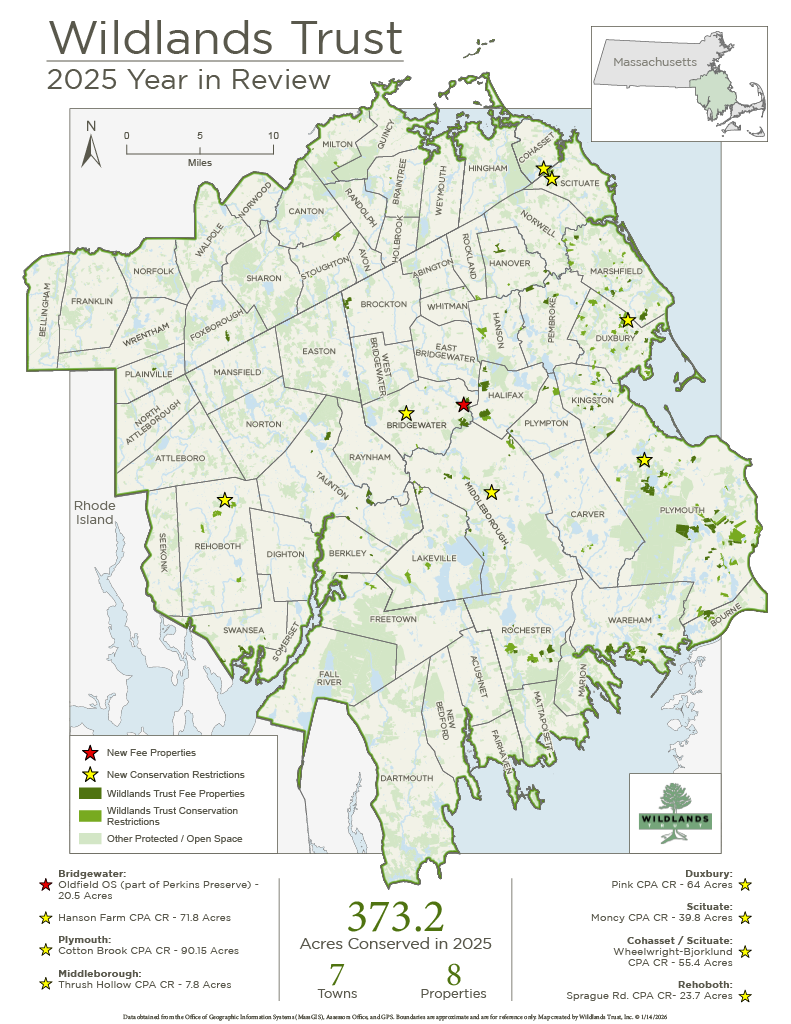
Wildlands’ 2025 land protection projects. Click the map to view a full PDF.
New Year’s Reflections from the Land Protection Office
By Scott MacFaden, Director of Land Protection
Helping CPA Towns Turn Investment into Impact
We completed five new Community Preservation Act (CPA) Conservation Restrictions (CRs) in 2025: the Hanson Farm CR in Bridgewater, the Cotton Brook Preserve CR in Plymouth, the Thrush Hollow CR in Middleborough, the Pink CR in Duxbury, and the Sprague Road CR in Rehoboth. Although these CRs are in different communities and protect different types of habitats, the connecting thread between them is that they all represent locally driven land conservation projects enabled in large part by CPA funds. A quarter-century after it became law, the CPA remains an invaluable asset to community-driven land preservation.

Hanson Farm in Bridgewater.
Saving Farmland
The Hanson Farm CPA CR in Bridgewater was the highlight of the year for farmland protection projects. We now co-hold a CR with the Town of Bridgewater on the 72-acre Hanson Farm, the last working farm of scale in Bridgewater and regionally beloved for its ice cream stand and farm store. The CR will forever ensure the protection of this last bastion of Bridgewater’s agricultural heritage.
Conserving Land in New Towns
We continued to expand our geographic footprint by adding two new communities to our portfolio through the acceptance of two CPA CRs previously held by the Maxwell Conservation Trust in Scituate and Cohasset. Collectively protecting 96 acres in the West End neighborhood, primarily in Scituate but including a small portion in Cohasset, these CRs encompass a variety of landscapes and habitat features, including scenic woodlands and vernal pools.
Founded in 1997, the all-volunteer and locally based Maxwell Conservation Trust prioritized protecting land in the West End neighborhood and worked closely with the Town of Scituate to successfully complete multiple projects in that area, including the two properties protected by these CRs. Similar to several all-volunteer land trusts Wildlands has worked with, the Maxwell Conservation Trust eventually determined it could no longer continue as an active organization and sought a qualified successor to accept an assignment of its CRs before shutting down its operations. Learn more here.
Looking Ahead to 2026
We’re excited about several new farmland projects that are either underway or in the early stages of preparation. In the former category, we’re working with the Friends of Holly Hill Farm and the Town of Cohasset toward completing a CR on a currently unprotected portion of that farm. If all goes as anticipated, the CR will be completed by early summer. In the latter category, a project that would achieve a permanent preservation outcome for Hornstra Farms in Whitman is in the planning stages.
Best of E-News: What Inspired You in 2025
When people are informed, connected, and inspired to protect the nature around them, the entire region benefits. That is what Wildlands E-News is all about. Below are five of the most-read E-News articles from 2025.
Curious about a particular aspect of our work or our region’s natural resources? Tell us in the comments below, and we might explore your question in a future newsletter!
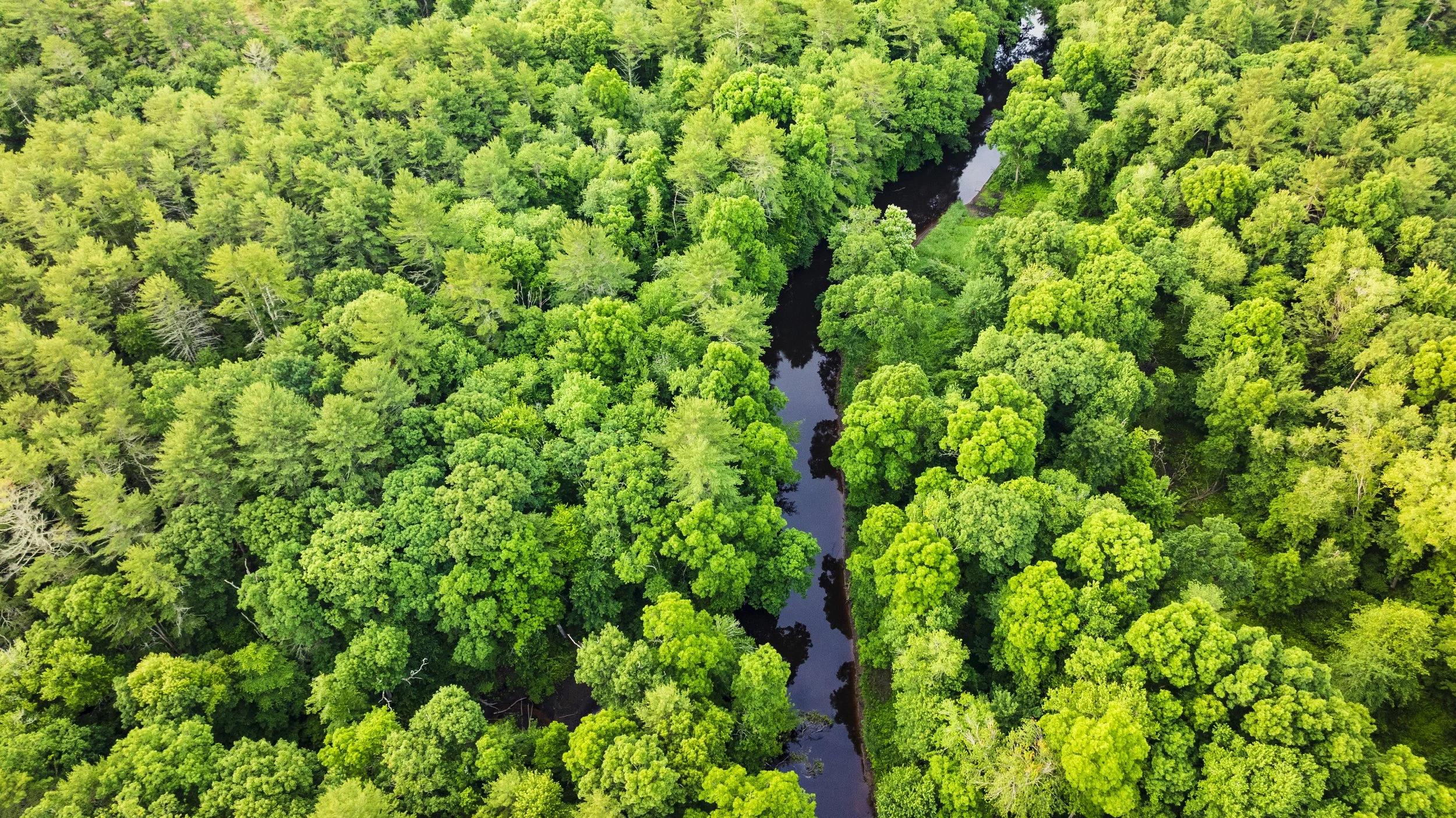
Taunton River at Wyman North Fork Conservation Area in Bridgewater.
1. Human History of Wildlands: The Taunton River Watershed
Key Volunteer Skip Stuck continued his popular series in 2025, spotlighting the human history hidden beneath the foliage of Wildlands’ most beloved preserves. In this most-viewed article of 2025, Skip broadens his focus to an entire region—the Taunton River watershed, where Wildlands has prioritized land protection for decades due to its unique ecological and cultural heritage.
2. Land Protection Update: Duxbury, Scituate, Cohasset
Scott MacFaden recounted Wildlands’ recent land protection victories, including a Conservation Restriction (CR) next to O’Neil Farm in Duxbury and two CRs in Scituate and Cohasset, Wildlands’ first-ever acquisitions in those towns.
Wildlands members receive exclusive updates from our land protection office through their complimentary subscription to our biannual print newsletter, Wildlands News. Become a member today at wildlandstrust.org/membership.
3. White Pine: A Common Tree’s Uncommon History
In his Wildlands E-News debut, local farmer, naturalist, and volunteer hike leader Justin Cifello shines a light on a somehow overlooked giant of our forests—the white pine. From their symbolism in Indigenous and colonial cultures to the surprising reason behind their occasional deformity, Justin traces a history that places the white pine at the center of our region’s social and ecological identity.
4. Welcoming New Staff
We said hello to four new staff members in 2025. Rebecca Cushing joined us in January as one of two new Land Stewards. Callahan Coughlin joined us in February as the second. Already, Rebecca and Callahan have earned new titles to reflect their increasing responsibility: Rebecca is now our Stewardship & Volunteer Coordinator, while Callahan is our Stewardship & Training Coordinator.
In May, we welcomed Rob Kluin as our new Donor Relations Manager. Rob succeeds Sue Chamberlain, who retired after 12 years at Wildlands. In August, Jason Risberg came aboard as our first-ever GIS Manager, giving a major boost to our mapping and analysis capabilities.
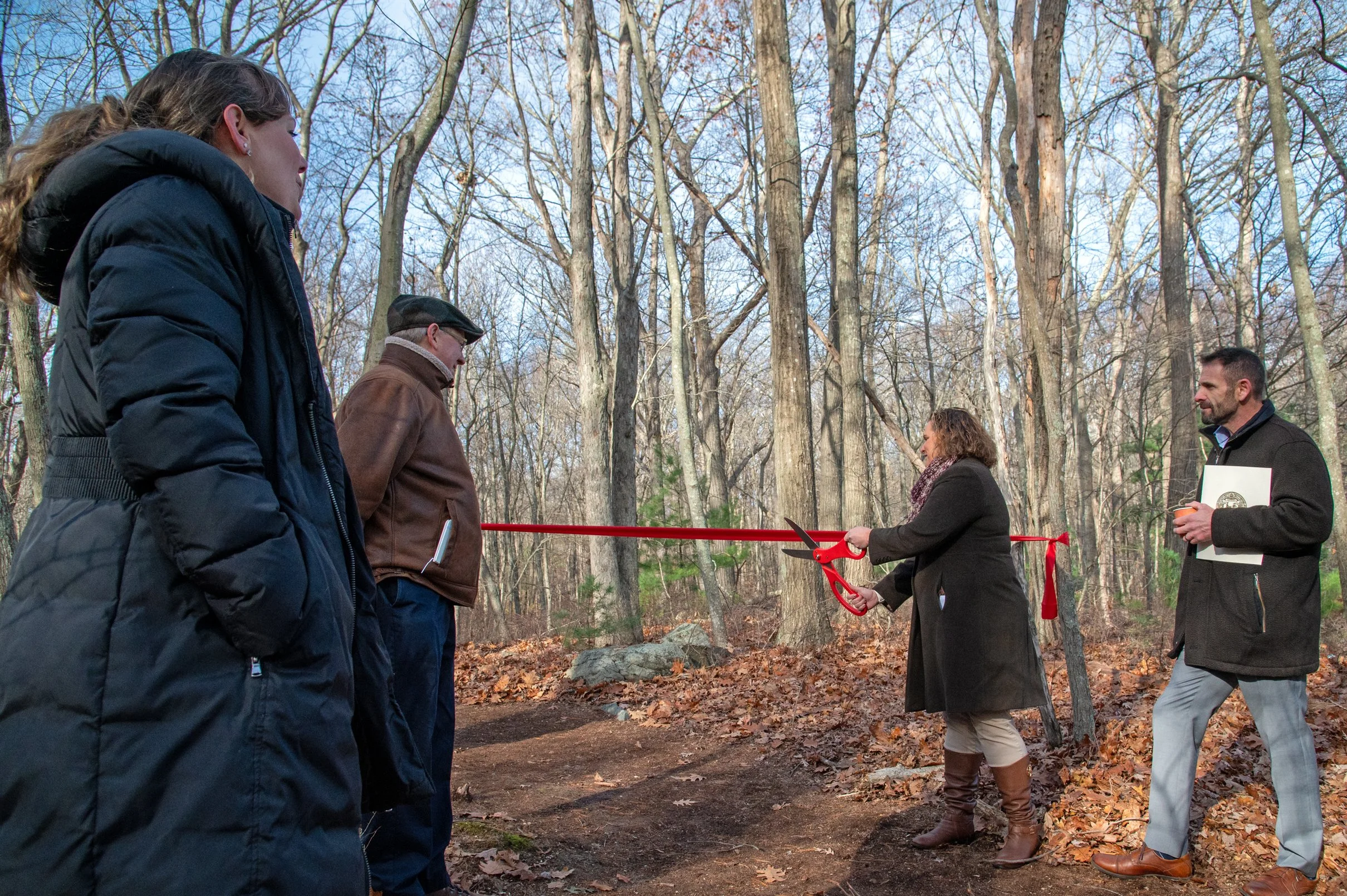
Town of Avon Select Board Member Shannon Coffey cuts the ceremonial ribbon to open Fieldstone Preserve.
5. Fieldstone Preserve Gives Avon & Brockton Residents New Place to Enjoy Nature
In November, Fieldstone Preserve opened to the public, providing Avon, Brockton, and surrounding communities with new access to nature in the region’s densest urban landscape. The 30-acre woodland features 0.7 miles of trails that connect to D.W. Field Park. The Town of Avon acquired the property in 2024 with funds from a state grant and a private foundation, secured by Wildlands Trust. The grand opening ceremony brought together public officials and nonprofit leaders working collaboratively to improve the area via the D.W. Field Park Initiative.