


What’s New at Wildlands
Your Trash is Not Welcome Here!
By Amy Markarian, Senior Copywriter
You look outside your window and see the sun shining, a slight morning breeze cools the air. It’s a perfect day to stretch your legs on your favorite local conservation area trail. Fresh coffee in hand, you arrive with overwhelming appreciation for the beauty that abounds. You step out of your car and approach the trailhead and, in an instant, your splendid surroundings are transformed into a DUMP.

This scenario, unfortunately, is not uncommon in southeastern Massachusetts. For years, local officials, private landowners, and conservation organizations have fought an uphill battle against illegal dumping on undeveloped land. Often, the items dumped on roadsides and in the woods are those that are either expensive to dispose of legally, require a special permit that may not be available to purchase on site (when items are already loaded in a vehicle and ready to be dropped off), or are considered hazardous waste items that are not routinely accepted at transfer stations. In at least some cases--based on where materials have been found-- it seems that polluters’ intentions may have been to properly dispose of the items. But, when doing so was discovered to be costly or inconvenient, a nearby open space was found to drop the load instead. Plymouth’s expanse of undeveloped lands and unmonitored road frontage, sadly, have historically made for easy dumping grounds in these situations.
All too often, according to Wildlands Trust’s Director of Stewardship, Erik Boyer, “it seems, people view conservation land as an easy place to get rid of things.” Sometimes it’s malicious, sometimes it may not be, but it always has a negative impact on the land and those who use it. Because of the harmful implications for wildlife and water sources in areas where dumping takes place, Wildlands Trust is actively taking steps to deter polluters.
In January, Wildlands' stewardship team was alerted to a massive pile of trash that had been left at one of our Plymouth preserves. Located close to a road in a town-managed cemetery, but within the boundaries of Wildlands’ adjacent conservation land, were 40 to 50 bags of household trash and various appliances left in a sprawling heap. The sheer quantity of debris to be removed made it clear that this was going to be a costly cleanup. However, it was discovered that several items had attached mailing labels containing one person’s name and address.
Our stewardship team notified the Plymouth Police, and an investigation led to criminal charges being filed against the responsible party. MA General Law - Part IV, Title I, Chapter 270, Section 16, states:
“Whoever places, throws, deposits, or discharges...trash, bottles or cans, refuse, rubbish, garbage, debris, scrap, waste or other material of any kind on a public highway or within 20 yards of a public highway, or on any other public land, or in or upon coastal or inland waters...or within 20 yards of such waters, or on property of another, or on lands dedicated for open space purposes, including lands subject to conservation restrictions and agricultural preservation restrictions...shall be punished by a fine of not more than $5,500 for the first offense and a fine not to exceed $15,000 for each subsequent offense…”*
In this case, where the responsible party was identified, charges were pressed and the law was utilized to ensure that the burden of time and expenses associated with the cleanup would not be shouldered by a non-profit conservation organization. The Plymouth County District Attorney’s office is currently seeking restitution from the offender for the costs associated with Wildlands’ safe removal of all of the items.
Wildlands Trust hopes that this situation will serve as a reminder to others that dumping is illegal, it is detrimental to our land, water supply, and wildlife, and it will not be tolerated. We will continue to work collaboratively with the Plymouth Police Department to ensure that our community’s natural spaces remain beautiful and safe for all.
(*https://malegislature.gov/Laws/GeneralLaws/PartIV/TitleI/Chapter270/Section16)

Kingston Dam to be Removed Using State-Awarded Funds
By Amy Markarian, Senior Copywriter
KINGSTON– On July 28, Wildlands Trust received a $729,000 state grant to remove the Sylvia Place Pond dam in Kingston, MA. The award will allow the conservation group to improve public safety in the area and to restore fish passage by conducting a breach of this significant hazard, poor-condition dam.
Governor Charlie Baker announced the 2021 Office of Energy and Environmental Affairs Dam and Seawall Program grant recipients from Gloucester’s Haskell Pond Dam on Wednesday. 28 grantees, including the conservation group and 27 cities and towns across Massachusetts, will receive more than $17 million to help repair failing dams, seawalls, and levees. Since the grant program’s inception in 2013, more than $95 million have been provided to address the state’s aging structures.
Wildlands Trust’s Executive Director, Karen Grey, says, “We have to be concerned with how severe storm activity is taking a toll on aging infrastructure. With this funding we can now eliminate the growing public safety issues to residents living downstream of this dam.”
Sylvia Place Pond is nearly surrounded by Wildlands Trust’s 27-acre Stewart/Person Preserve, in Kingston. The Sylvia Place Pond Dam has outlived its usefulness as an historic impoundment for mill power and ice harvesting. It is part of a series of interconnected manmade ponds that were originally constructed to supply power to nearby mills. There is a herring ladder at the north end of the pond that allows fish to complete their annual trek upstream for spawning in nearby Russell Pond. The area is also home to such wildlife as red fox, otter, mink, deer, osprey, and great blue heron.
Wildlands Trust is a non-profit organization dedicated to conserving land and preserving the natural heritage of Southeastern Massachusetts. The organization works to permanently protect and steward important habitats and landscapes, including woodlands and fields, ponds, coastal areas, agricultural lands, and river systems. Founded in 1973, Wildlands Trust has worked to protect nearly 13,000 acres of open space in 48 Massachusetts towns.

Historic Hanover Field Permanently Preserved
By Amy Markarian, Senior Copywriter
HANOVER – On Friday, July 23, 2021, a months-long collaboration between regional conservation group, Wildlands Trust, and the Town of Hanover culminated with the purchase and permanent protection of Sylvester Field. Encompassing a small pine grove and 660-feet of frontage on Third Herring Brook in Hanover’s Four Corners neighborhood, Sylvester Field’s highly-visible 10-acre meadow and stone wall bordering Washington Street is a cherished part of the town landscape. It has both historical and ecological value, and has long served as an agricultural, recreational and aesthetic resource for the community.
In May, with support from the Hanover Open Space Committee and the Hanover Historical Commission, residents of Hanover unanimously approved the use of $250,000 in Community Preservation Act funds to purchase a permanent Conservation Restriction on the field. With this partnership, along with the generous contributions of 307 individual donors, Wildlands Trust was able to act quickly on the rare opportunity to purchase this highly-valuable parcel of open space in Hanover.
“It was an incredible effort, with hand-delivered mailings, personal solicitations, a farmers market, banners, signs, field tours and more, which continued unabated until the goal was reached!” marveled Sue Chamberlain, Wildlands Trust’s Donor Relations Manager. According to Chamberlain, this grass-roots effort proved critical for the success of the project. A core group of 16 volunteers, led by Four Corners resident, Caleb Estabrooks, raised $150,000 to be combined with a $200,000 matching gift from a generous donor. This community-generated funding supplied half of the total cost of the land in just six months.
Most recently known to many locals as Robinson Field, the last property owner was Clayton Robinson, who died in March 2020. Under his family’s ownership, a mowed path was maintained around the edge of the field, and local residents have long-enjoyed walking past the tall grass, through the pines, and down to the water’s edge. After his death, Robinson’s cousin and estate representative, Debbie Lincoln, was an important advocate among family members for the preservation of the scenic open field and the continued public use of its frequently-visited walking trails.
When presented with the opportunity to preserve this land, Wildlands Trust immediately recognized the ecological value of Sylvester Field. The property is home to numerous wildlife species, both common and rare, and provides an extensive riparian habitat along the Third Herring Brook, an important tributary of the larger North River.
Under Wildlands Trust’s ownership, Sylvester Field will be maintained in its current state. The field-edge walking trails will remain and annual mowing of the field itself will continue. The addition of a small parking area and an informational kiosk will improve accessibility for public enjoyment of the preserve.
Long before European arrival, Native Americans occupied the area, including the field, which lies at a strategic location near the confluence of Third Herring Brook and the North River. In the mid-1600s, it was owned by William Barstow, who is believed to be the first European settler in the area. It later became part of a larger farm, changing hands to the Stockbridge family and then the Sylvester Family. When the Sylvester family sold much of the farm in the 1940s, Betsey (Sylvester) Robinson purchased this parcel to save it from development. The land continued to be used for agricultural purposes for many years, including the grazing of Hornstra Farms cows and the production of hay, before settling into its latest role as a scenic resource for the community.
Wildlands Trust is a non-profit organization dedicated to conserving land and preserving the natural heritage of Southeastern Massachusetts. The organization works to permanently protect and steward important habitats and landscapes, including woodlands and fields, ponds, coastal areas, agricultural lands, and river systems. Founded in 1973, Wildlands Trust has worked to protect nearly 13,000 acres of open space in 48 Massachusetts towns, including: Great River Preserve, in Bridgewater; Brockton Audubon Preserve; Cow Tent Hill Preserve and Cushman Preserve in Duxbury; the Nook in Kingston; Hoyt-Hall Preserve in Marshfield; Willow Brook Farm in Pembroke; and the Davis-Douglas Conservation Area in Plymouth.

Many Hands Make Light Work
By President & Executive Director Karen Grey
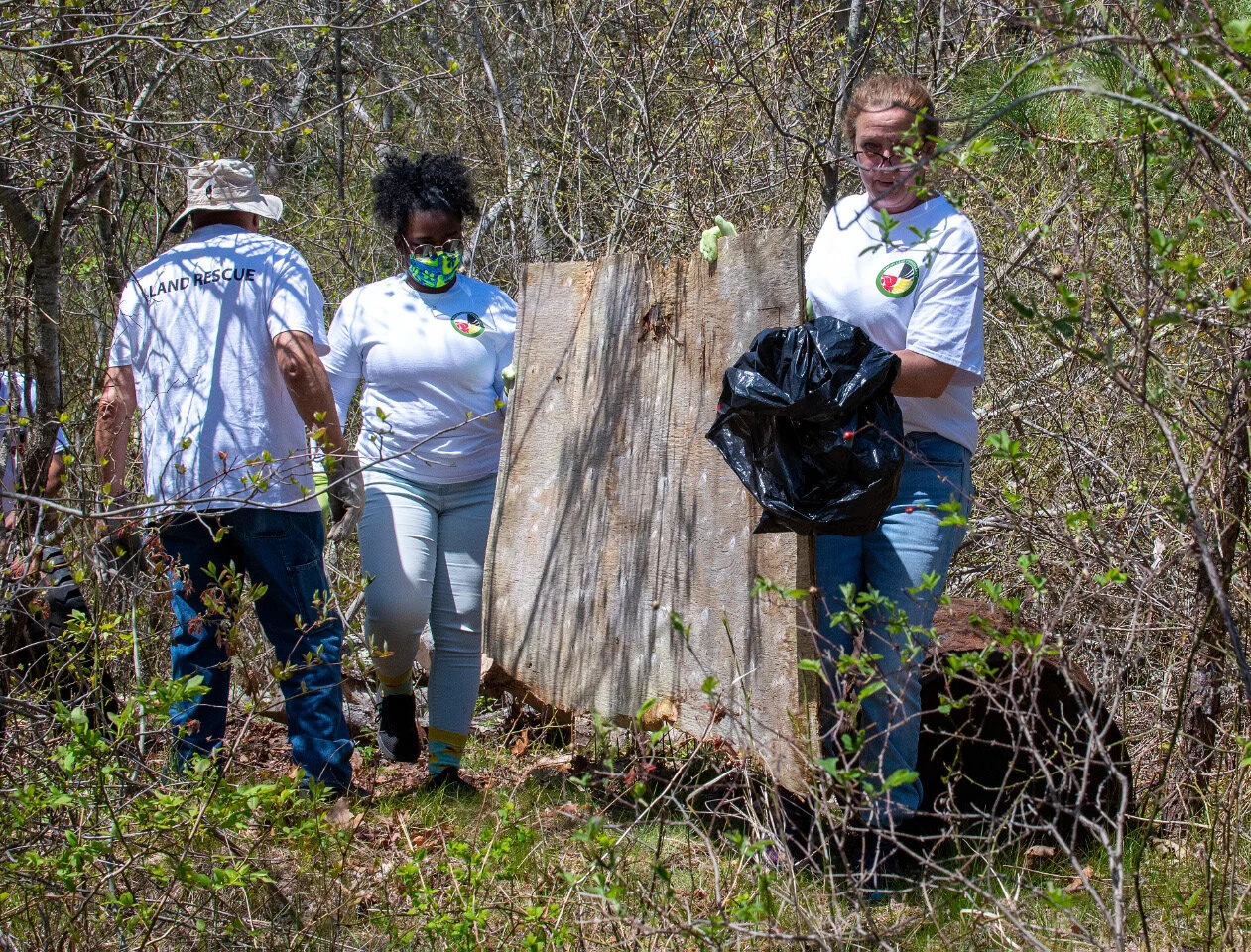
Stewarding conservation land is messy, hard work, especially when a parcel has been neglected and stewards are called upon to clean up years of misuse, overgrowth and dumping. These types of projects require the good cheer, know-how and efficiencies brought to bear by a team of can-do people, such as the group that convened on May 15, 2021 to revitalize a parcel in Yarmouth recently protected by the Native Land Conservancy (NLC).
Founded in 2012 in Mashpee, NLC is the first Native-run land conservation group east of the Mississippi. Its mission is to preserve healthy landscapes for all living things and to help restore land to its natural state. As a developing land trust, NLC relies on volunteers for stewardship work, and Wildlands was happy to send a few members of our A-Team (Owen Grey, Marilynn Atterbury, and Rob MacDonald), along with our truck and tools, to assist with the set-up of this 11-acre parcel on Cape Cod.
As time and resources allow, Wildlands is committed to helping other, less-resourced land trusts in any way we can.


Another Important Milestone for the Sylvester Field Project
Thank you to the citizens of Hanover!
On the evening of Tuesday, May 4, 2021, Hanover Town Meeting unanimously approved a request for $250,000 in Community Preservation Act funds for the Historic Sylvester Field preservation project. The town will use the funds to purchase a permanent Conservation Restriction on the field.
Wildlands will use the town’s contribution to help fund its purchase of the property from the Estate of Clayton Robinson. We are working toward a closing in July.
Kudos to Open Space Committee Co-chair Hal Thomas for his outstanding presentation of the project to Town Meeting. Thanks also to Hanover Historical Commission Chair Peter Johnson for his informative presentation evoking the Field’s rich history.
Situated in Four Corners, one of Hanover’s oldest villages, Sylvester Field is one of Hanover’s most cherished scenic, agricultural and historic resources, and a true community touchstone. The Estate of Clayton Robinson has generously afforded Wildlands and the town the opportunity to preserve the field, and our ongoing preservation effort is an example of how public and private partners can collaborate to achieve substantial conservation outcomes.
We also want to thank all of the private donors who have supported the project thus far. There’s still an opportunity for new donors to support the project, as we are working to raise the last $60,000 we need to meet our private fundraising target. You can donate to the project at: https://wildlandstrust.networkforgood.com/projects/124001-save-sylvester-field
Thank you!
