


What’s New at Wildlands
Volunteer Spotlight: Rob MacDonald
When and how did you first learn about Wildlands Trust?
I believe I first learned about Wildlands Trust through the Willow Brook Preserve in Pembroke. It’s pretty close to my house and one day, while driving down Route 14, I spotted the entrance. Eventually I stopped by and explored it with a walk through the property.
How did you discover the Adopt-A-Preserve (AAP) program?
We [Rob and his wife] had been members of Wildlands Trust before the AAP program existed and had been involved with volunteer work at Wildlands through some of your workdays. Eventually I heard about the AAP program from someone I knew who was working at [Wildlands]. They informed me that Erik [Boyer] was looking for volunteer help with the AAP program.
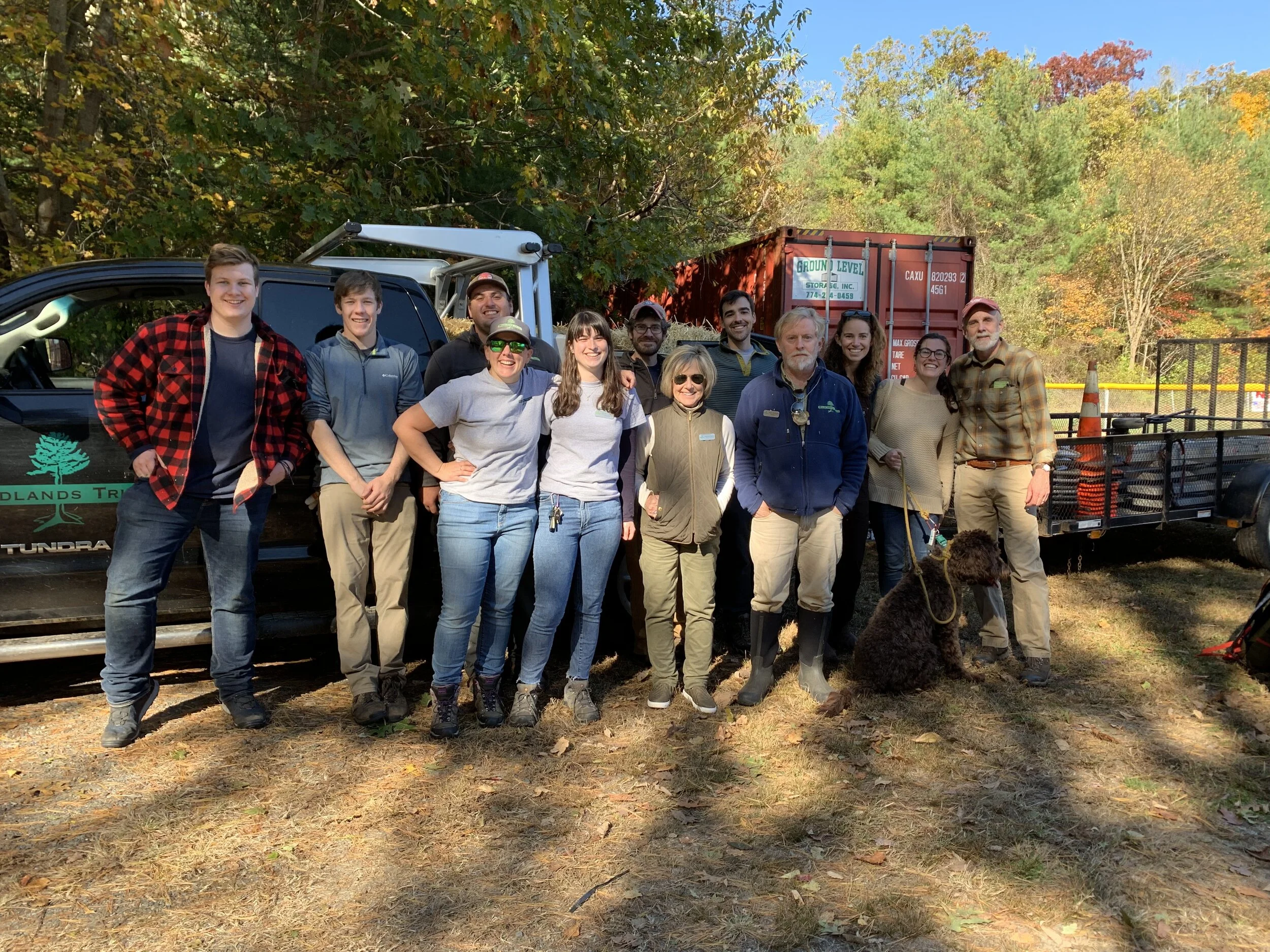
Rob MacDonald (far right) poses with other volunteers at Brockton Nature Festival.
How many years have you been a part of AAP?
Well, I was first involved with Wildlands Trust in about 1999 when I participated in a corporate workday at Willow Brook Preserve. This was an organized community service event with Bank Boston employees where we burned brush and removed invasive species to clear out the meadow habitat near the beginning of the trail system. Once AAP was created in 2014 and I heard about it, I joined shortly thereafter.
What Wildlands properties have you “adopted”?
Striar Conservancy in Halifax and Tucker Preserve/the Indian Head River loop, which goes through Pembroke, Hanson, Hanover, Plymouth County land, and private property.
What is your favorite thing to do while out on monitoring visits?
Photography. I am always looking for shots of birds while on my monitoring visits. And then, during the spring when vernal pools are active, I like to look for amphibians to photograph. Typically, I bring out a long-lens camera for pictures of birds and a macro-lens for taking close-up pictures of fungi and amphibians.
What are some highlights for you along the Indian Head River Trail (IHRT) loop?
The bluff in Tucker preserve where the trail cuts through a hemlock grove opposite of the tack factory along the river is a nice section of trail. I also really like the babbling stream you encounter towards the back side of Tucker. It’s one of several spots that remind me of New Hampshire. I also really like the section of trail that cuts through Rocky Run, which is beautiful town of Hanson conservation land.
What have been your favorite wildlife sightings at Striar and Tucker?
River otter, which I’ve encountered at both Tucker and Striar. I recently saw one at Tucker, along the Indian Head River, soon upon entering Tucker from Pembroke Conservation land. The otter was resting on the ice on the river, eating a fish that it had caught.
When I saw an otter at Striar, I was looking out at a bend in the Winnetuxet River. I heard a bark and the otter slipped into the river behind me. I suspect it was voicing a warning signal to another otter somewhere in front of me. In terms of exciting bird sightings, I‘ve seen a wide variety of birds including barred owls, yellow cuckoos, ovenbirds, wood ducks and a palm warbler at Striar.
What is the most memorable experience you have had while at a Wildlands property?
At Striar, I have done vernal pool walks where participants come out at night to explore what they can find in the pools. Kids and adults alike get extremely excited about the chance to dip their hands into the pools to see what they find. Many people would not normally go on hikes at night on their own so the opportunity is unique and exciting for that reason too.
What is your favorite thing about AAP?
The monitoring visits present you with an opportunity to pay greater attention to the place you are in. I definitely focus more on the details of the surroundings than I would on a hike. My responsibilities as an AAP member makes me much more attentive while out on a preserve. }
What is it like being a part of the volunteer hike leader program?
On several occasions, people have come to one of these Wildlands Trust hikes and mention that they were sometimes hesitant to go out and hike in the woods alone. These organized group hikes gave them the opportunity to get out in a group atmosphere and enjoy exploring the varied Wildlands Trust preserves. So being part of a program that affords these folks, who might no otherwise get out into the woods, is pretty nice.
Are there any nature preserves in the region that you like to visit outside of the ones you adopt?
Burrage Pond Wildlife Management Area, a 1,638 acre MassWildlife-managed preserve that stretches through Hanson and Halifax is my favorite. The preserve is a habitat for beavers, otters, and many different species of birds. Burrage Pond’s landscape includes dormant cranberry bogs. Some of these ex-cranberry bog areas have remained open to develop into grassland habitats and others have been flooded to allow for habitat for aquatic birds. The management area also includes an interesting floodplain habitat along Stump Brook River that supports Atlantic white cedar and eastern hemlock trees.
I know you have visited for these trails for many years. Have you seen the area change over the years?
I’ve been walking the trails along the Indian Head River for at least 25 years. As for changes, the Hanover section of trail has become more formalized is now a well-marked trail. Also, on the western section of the trail loop, where you cross the bridge on State Street in Hanson, the trail used to be difficult to find because it was completely unmarked. That entrance has now been opened up and is much easier to find. Overall, the trail system has become more formalized and clearer while maintaining the same peaceful and wild feeling I got hiking these trails 25 years ago.
As a resident of Hanson, how do you think the community can benefit from a natural resource like the Indian Head River Trail?
The Indian Head River trail system presents Hanson community members with a beautiful hike along the Indian Head River through Rocky Run Conservation Area, a showcase example of protected, natural, town of Hanson conservation land.
Enhancing the Region Through Conservation
As a regional land trust, Wildlands Trust’s work throughout the South Shore benefits the fabric of our communities in many different ways.
By Membership and Communications Manager Roxey Lay
It’s a new year and with it comes a new year of projects, land acquisitions, public programming and more, all in the name of conservation. Since 1973, Wildlands Trust has committed to conserving and permanently protecting native habitats, farmland and lands of high ecological and scenic value that serve to keep our communities healthy and our residents connected to the natural world. And every year, you and many other supporters like you, make this work possible by renewing your commitment to Wildlands. But why do we do this work? Why are land trusts important?
The state of Massachusetts lists on its website five reasons why land conservation is “critical in preserving and enhancing the quality of life in Massachusetts.” [1] Read on to see how Wildlands’ work directly benefits our region and the residents who call it home.
Protection of water resources
Clean water is essential to any community. Nearly every property within Wildlands’ portfolio contains some type of water resource and a key factor in conserving these ecologically significant properties is that doing so protects against contamination. When water flows over the ground, it can potentially pick up a number of pollutants, “which may have sinister effects on the ecology of the watershed and, ultimately, on the reservoir, bay, or ocean where it ends up.” [2] Those pollutants can also soak into the ground and contaminate groundwater, “where it will eventually seep into the nearest stream…or into underground reservoirs.” [2] By conserving properties that contain and/or abut hydrological resources, Wildlands is able to limit the potential for pollution of those resources and habitat.
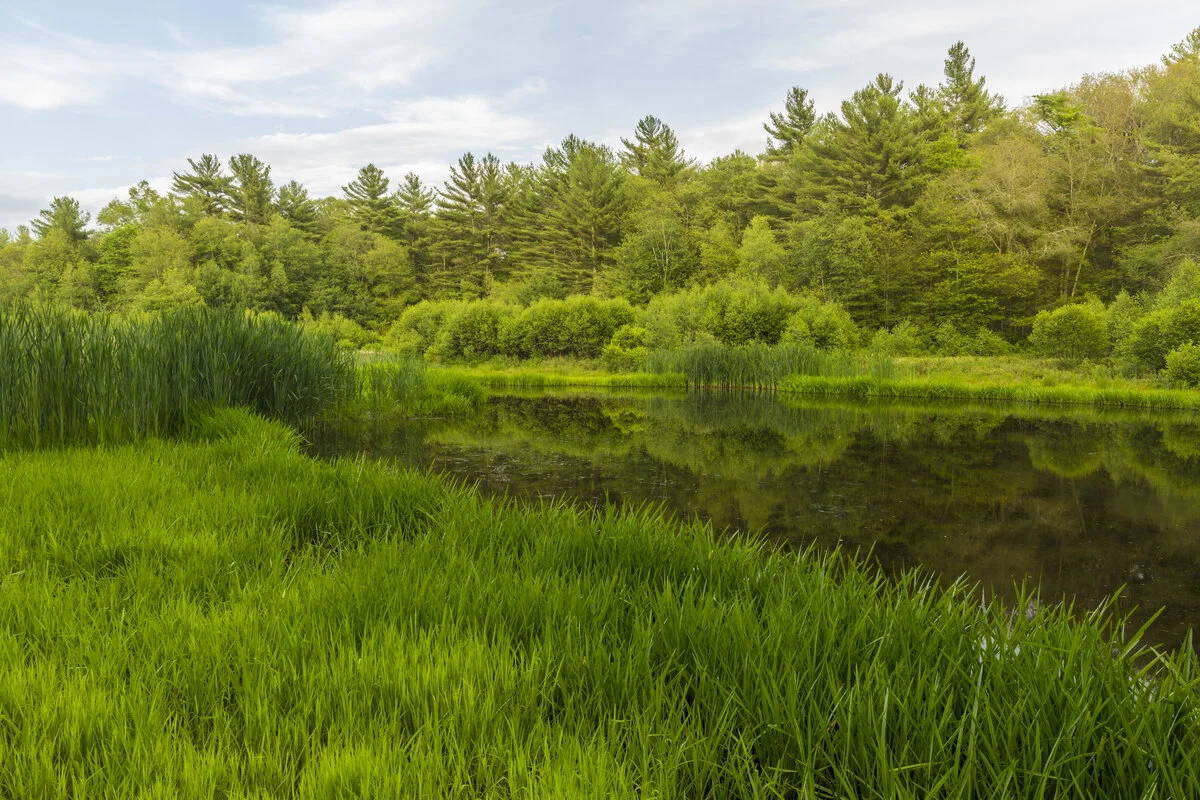
Wetlands at Striar Conservancy, Halifax.
Striar Conservancy in Halifax runs along the Winnetuxet River (identified by the National Park Service as one of the top four priorities for conservation along the Upper Taunton River) and combined with the town of Halifax property on the other side of the river, preserves 250 acres along the Winnetuxet. Striar is also host to vast wetland habitat, which, in addition to providing habitat to a number of local species, filters water running along the ground before it enters the river. “Wetlands are filters for water coming off the land, reducing sediment and chemicals in run off before it gets into open water. These chemicals and sediment could kill fish and amphibian eggs, smother bottom feeding wildlife and plants, and clog waterways.” [3]
If water resource protection is something you feel strongly about, you aren’t alone; clean water is a concern for the majority of Americans. In the 2019 Gallup Environment poll, 53% of respondents worry “a great deal” about the pollution of rivers, lakes, and reservoirs and 56% worry “a great deal” about pollution of drinking water. By supporting Wildlands Trust, you are helping keep critical water resources clean.
Providing open spaces and parks for our urban communities
Wildlands’ service region covers 45 towns throughout Southeastern Massachusetts. In Brockton, Wildlands staff have taken on a number of projects since first acquiring Brockton Audubon Preserve in 2012, ranging from land stewardship, tree planting, and youth education. In 2019, Wildlands worked with the city to restore and manage Stone Farm Conservation Area. Together, these two properties provide residents with 230 acres of open space for outdoor recreation, as well as health and environmental benefits that come with having access to public open space:

Hikers head out on a guided hike at Stone Farm Conservation Area during its grand opening at Brockton Nature Festival. (October 2019)
A sanctuary for escaping high summer temperatures and finding shade under a protective canopy.
Access to an open, living laboratory that provides opportunities for environmental education.
Maintaining habitat species biodiversity in Brockton.
Trees trap and store carbon from the atmosphere, as well as keep the city cooler.
In addition to our growing presence in the city, Wildlands’ community outreach manager, Conor Michaud, has recently been asked to serve on the city’s open space planning committee. Wildlands looks forward to continuing outreach efforts within the city and connecting residents to the land.
Creating and enhancing outdoor recreation opportunities statewide
Wildlands Trust’s monthly programming and events provide residents and visitors throughout Southeastern Massachusetts opportunities to experience the open space we protect. Offering a variety of options, participants can go on a general or themed hike, take a yoga or guided meditation class, get creative with arts and crafts projects, attend an educational presentation, and more.

Attendees watch intently during “Eyes On Owls”, a live owl presentation at Davis-Douglas Farm.
Wildlands’ public preserves are also host to trail systems that are inclusive to visitors of varying abilities. Trails can range from gentle field walks like at Cushman Preserve in Duxbury, to more challenging and hilly terrain like at Halfway Pond Conservation Area. In Bridgewater, the 125 acres comprising Great River Preserve (a vital link in a 1,400-acre stretch of river corridor) contains a handicap-accessible entrance and a wheelchair-accessible path leading from the property’s fields to the Taunton River.
With programs tailored to appeal to a number of interests and preserves with a wide-range of trail systems, Wildlands works to connect everyone to the natural world.
Interested in joining in on the fun? Find upcoming Wildlands programs and events at wildlandstrust.org/events or check out a trail map at wildlandstrust.org/trails
Preserving working farms
Wildlands’ portfolio contains a number of properties with Agricultural Preservation Restrictions (APR). This restriction protects the property from non-agricultural development and ensures it remains in a state of active agriculture. School House Field at Eel River Preserve is an example of how Wildlands partners with local farmers to help them find land while also maintaining the active agricultural status of a property. The most recent partnership on this land is with local brewery owner Paul Nixon, who has been growing hops on the property since 2018.

Cows graze in the fields at Anderson Farm, West Bridgewater.
Wildlands also works with state and town governments on APR projects. In 2004/2005, Wildlands brokered the deal to preserve the 145-acre Historic O’neil Farm in Duxbury. The restriction placed on this property, which has “been in continuous agricultural use since the early 1700’s” [4] and remains as the last working dairy farm in Duxbury, ensures it will continue to operate as a farm in perpetuity. In 2010, Wildlands also helped save the 116-acre Anderson Dairy Farm in West Bridgwater by working with the Massachusetts Department of Agriculture, town of Bridgewater, and the Anderson family to place an APR on the property. The farm’s importance lies not only in its significance to the town’s farming heritage, but also in its location. The property sits along the Town River (a tributary to the Taunton River) and Hokomock Swam (the largest freshwater wetland in Massachusetts), which provides habitat for various wildlife. Most recently, Wildlands is again working with the town of Duxbury, this time to save the 17-acre Herrington Farm.
The connection between Wildlands and local farms extends into its youth programming as well. During the summer, Wildlands’ Green Team members visit local farms like Bay End Farm in Bourne to learn about organic vegetable farming. Team members take part in the entire farming process, helping out with planting, weeding, harvesting and processing various crops. At Soule Homestead Education Center in Middleborough, team members assist in invasive species removal in pastures and learn about animal husbandry.
Protecting wildlife habitat
Prior to Wildlands acquiring a property, there are a number of criteria it must meet, such as outstanding or noteworthy ecological significance. Lands that fit this criterion contain rare or unusual habitat types, provide habitat for rare or endangered species, contribute to local and regional habitat diversity, and/or possess a BioMap Core Habitat or Supporting Natural Landscape designation.
Rich with diverse river habitat, including marshes and seepage swamps, along the Winnetuxet River, Striar Conservancy supports a variety of local species like the uncommon river otter, wood duck, woodcock, and ruffled grouse. The 168 acres of undeveloped land comprising the preserve also provides habitat for deer, fox, over 90 species of birds like the upland sandpiper and barred owl, as well as state-listed rare species, like the bridle shiner, Coopers hawk, and Mystic Valley amphipod.

Halfway Pond peaks through pine trees at Halfway Pond Conservation Area, Plymouth.
Halfway Pond, at Halfway Pond Conservation Area, provides habitat for the federally endangered northern redbelly cooter (formerly known as the Plymouth redbelly turtle), and also supports six mussel species, including two state-listed rare species. Southeastern Massachusetts is also host to the Massachusetts Coastal Pine Barrens, a unique ecoregion which can be found on Wildlands’ Plymouth properties. This specific habitat is critical to the survival of a number of species. In fact, “the Massachusetts Department of Fish and Wildlife has state-listed 182 species of plants and animals in the Pine Barrens ecoregion as endangered, threatened or a species of concern.” [5]
Climate Change
With nearly 10,000 acres of land in Wildlands’ portfolio, it has become increasingly important for Wildlands to consider the resiliency of these lands and the region overall. In 2019, Wildlands added a criterion into the organization’s mission statement which focuses on climate mitigation and the adaptation potential of a property acquisition. The intention of this benchmark is to help the organization identify lands that contain habitats which are expected to be affected by climate change more so than others (cold-water streams, tidal marshes, and vernal pools).
Wildlands has also incorporated this outlook into its current holdings. While creating this new criterion, Wildlands analyzed the properties currently in its portfolio, created a vulnerability assessment for each one, and a hybrid management strategy. Through the direct protection of critical climate-resilient habitats, adjacent land parcels, and modifying current management practices, Wildlands hopes to increase the region’s overall resiliency to climate change.
Supporting land trusts like Wildlands Trust is not just about protecting land, it’s about enhancing the quality of life within your community. The benefits that come from land protection and the organizations that serve that purpose, extend out into multiple aspects of our region and set an example for other parts of the state, country and world. We thank you for your dedicated support and look forward to continuing to enhance the beauty and health of Southeastern Massachusetts for years to come.
How can you help enhance the quality of life in Southeastern Massachusetts with Wildlands Trust?
Wildlands Trust Receives Grant For Youth Programs
Wildlands Trust is pleased to announce it has been selected to receive a $30,000 grant toward the upcoming Flagg Pond and Our Changing Forests studies in Brockton.

Students from Brockton High School participate in a Flagg Pond cleanup day.
Flagg Pond Study
Beginning this spring, Wildlands staff will work with Brockton High School students and faculty on analyzing the current state of Flagg Pond in Brockton. This multi-year, Citizen Science student-based project will look at the wetland buffer zone, vegetation, and assess the overall water quality of the pond. The project will kick off with Brockton’s Envirothon team and continue into the summer with Wildlands’ Green Team, with both groups performing water quality testing. Wildlands staff will also work with Brockton High School (BHS) faculty to establish the study as part of a curriculum within various classes in the future at BHS.

Envirothon team members collect data at Stone Farm Conservation Area.
Our Changing Forests Study
In partnership with the Harvard Forest Schoolyard program, Wildlands Trust is taking part in the state-wide Our Changing Forests Study. This past fall, Wildlands Trust staff set up forest study sites at Brockton Audubon Preserve and Stone Farm Conservation Area, where Brockton High School students visited and recorded data at both locations. Moving forward, students from local schools, with Wildlands staff, will continue to identify and measure trees, analyze the landscape, and submit gathered data from these two sites to Harvard Forest as a part of this multi-year, student-driven study.
Keep an eye out in the coming months for more updates and information regarding these two programs. If you have any questions about either study, please contact:
Flagg Pond Study: Conor Michaud cmichaud@wildlandstrust.org
Our Changing Forests Study: Rachel Calderara rcalderara@wildlandstrust.org
Bringing Adopt-A-Preserve to Brockton
With 18 new Adopt-A-Preserve volunteers trained in 2019 and 29 preserves monitored, Wildlands looks to expand the program at Brockton preserves.
A path leads visitors through the dense woods at Brockton Audubon Preserve.
Since 2010, Wildlands Trust has welcomed TerraCorps service members onto its staff to help expand its organizational capacity in community outreach and land access. TerraCorps, formerly MassLIFT, is a Massachusetts-based AmeriCorps program with members serving at nonprofit land conservation and urban agriculture organizations across the state. This year, Wildlands is hosting two TerraCorps members, a community engagement coordinator – serving her second year at Wildlands with a focus on public programming – and a land stewardship coordinator, whose focus is growing Wildlands’ Adopt-A-Preserve (AAP) program.
Throughout the coming year, a focus for the AAP program will be at Wildlands’ Brockton Audubon Preserve and the city of Brockton’s Stone Farm Conservation Area. For those unfamiliar with the program, trained volunteers choose one or more preserves within Wildlands’ 1,500-square-mile service area to monitor on a monthly basis and submit reports to Wildlands’ staff on the state of the preserve.
Stewardship Manager Erik Boyer leads a group of hikers at Stone Farm Conservation Area during the Brockton Nature Festival.
Over the last three months, community members have expressed a heightened interest in stewarding the open spaces in Brockton - a direct result, we believe, from our recent work to promote community involvement on the properties. Efforts have included activities like guided hikes and community events such as the Brockton Nature Festival (BNF), held this past October at Stone Farm. Hosting events like the BNF are great ways to introduce preserves and Wildlands Trust to people within the local community and surrounding areas who may not have been familiar with Wildlands or our work prior. Stewardship staff have also recently hosted AAP trainings at both Brockton Audubon and Stone Farm.
By continuing to promote these preserves through various community engagement activities, Wildlands’ hopes to establish a solid group of volunteers to help keep these properties safe for wildlife and visitors throughout the year. Volunteer-based programs like Adopt-A-Preserve not only assist our stewardship staff in keeping our properties safe and ecosystems healthy, but to further connect our communities to the natural world, increase visibility of public open space, and encourage usage by visitors throughout the region. If you are interested in becoming an AAP volunteer in Brockton or at any other Wildlands preserve, please apply at: wildlandstrust.org/volunteer
Volunteer Spotlight: Rachel Thilbeault
By Eamon Horrigan, Land Stewardship Coordinator
Recently, Wildlands’ Land Stewardship Coordinator Eamon Horrigan sat down with long-time Brockton resident and Wildlands volunteer, Rachel Thilbeault, to discuss Brockton Audubon Preserve and her volunteer work at Wildlands:
How did you first discover Brockton Audubon Preserve and Wildlands Trust?
When I moved here, I realized right away that there were walking trails back behind my house. The trails were the same as they are now, apart from the trail with a boardwalk leading out to the [utility] easement. A friend from Brockton told me about Wildlands’ work at Brockton Audubon about 4 years ago.
How many years have you been involved with the property?
It has been 31 years since I first moved to Brockton and walked the trails back there. In 2005, I helped certify the vernal pool on the preserve by proving the presence of spotted yellow salamander juveniles in the pool.
A 20-foot-high glacial erratic can be found in the northeast section of the property.
What is your favorite thing to do while out on the property?
Watch for wildlife. [I’m] always looking to see animals like foxes and owls.
Do you have a favorite spot on the trails?
The huge glacial erratic at the trail intersection out there. It is amazing the way that is balanced. It looks like one of these days it is bound to fall over.
What is the coolest wildlife sighting you’ve had at the preserve?
Probably a great horned owl. It was perched on a large white pine tree and I was shocked by how large it was. I also saw two yellow spotted salamanders under a log, which was another cool sighting.
Do you have a favorite time of year to visit?
In the spring, when all the flowers are in bloom and before the leaves on the trees come out. I love to see all the violets around the vernal pool. I also really like to see the yellow of the marsh marigolds and the May apples that bloom on the right side of the trail near the parking area.
What is the most memorable moment you’ve had at the preserve?
Leading my first hike because it was nice to take people out and show them around. I liked having the chance to show people they can escape the rat race of the city and spend a couple hours relaxing in the woods.
What is it like being a volunteer hike leader with Wildlands Trust?
Well, it feels good to show people what is out there and makes me feel proud to have open, public land in Brockton. I think it is a privilege to have an opportunity to escape the hectic city.
A toad, one of many species found at the preserve, rests on the forest floor.
Do you think that property usage has increased since you first got involved or stayed relatively the same?
Definitely more people have been going out there. Many dog walkers. I talk to plenty of people who remark on how they did not know this [preserve] was out here. Whenever I am doing trail work or picking up trash, people are interested and ask what I am doing out here.
In addition to leading hikes, you’re also an Adopt-A-Preserve (AAP) volunteer at Brockton Audubon, what is your favorite thing about AAP?
Going out [to the preserve] with the company of my fellow, friendly Brocktonians, Cynthia and Alan. It’s a chance to tell stories about how Brockton once was.
Do you have a favorite Wildlands property to walk outside of Brockton Audubon?
Great River Preserve in Bridgewater. It’s a great place to ride bikes and it’s nice to sit at the benches by the water and take a rest after a bike ride.
Outside of Wildlands, are there any other trails you also like to hike?
Borderland State Park (Easton, MA) and Blue Hills Reservation (Milton, MA). Borderland has a lot of pretty trails and a nice mixture of terrain; really flat trails and more hilly ones. Blue Hills is great because of the Skyline trail, getting to see the weather station there, and climbing Buck Hill for a view of Boston.
Thank you to Rachel for sitting down and speaking with me about her experience volunteering at Widlands Trust and Brockton Audubon Preserve. If you’d like to learn more about Wildlands’ Adopt-A-Preserve program or any other volunteer opportunities at Wildlands, visit our volunteer page at: wildlandstrust.org/volunteer
Wildlands’ Volunteer Spotlight Series showcases the interests and experiences of Wildlands’ dedicated volunteers. If you’d like more information on volunteering with Wildlands, please visit our volunteer page or contact us directly.