


What’s New at Wildlands
Wildlands Teams Up with Sierra Club for Volunteer Service Week
By Stewardship Manager, Erik Boyer
Sierra Club volunteers and Wildlands staff pose for a group photo at Myles Standish State Forest.
This past August, twenty-four volunteers from the Sierra Club joined Wildlands Trust for a week of service on some of our trails on the South Shore. The group consisted of volunteers from all over the country who dedicated their time from August 5 – August 9 and helped improve the trails at Wildlands’ Tucker Preserve and the Equestrian Loop at Myles Standish State Forest. This is the fourth year of this partnership, which focuses primarily on volunteer work at Wildlands but has included service projects with the town of Plymouth and the Friends of Myles Standish.
This year, for the first time, we spent a day outside of Plymouth on the Indian Head River in Pembroke and Hanover. The first day, the group spent the day cutting back trails on the Indian Head River Loop (IHRL), a trail that passes through the towns of Pembroke, Hanover, and Hanson. A good portion of this work took place on Tucker Preserve, which is one of the entry points to the IHRL. A group also assisted a local Boy Scout for his Eagle Scout project, where they opened up the trails at the town of Hanover’s Iron Brook Mine Trails.
Sierra Club volunteers working together on a trail in Plymouth in 2017.
At the end of the week, the group worked with the Friends of Myles Standish and helped cut back vegetation on portions of the Equestrian Loop. Volunteers cut back the dense understory scrub oak and bayberry from the trails and cleared fallen trees with handsaws. Over 3 miles of trails were cleared over the course of two days!
Thanks to the efforts of Zehava Rosenberg and Madeleine Zember, two Sierra Club volunteers, over 20 volunteers come to Plymouth for a weeklong service trip each year. Due to the help of the volunteers this year, hikers will be able to enjoy these trails this fall. If you would like to learn more about the Sierra Club’s service trips, check out: content.sierraclub.org/outings/volunteer-vacations. For information on how you can volunteer with Wildlands Trust, visit our website at wildlandstrust.org/volunteer.
Youth Unplug for a Summer of Service
By Outreach and Education Manager, Rachel Calderara
Another July has come and gone, and with it, another Green Team program has ended, but not before 26 amazing teens put in over 700 hours of volunteer work on the protected lands of Southeastern Massachusetts.
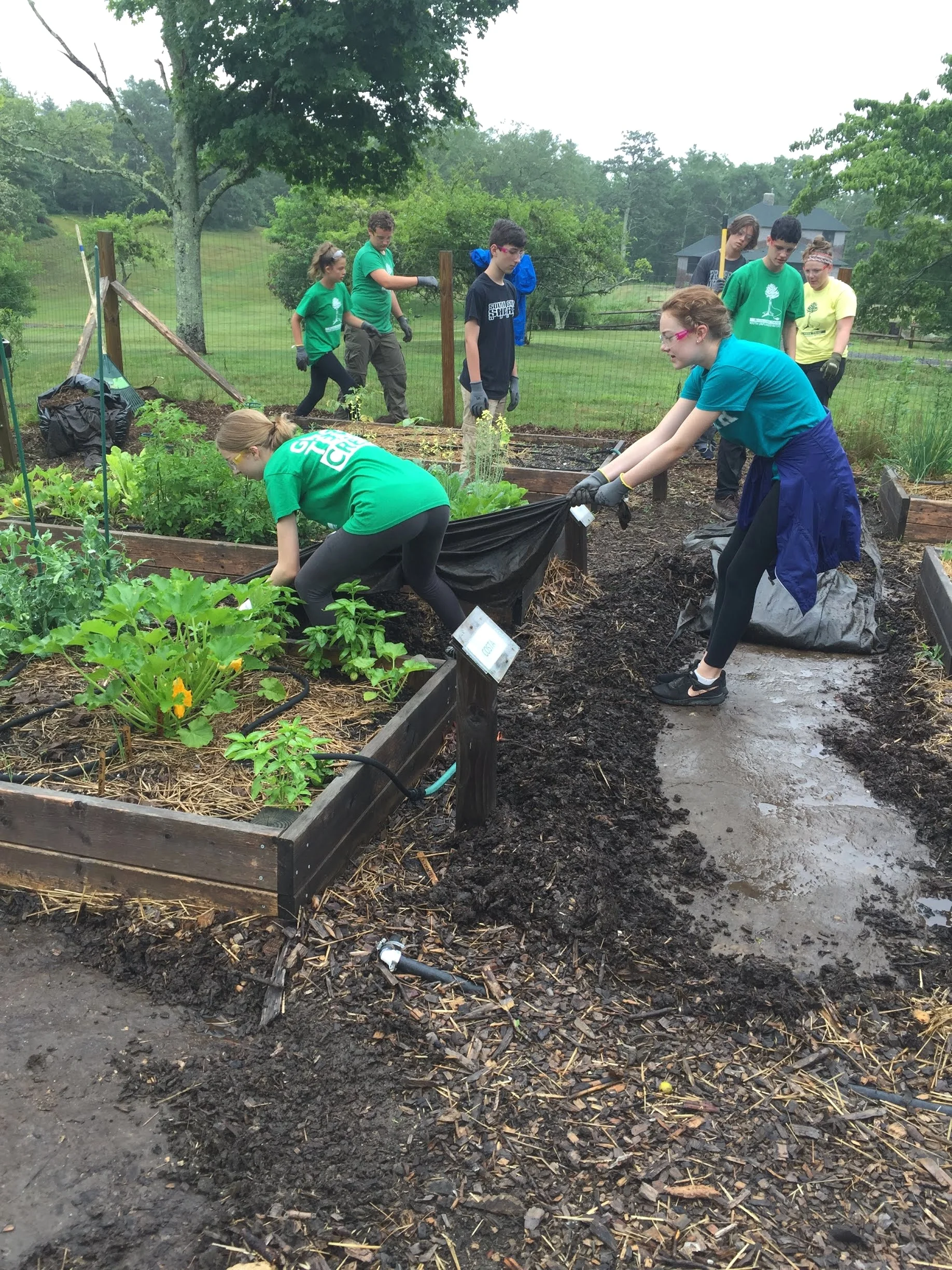
Green Team 1 crew members get their hands dirty at Bay End Farm.
What is Green Team?
2019 marks the fifth year of Green Team, a keystone program in Wildlands’ Youth Unplugged Initiative. Green Team is an interactive opportunity for teens to engage in environmental learning through volunteerism. After applying to the program in the spring, each applicant goes through a thorough interview process in hopes of being offered a spot on the team. Only those who have proven their interest and motivation to work hard in the outdoors with their peers are accepted onto Green Team. This year, we accepted 13 middle school-aged crew members into the 1 week Green Team 1 program, and another 13 high school-aged crew members into the 2 week Green Team 2 program.
What does Green Team do?
Each day, the Green Team travels to various sites across the region to work on relevant, hands-on environmental projects with professionals in the field. This year was one for the books with more crew members, more hours, and more projects than ever before!
Green Team 1 Projects:
Trail clearing at Mass Audubon’s Great Neck Wildlife Sanctuary (Wareham)
Invasive species removal in the pastures at Soule Homestead (Middleborough)
Organic vegetable farming at Bay End Farm (Bourne)
Restoring the community garden pathways at Wildlands Trust’s headquarters (Plymouth)
Green Team 2 Projects:
Farm animal husbandry at Soule Homestead (Middleborough)
Organic farming and greenhouse restoration at Round the Bend Farm (South Dartmouth)
Trail maintenance at Northeast Wilderness Trust’s Muddy Pond Preserve (Kingston)
Picnic table and bench building for trails at Wildlands Trust’s Emery Preserve (Plymouth)
Blueberry harvesting and pruning at Cornish Fields Farm (Plymouth)
Garlic harvesting and processing at Bay End Farm (Bourne)
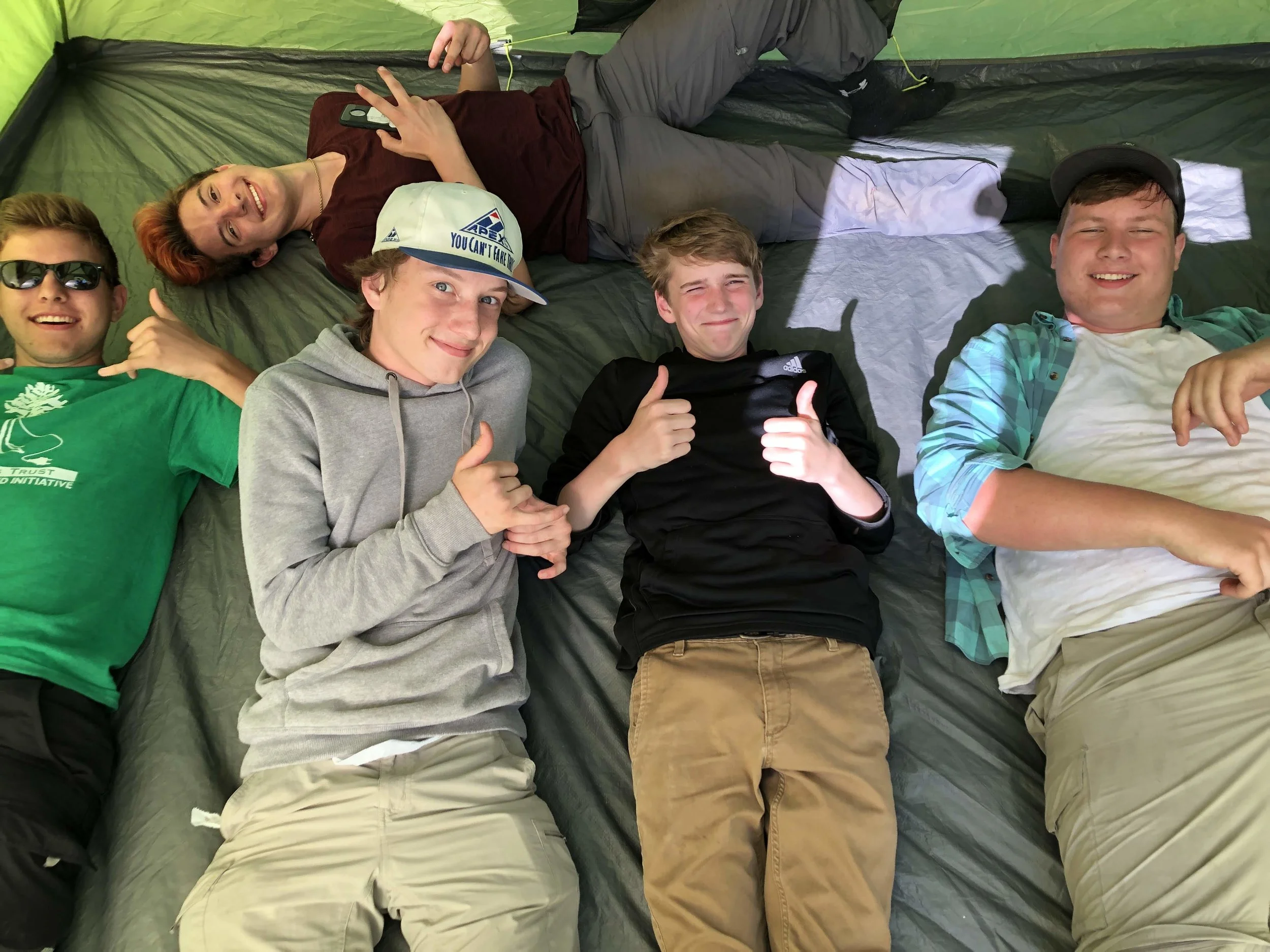
The service days are sprinkled with educational activities like tick safety talks, birding walks, farm tours, meditation, yoga and more. On the final night of Green Team 2, we take the team on an overnight campout where they enjoy dinner, a night hike, and a campfire.
Green Team 2 after harvesting garlic at Bay End Farm.
What’s next for Youth Unplugged?
Three weeks of Green Team are a whirlwind for staff and crew members alike, leaving us all thoroughly exhausted yet still wishing for more time together. These ambitious teens will not rest and we are left feeling like there is more we can do to keep encouraging their interest in the outdoors. This nagging feeling, along with numerous requests from the crew for continued volunteer opportunities, prompted us to pilot a new program we’re calling Service Learning Saturdays. Once a month, all Green Team alumni are invited to our Plymouth headquarters to work on projects ranging from invasive species removal to gardening and more. During the first Service Learning Saturday on August 24, four crew members helped us pull out overgrown invasive vegetation at both the barn foundation and the old oak tree.
The teens we have the pleasure of working with are intelligent, kind, caring young people who give us hope for the future. We thank them for another wonderful year of Green Team, and look forward to Service Learning Saturdays this fall!


Follow us on Facebook for Service Learning Saturday pictures and updates at: facebook.com/wildlandstrust.
Looking Back on a Year at Wildlands
By Hayley Leonard, TerraCorps Community Engagement Coordinator
Hayley (second from the right, back row) and the 2019 Green Team I group.
For the past year, I’ve been serving in an AmeriCorps position at Wildlands Trust as the Community Engagement Coordinator. My AmeriCorps program is called TerraCorps and was created with the mission of preparing and mobilizing emerging leaders to help communities gain access to and conserve land. The program works by partnering with community-based land-focused groups across Massachusetts, who then interview and offer positions to applicants of the TerraCorps program. Members serve in one of four, 11-month full-time positions; Community Engagement Coordinator, Land Stewardship Coordinator, Regional Collaboration Coordinator, and Youth Engagement Coordinator. This past year there were 36 TerraCorps members serving in communities across the state.
Hayley leading a program at Emery West Preserve, Plymouth.
During my year at Wildlands Trust, I have had the opportunity to work on a wide array of projects. One that I had a lot of fun with was co-developing a volunteer hike leader program alongside the Outreach and Education Manager. The program was designed to train volunteers on how to safely and effectively lead and sweep hikes while representing Wildlands Trust. We held our one-day training in March, and as a result, now have 8 volunteers leading hikes for Wildlands Trust.
I will be staying with TerraCorps and Wildlands Trust for another year and continue working on programming. Doing a second year will give me the chance to finish some projects that I had started during my first year, like developing tours of some of Wildlands Trust’s most popular preserves. In the next year, I’m looking forward to continuing to work with the communities that Wildlands Trust serves.
From Farmland to Grassland
How Wildlands’ management of former farmlands provides a reliable habitat for pollinators and other wildlife throughout the South Shore.
By Membership & Communications Manager, Roxey Lay
When you think of a Wildlands Trust preserve, you may immediately think of trails that lead visitors throughout woodlands to explore the undeveloped pockets of the region. What you may not think of immediately are fields. In addition to the wooded areas Wildlands protects, there are also a number of former farms, managed by stewardship staff to remain as open grasslands. Habitats like these fields tend to disappear in this part of the state, either through development, the installation of solar fields, or through lack of management. “Grasslands don’t want to stay grasslands”, Stewardship Manager, Erik Boyer explains. “Their natural state is forest.” With fewer grassland habitats throughout the region, Wildlands makes it a point to maintain a number of properties like Great River Preserve, Willow Brook Farm Preserve, and Phillips Farm Preserve, as such in order to provide a stable habitat and foraging area for wildlife that rely on vegetation that grows there.
Joe-pye weed, Eutrochium purpureum, grows at Great River Preserve in Bridgewater.
A primary group that rely on these areas are pollinators, like bees. Throughout North America, there are nearly 4,000 native species of bees [1]; however, 14 species in New England are on the decline by as much as 90% [2]. This does not include the European honey bee, which is not native to North America, having been brought over in the 1600s by the colonists. In an attempt to pinpoint the cause of this decline, “scientists have blamed a range of factors including insecticides (neonicotinoids), parasites, disease, climate change and lack of a diverse food supply” [2]. Native flower diversity is a critical part in helping the region’s native bee species as well as having various plants that bloom during different months throughout the year. “Having large open fields that have native plants that provide a continuous food supply to common and specialty bees are important”, explains Plymouth County Entomologist, Blake Dinius. “Many types of bees only forage during certain months out of the year.” A large number of common plants that attract generalist foragers like honey bees and bumble bees aren’t always adequate for specialist species who only feed on specific flowers; if those types of plants aren’t available, these species die off.
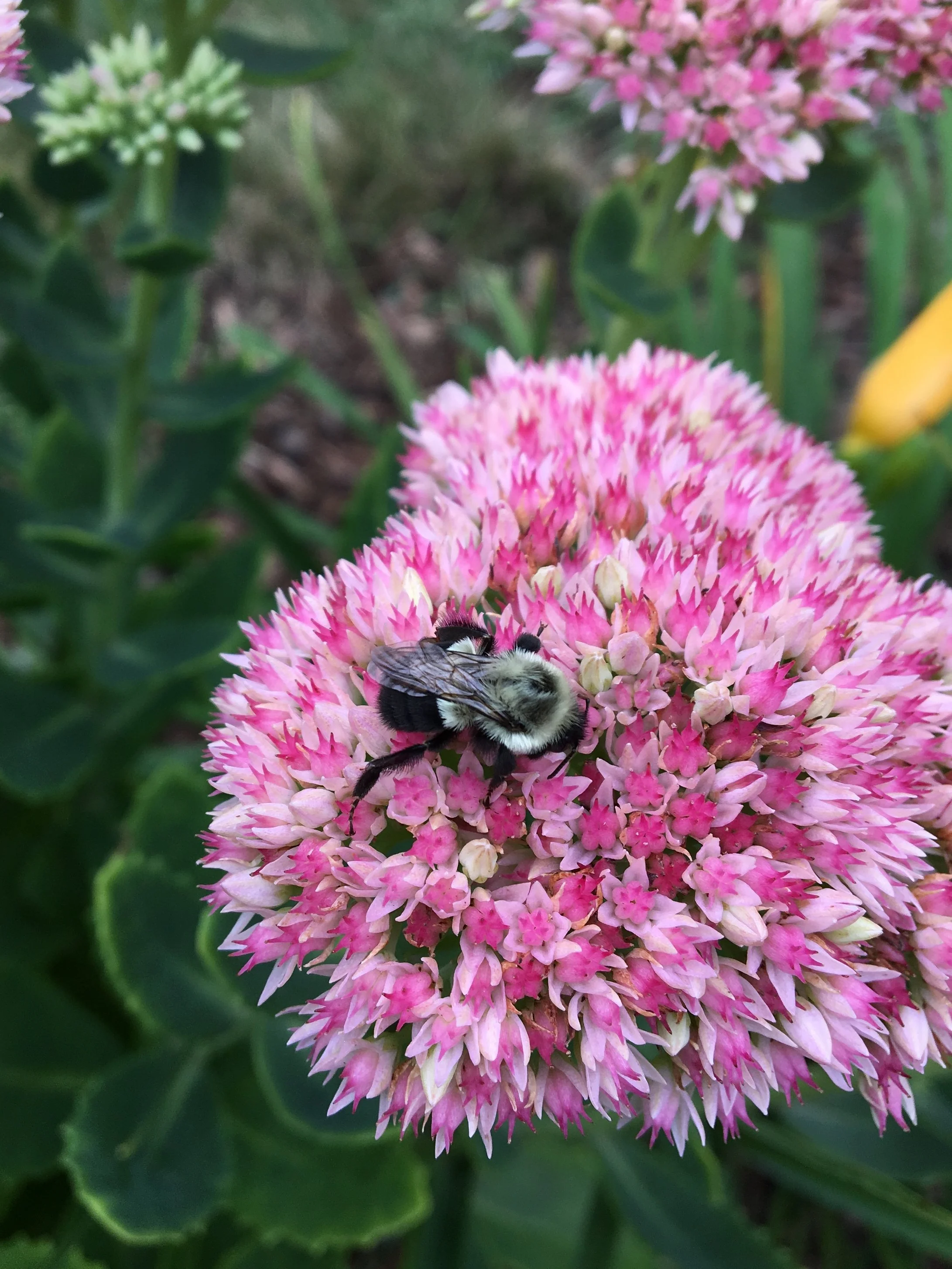
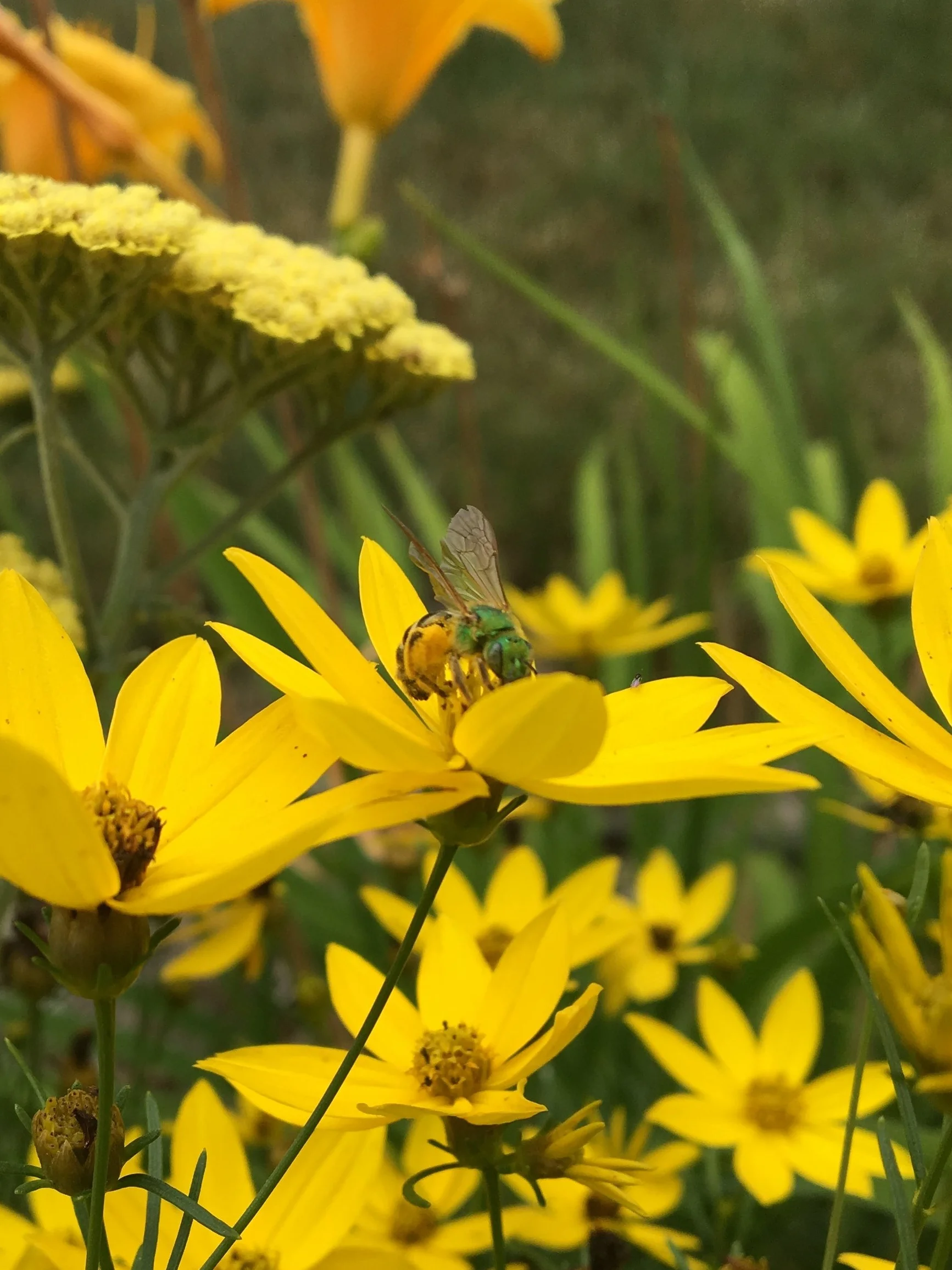

The distance between foraging sites is important as well. “Bees and other insect pollinators require nesting sites (suitable soil, dead wood, abandoned mouse nests, burrows) and floral resources (nectar and pollen) to persist” [3]. Unlike the honey bee, which lives in a hive, 70% of all bees nest underground [4] and viable nesting and foraging sites like open grasslands are at risk due to “row-crop agriculture, grazing and fragmentation of habitat” [3]. While larger species like honey bees and bumble bees travel 2-3 miles (sometimes farther) outside of their nesting location for food, many solitary bees, who are smaller yet “known to pollinate plants more efficiently than honey bees” [5], travel very short distances (typically less than a mile). Maintaining sites that are relatively close together are important in supporting the wide range of needs among various species.
Habitat loss and fragmentation, the process of reducing large tracts of land into smaller pieces via development, “are currently the main threats to terrestrial biodiversity”[6]. Wildlands works to expand continuous areas of ecological significance when acquiring land by identifying parcels that share borders with properties protected by towns and other organizations. This type of collaboration results in the creation of larger wildlife corridors throughout various habitats. Willow Brook Farm in Pembroke is a prime example of this. The roughly 167 acres that compose Willow Brook are nestled between Herring Run Historical Park and Misty Meadows Conservation Area. The shared borders between these three conservation lands results in a much larger protected area and reduces the distance between open spaces.
In short, Wildlands’ preserves which contain managed open fields provide food, a safe place to nest and a pesticide free environment for pollinators and other wildlife who rely on them. While there is much to learn in regards to why bees are facing declining numbers, there’s no doubt these spaces play an important role in their survival and the overall environmental health of the region. Through the preservation of varied habitats that include these grasslands, Wildlands and other land conservation organizations are working together to secure expansive tracts of vital habitat that may otherwise be lost forever.
A map showing the shared borders of Misty Meadow Conservation Area, Willow Brook Farm Preserve and Herring Run Historical Park.
[1] https://www.popsci.com/science/article/2013-06/10-spectacular-native-bees/
[2] https://www.apnews.com/f768748b36c648e49c14b0366fdec7e8
[3] https://www.nap.edu/read/11761/chapter/5#93
[4] https://entomology.cals.cornell.edu/extension/wild-pollinators/native-bees-your-backyard/
[5] https://www.growwilduk.com/wildflowers/bees-pollinators/take-crash-course-solitary-bees
[6] https://www.sciencedirect.com/topics/earth-and-planetary-sciences/habitat-fragmentation
Volunteer Spotlight: Brian Vigorito
By Stewardship Manager, Erik Boyer
For the past three years, Brian Vigorito has volunteered at Willow Brook Farm Preserve in Pembroke through Wildlands’ “Adopt-a-Preserve” program. He is a regular at Wildlands’ Trailblazer projects and is one of our Hike Leaders. He is an avid hiker, birder, photographer and self-trained naturalist. Learn more about him and why he volunteers with Wildlands in my conversation with him below:
Brian smiles for the camera during a Trailblazers day at Willow Brook Farm.
How did you first get interested in spending time outdoors?
I always played in the woods as a kid and hiked, but got away from it as I got older. Several years ago, I noticed there was a nature preserve [Willow Brook Farm] five minutes from where I live in Pembroke and started hiking there a few times a week. Around three years ago, I decided that I was interested in helping Wildlands at Willow Brook Farm and reached out to them to become a volunteer. I became interested in birding and photography just the last few years after attending Wildlands’ programming.
What is the most unique species of bird you have seen anywhere?
A Great Black Hawk, which I observed last year in Portland, Maine.
What is the most unique species that you have seen at Willow Brook Farm?
A black burnian warbler. I saw it on the Harry and Mary Todd Trail loop in the shrubland area, which is a great birding spot. After I first started getting into birding, I learned about an app called INaturalist which allows you to upload photos and submit your identification at an area. This is how I started to get into photography.
Photo courtesy of Brian Vigorito.
I recall that you had one particularly odd photo that reminded me of an awkward meeting of distant relatives, what’s the story behind it?
I went out to Shifting Lots Preserve on a cold and windy early spring day and observed a snowy egret and two little blue herons hunkering down on the edge of the marsh trying to stay out of the wind.
What is your favorite part about “Adopt-a-Preserve”?
That I can go five minutes from home to walk Willow Brook Farm and I can do it when I’ve got time, and it’s nice that it’s an open-ended experience.
What is your favorite trail work memory?
I would say building the new trail through the forest of green briar in the middle of the summer. It was impressive to watch Owen Grey mow down a 7-foot wall of briar.
What is your favorite thing to do while out on the property?
Definitely ID’ing organisms. I have identified 189 species at Willow Brook. This includes 94 species of birds, 8 mammals, 4 reptiles, 6 amphibians, 34 insects, and 47 plants.
What is your favorite trail work tool?
It would definitely be hand pruners. I’m a detail oriented person and it’s enjoyable to fine tune the trail behind the power tools.
What is the strangest item of trash you have picked up?
A 10-foot metal pipe during a beach cleanup at White Horse Beach in Plymouth.
What is your favorite spot on the trails at WBF?
The observation overlooking Herring Brook. It’s a great birding location and it gives you the best view of the property.
What’s the best time of year to visit Willow Brook?
The winter, it’s especially a great walk just after a snow fall as you can follow all of the wildlife tracks in the snow.
What is the coolest critter you’ve found out there?
A four-toed salamander under a log.
What is your favorite Wildlands property to visit outside of Willow Brook?
Shifting Lots, it’s my go-to spot for good birding – especially shorebirds!
What would you tell anyone who is thinking about volunteering with Wildlands?
You get to meet a great community of people at projects and other events. Adopt-a-Preserve is great because you can do it at your own pace and on your own time.
Want to Volunteer through Adopt-A-Preserve?
Wildlands’ Volunteer Spotlight Series showcases the interests and experiences of Wildlands’ dedicated volunteers. If you’d like more information on volunteering with Wildlands, please visit our volunteer page or contact us directly.