


What’s New at Wildlands
Seasonal Staff Success in Summer 2022
Read Time: 2 min
By Rachel Calderara, Director of Special Projects
Summers are for growth; not just for the local flora, but also for our staff! With 10,000 acres to protect in 52 towns, Wildlands’ stewardship staff have their work cut out for them during the growing season. That’s why each summer we hire a handful of seasonal staff to help us tackle the busiest time of year. Not only do they help keep our trails clear and free of obstructions, but our seasonal staff also engage with volunteers, help lead youth projects, and collaborate with partner organizations. As summer winds down, we’d like to take a moment to appreciate everything our stewardship staff accomplished this season in service to the environment and our communities.
Three new staff joined us this summer, doubling the size of the stewardship department. Tess Goldmann, who was first introduced to Wildlands Trust as a high school Green Team member in 2017 and 2018, joined Wildlands as a Seasonal Land Steward after earning a dual degree in Biological Science and Computer Science at Smith College. Lucky for us, she’ll be staying on to help with a variety of projects through the end of the year. Tyler Williams was with Wildlands from May to August and has returned to UMass Boston to complete his senior year as an Environmental Science major. Nico Johnston joined us all the way from Texas for a second summer and returned home in August for his senior year of high school.
The long list of accomplishments that wouldn’t have been possible without Tess, Tyler, and Nico includes:
Constructing two miles of new trails at Halfway Pond Conservation Area.
Installing new roadside signage at Showcase Preserves.
Repairing benches and picnic tables with the Brockton Green Team at D.W. Field Park.
Constructing a half-mile connector trail that links the IHRT loop with the trails at Chapman’s Landing in Hanover.
Installing bog boards at Mark’s Cove Conservation Area with Buzzards Bay Coalition and Wareham Land Trust.
Caring for our conservation lands is both challenging and rewarding, and we are grateful to Tess, Tyler, and Nico for their hard work this summer! We hope you find the time to get out on the trails and enjoy the fruits of their labor this fall.
Does this sound like the kind of work YOU would like to be doing? We’re HIRING a full-time Stewardship Coordinator! Learn more here.

Photo by Rob MacDonald
Wildlands' Community Welcomed Back at Opening Day 2022
Read Time: 2 min
By Amy Markarian, Senior Copywriter
On May 1, the Wildlands community came together at our Davis-Douglas Farm headquarters, in Plymouth, to kick off the 2022 programming season. Near-perfect spring weather was a bonus for all who attended our Opening Day celebration, making for a fun and relaxing Sunday afternoon that surely left many visitors daydreaming of the summer days ahead!
Friends of all ages, people and pets, families, returning members, staff, volunteers, and first-time visitors enjoyed local beer and live music on the lawn, explored craft activities and games, and learned all about the Wildlands Trust community, the work we're doing, and the various opportunities to join us--at our programs and events, as volunteers, and through membership.
The Conservation Barn was open for visitors to peruse information tables about current offerings and initiatives at Wildlands, or to purchase soft pretzels, fresh out of the oven. Many visitors enjoyed lengthy conversations with our staff and volunteers inside the Barn, while some of our youngest visitors dropped in just long enough to find the lollipops that adorned the display areas.
Wildlands’ Programming and Outreach Manager Claire Johnston said, “We are thrilled to have people interested in learning about us, what we’ve been doing, and what’s to come!” And our entire staff loved seeing all of the smiling faces and the steady buzz of activity around our headquarters that day. We can't wait to keep the momentum going as our 2022 programming season gets underway, so be on the lookout for more fabulous events to come!
Shifting Lots' Shorebirds Are Counting on You!
Read Time: 1 min
By Amy Markarian, Senior Copywriter

The Piping Plovers are back at Shifting Lots for the 2022 season! Protective fencing was installed around the birds’ nesting area at the end of March by staff and volunteers from Wildlands Trust and the Friends of Ellisville Marsh. The shorebirds are expected to begin laying their first eggs in early May, and will remain at the preserve throughout the summer months.
In preparation for the birds’ annual return, Wildlands’ staff and volunteers set up information tables at various times throughout the month of March, talking with visitors and providing informational materials about the value of wild beaches and marshes, the ways we manage the land to support wildlife, and how visitors’ actions can help to protect this important habitat. In case you missed this on-site educational opportunity, our team has created a short summary to provide you with all the “need-to-know” information about Shifting Lots Preserve and its shorebird protection.


Indian Head River Coalition Completes Work on Multi-town Hiking Trail Loop
By Amy Markarian, Senior Copywriter
Read Time: 2 min
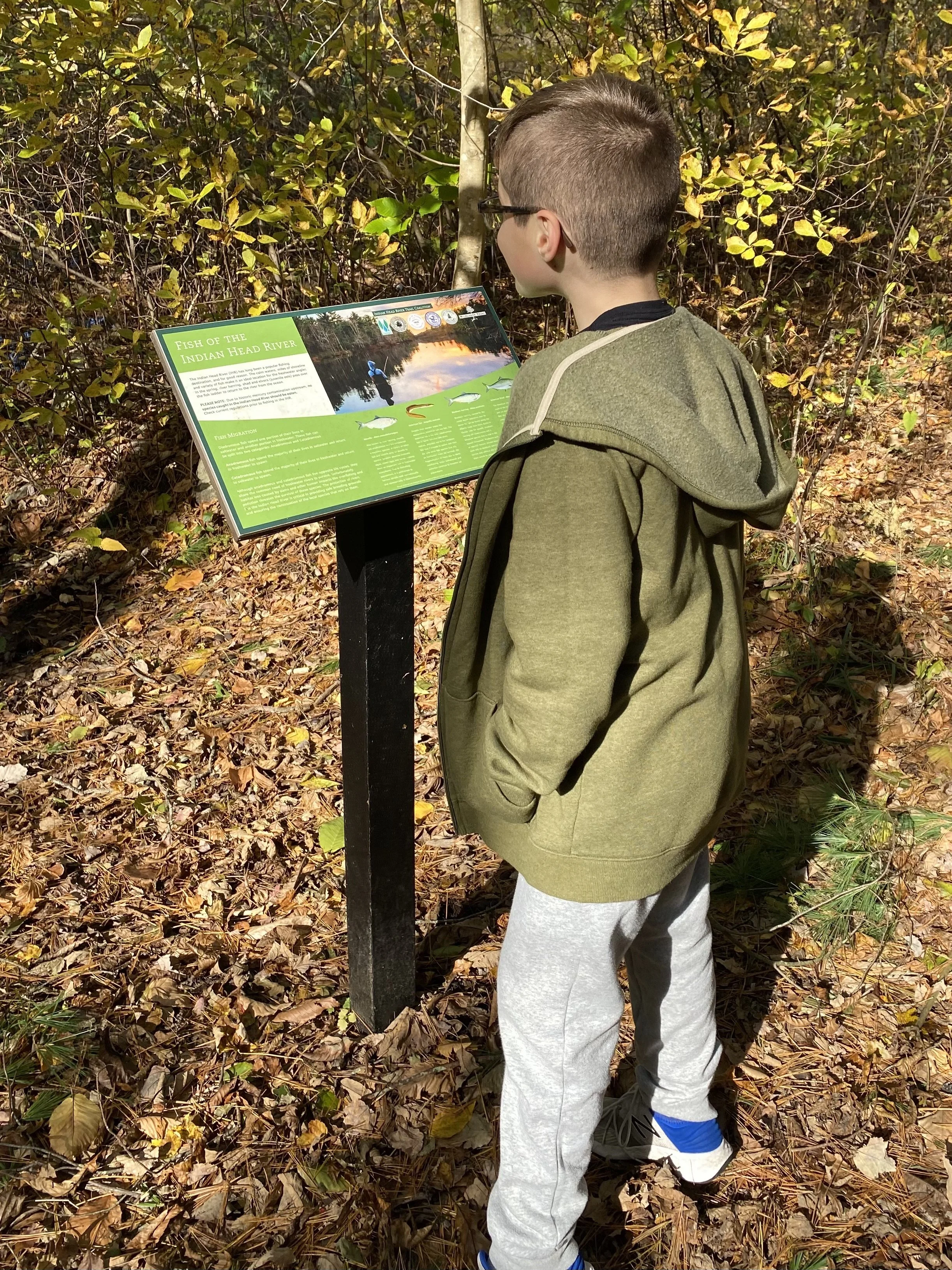
The Indian Head River Trail, a popular recreational trail system spanning the towns of Hanover, Hanson, and Pembroke, just received a 3-year makeover and it's ready for spring hiking season! The latest improvements welcome new and returning visitors with an enhanced trail experience for all.
In 2017, a group of landholding entities—the Pembroke, Hanover, and Hanson Conservation Commissions, Plymouth County, North and South River Watershed Association, and Wildlands Trust—formed the Indian Head River Trail Coalition (IHRTC) to preserve the historic and natural qualities of the Indian Head River and its surrounding lands, while also encouraging passive recreation in and around the river.
In 2018, the coalition was awarded a 3-year Massachusetts Department of Conservation and Recreation (DCR) Recreational Trails Program grant to expand and improve the Indian Head River trail system. Following completion of this work in late 2021, the area currently boasts six continuous miles of trail, connecting 325 acres of conservation land along the river. The neighboring trail systems of Wildlands Trust’s Tucker Preserve and Hanover’s Iron Mine Brook are now linked with the Indian Head River Trail, offering one complete loop incorporating the various conservation properties around the river.
The DCR funding supported both trail blazing and maintenance of existing trails to create the loop. In addition, it allowed for the installation of several new features, including: map holders and trail markers to improve navigability; signage providing ecological and historical information; 800 feet of “bog board” walkways over areas of trail deterioration; benches at scenic viewpoints; informational kiosks to welcome visitors at several entrances to the trail; and printed trail maps reflecting the newest changes to the expansive trail system.
In conjunction with the Indian Head River Trail Coalition, local volunteers provided critical assistance throughout the project. Led by Wildlands Trust’s director of stewardship Erik Boyer, volunteers from The Town of Hanover, Wildlands Trust, REI, the New England Mountain Bike Association (NEMBA), and a Hanover boy scout troop assisted with trail clean up, installation of trail enhancements, ongoing trail monitoring (through Wildlands’ Adopt-a-Preserve program), and guided hikes to introduce new visitors to the trail system. Assistance with historical content pertaining to the Mattakeeset Tribe was provided by Dr. Larry Fisher.




What Does It Mean to Be an Abutter?
By Amy Markarian, Senior Copywriter
Read Time: 5 min
By definition, an abutter is “a person who owns adjacent land.” When talking about conservation, this refers to anyone who owns property that shares a border with protected land. Sometimes, there are only a handful of abutters to a preserve, as may be the case in rural areas or when it is partially bordered by natural features (like the ocean or a river) or adjoining conservation lands. In other cases, particularly in more developed areas, one parcel of protected open space may be surrounded by several abutters. An example is when multiple residential properties border a preserve that lies within or behind a neighborhood. Regardless of the setting, it’s important for anyone who lives in proximity to conservation land to understand the unique benefits and responsibilities that come with being an abutter.
It’s easy to conjure a list of the benefits one enjoys when living close to protected land. Generally speaking, nearby property values are favorably impacted. Abutting landowners also benefit from access to open space and trails, and the natural landscape provides aesthetic value. Additionally, there is comfort in knowing that the environment surrounding one’s home will always remain in its natural state, without the threat of development. Wildlands is fortunate to have many positive relationships with our property abutters, who appreciate and respectfully enjoy the protected land they border.
However, not everyone understands the responsibilities that come with being a good neighbor to conservation land. Sometimes, according to Wildlands Trust’s Director of Stewardship Erik Boyer, “People don’t know who owns the woods behind their house, and they just don’t think to look into it.” This can lead to a number of challenges for organizations like Wildlands Trust, who are responsible for protecting the land. In some cases, an abutter’s lack of knowledge about the obligations of being a neighbor to a preserve can result in violations of conservation law. This is known as encroachment.
In general terms, encroachment is defined as the act of “trespassing upon the property, domain, or rights of another, especially stealthily or by gradual advance.” When property owners begin to use neighboring open space as an extension of their own yard, it is encroachment. Infringements can range from relatively minor and unintentional to significant and/or deliberate. Whatever the magnitude of the violations, they all threaten to damage natural environments and the wildlife that inhabit the area and, therefore, must be addressed. Erik points out that Wildlands Trust would much prefer to utilize our resources to maintain properties and trails for safe recreation than to address issues of encroachment from abutters.
What constitutes encroachment?
To prevent unintended violations, our stewardship team compiled a list of some of the problematic abutter behaviors that have been encountered on Wildlands’ properties, and the ways in which these encroachments threaten conservation land.
Dumping yard waste - This is one of the most common issues we see. People use neighboring woods to dump grass clippings and other yard waste, often with the misconception that, because the materials are “natural,” they don’t pose a threat to the environment. Unfortunately, the reality is that such materials are not at all conducive to native soil, and they are often treated with chemical fertilizers, insecticides, etc. that threaten both plants and animals.
Dumping trash - Man-made junk also gets thrown into the woods by homeowners or the contractors they hire. While most people (fortunately) don’t throw their household trash out the back door, it’s not uncommon to find items like scrap wood, shingles, and other unwanted items or equipment deposited on adjoining land. This creates both aesthetic and environmental issues.
Creating unauthorized trails and/or cutting trees to clear a scenic view - Cutting trees and clearing vegetation on conservation land is not allowed. Whether it serves to open up a homeowner’s view of a nearby pond or creates access from a neighborhood or private property to an existing trail system, without permission to do so, it is a violation. Wildlands welcomes volunteers to sign up and assist with trail maintenance on our properties, but reminds people that only Wildlands’ staff members are permitted to cut trees or create trails on our land.
Using motorized vehicles - ATVs, dirt bikes, snowmobiles, and other vehicles tear up trails, damage vegetation, and generate both noise and air pollution. They also pose a danger to other visitors passively recreating on the trails. Motorized recreational vehicle use is not allowed on any of Wildlands’ properties.
Building or digging beyond property lines - This is a significant and costly example of encroachment, whether it is done with the property owner’s knowledge or not. When building a shed or garage, or digging to install a driveway or pool, it is extremely important for abutting property owners to know the exact location of their property lines, and acquire appropriate permits before beginning such work. The permitting process alerts owners to applicable restrictions that may exist. Failing to obtain permits can have serious environmental consequences (especially when close to wetlands), and can become extremely costly and problematic for the abutter to resolve when violations are later discovered.
Hunting - While this is seldom an issue on our preserves, it is worth pointing out that owning property that abuts conservation land does not authorize someone to hunt on any land where it is not permitted. Doing so is unsafe for visitors and nearby residents, and it disrupts the natural habitat for wildlife.
As for what Erik most wants abutters to know, it boils down to, “Know the property lines and the rules of the adjacent conservation area, and be respectful.” Pay attention to posted regulations and don’t damage or remove informational signage. When issues arise, if necessary, conservation organizations have the law to fall back on, and pursuing litigation is an option. However, Wildlands’ stewardship team prefers to talk first, rather than jumping to a heavy-handed response. In the majority of cases, when people didn't realize their offense and wish to make amends, education and communication prove to be the best tools to resolve issues and maintain positive relationships with our neighbors.
