


What’s New at Wildlands
Books and History Converge at Hoyt-Hall: Former Landowner Honored By Family
By Amy Markarian, Senior Copywriter
Read Time: 5 min
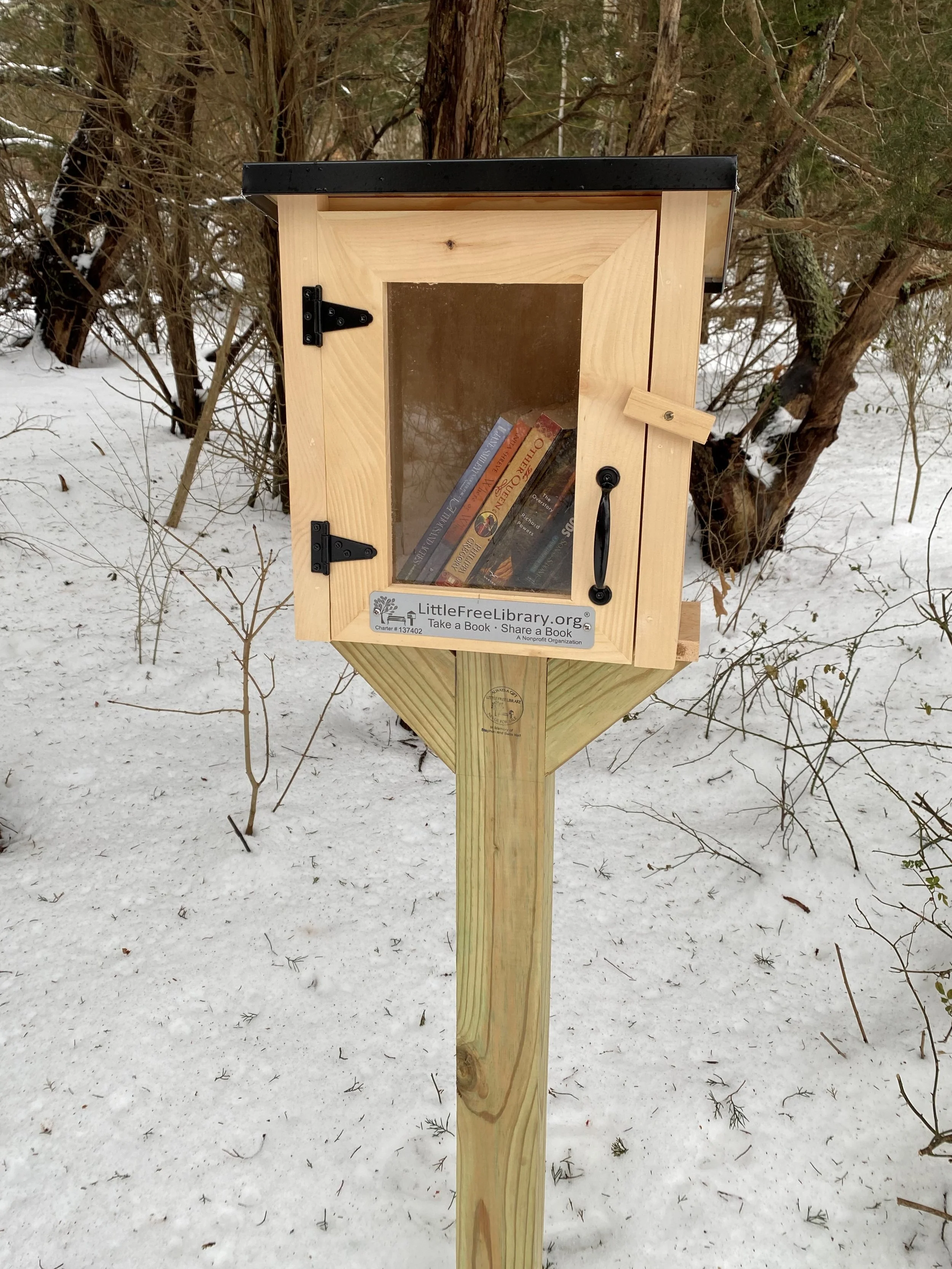
On January 23, just before a winter storm buried Hoyt-Hall Preserve under nearly two feet of snow, ground was broken for the installation of a new Little Free Library at the Careswell Street trailhead. The project was the brainchild of Steve Wood, who grew up spending time with family on the property once owned by his grandfather, Stephen Hall. To understand the significance of this meaningful gift, we traced back over 100 years to the Hall family’s early presence in the Marshfield community. Several family members shared their memories, creating a beautiful mosaic of memory, place, and kin.
In 1884, Walton Hall purchased the renowned Daniel Webster Estate (then called the Daniel Webster Farm) from Webster’s family. As its owner, Walton became a gentleman farmer, developing approximately 1000 acres of bogs and orchards along Webster Street and extending down to Green Harbor. According to his great-granddaughter, Michele Armour, when Walton died in 1928, his sons Lincoln and Lewis managed the farm and bogs. Later, Lincoln Hall bought the nearby property that is now known as Hoyt-Hall Preserve, where he lived and developed cranberry bogs that were utilized until the late 1960s. While the bogs that were once located on the Webster Street side of the property have since reverted to a natural state and the pond is no longer used for irrigation, evidence of the land’s agricultural history can be seen in the remnants of an old windmill on the property.
Michele remembers early childhood visits to this home – her grandfather piling the kids in the back of his truck and bumping down the unpaved road to the bog so they could help with the dry harvest of cranberries. After her grandfather’s death in 1969, Lincoln Hall’s son Stephen moved from Lexington to the Marshfield home, where he lived for many years with his wife Bella and daughter Michele. The couple’s older daughter Jackie was living on her own by then, but visited often with her young family–including sons Steve and Marc.
Stephen Hall had met his wife Bella in Paris, France, while serving in World War II. When the war ended and Bella emigrated to the United States with him, Stephen understood the challenges she may face and promised that her family would always be welcome to visit. Throughout their life together, Bella’s family members came to stay with them in Marshfield every year, often for extended visits, and once with as many as 14 people. Jackie and Michele got to know their distant relatives through these annual visits, and have profound recollections of time spent in the company of family on the spacious estate. Jackie’s sons, too, developed a close bond with their grandparents and other relatives there, spending holidays and vacations at the family home. With plenty of room for all, it offered a place for gathering and building connections with nature.
Both of Stephen Hall’s daughters have fond memories of their family’s outdoor adventures on the property – exploring the cranberry bog, the woods, and the pond that they used for fishing and boating. They remember, too, their father’s appreciation for the osprey that nested on the property. Stephen was a nature lover who spent a lot of time outdoors, clearing trails and observing wildlife. At the same time, according to Jackie, her father was also “enamored with, and knew just about everything there was to know about, Daniel Webster.” Having lived in the historic Daniel Webster House as a child, Stephen developed an interest that led him to become an avid Daniel Webster and Marshfield historian.
In his later years, Stephen Hall knew that the Careswell Street property meant too much to his family to risk being lost to development. When the family sold the land to Wildlands in 2000, he was comforted by the knowledge that it would be protected and beautified, with trails added for visitors to explore. According to Jackie, it meant a lot to her father to think that the land would be preserved and enjoyed by many. Michele considers it her father’s legacy to have the land protected in perpetuity, adding that the family couldn’t have asked for more than what it has become under Wildlands’ care today.
It is this sentiment that led Stephen Hall’s grandson, Steve Wood, to plan the donation of the Little Free Library at Hoyt-Hall Preserve this winter. He wanted to give back to Wildlands Trust for caring for the land his family loves, and the library is a gift that is both beneficial to visitors and meaningful for his family. Filled with intentionally selected books contributed by family members – about Marshfield, Daniel Webster, and wildlife – it honors his grandfather’s love of books and local history. Steve hopes the new little library will also foster a sense of community among preserve visitors through book sharing.
Little Free Library is a non-profit organization that supports the creation of small, weatherproof kiosks for donating and borrowing books. Steve Wood first saw a Little Free Library at a cafe near his home in Dorchester. After learning more about the initiative to promote reading, he installed well-utilized Little Free Libraries at both his home and the hospital where he works. This winter, Steve contacted Wildlands with his idea to install another one at Hoyt-Hall. Wildlands currently has Little Free Libraries on two other preserves - Willow Brook Farm, in Pembroke, and Brockton Audubon Preserve, in Brockton - and stewardship manager Owen Grey knew this addition would reach many people who come from all over the South Shore to hike at Hoyt-Hall Preserve.
We are thrilled that visitors will benefit from this meaningful gift, and we are equally grateful to have the opportunity to build lasting relationships with families through the preservation of land. Land conservation truly is about so much more than the number of acres on a map. Wildlands Trust serves individuals, families, and communities in order to help landowners fulfill the wishes they have for the natural spaces they care about. This process lays the foundation for relationships that last through generations. We are grateful to Steve Wood and the family of Stephen Hall for being a part of the Wildlands community!


Eagle Scout Project Benefits Wildlands' Great Neck Conservation Area
By Amy Markarian, Senior Copywriter
Local Eagle Scout Ethan Nardone and his team of volunteers, along with the Southeastern Massachusetts and Cape Cod chapters of the New England Mountain Bike Association (NEMBA) installed an impressive 240 feet of bog boards at Great Neck Preserve, in Wareham this month! This 24-inch wide wooden “bridge” is designed to accommodate both hiking and mountain biking. It allows trail users to avoid mud and standing water, and limits the impact of pedestrian and bike traffic on the trail and surrounding environment.
Nardone planned the workday for his Eagle Scout Service Project, recruiting volunteers and fundraising for the project. NEMBA’s generous contributions provided both financial and physical support. In coordination with Wildlands’ Director of Stewardship, Erik Boyer, Nardone’s friends and family, biking team members from a local school, members of both NEMBA chapters, and Wildlands staff and volunteers spent the day carrying lumber and tools onto the trail, then assembling the bog boards on site.
The new bog boards are a fantastic addition to the trail at Great Neck Preserve, and Wildlands is grateful to benefit from this outstanding collaboration!
Photo credit: SEMass NEMBA Chapter President, Tommy Walker


A Life Remembered: Memorial Bench Dedicated to Wildlands’ Volunteer at Halfway Pond Preserve
By Amy Markarian, Senior Copywriter

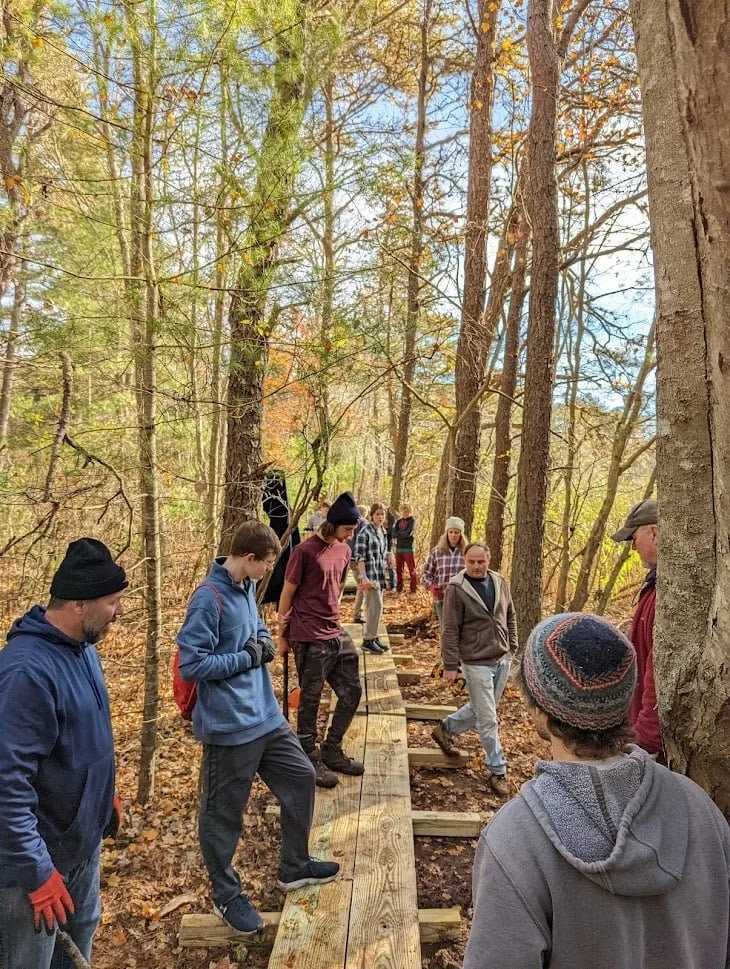
On October 15, a group of friends, family members, and Wildlands’ staff members gathered to celebrate the life of Wildlands’ volunteer, Pat O’Rourke. It was a morning spent remembering a mother, grandmother, sister, and friend. Stories were traded over breakfast, and a hike through Halfway Pond Preserve led the group to a simple wooden bench overlooking a cherished view from the trail. There, a plaque was installed to dedicate the bench in Pat O’Rourke’s memory.
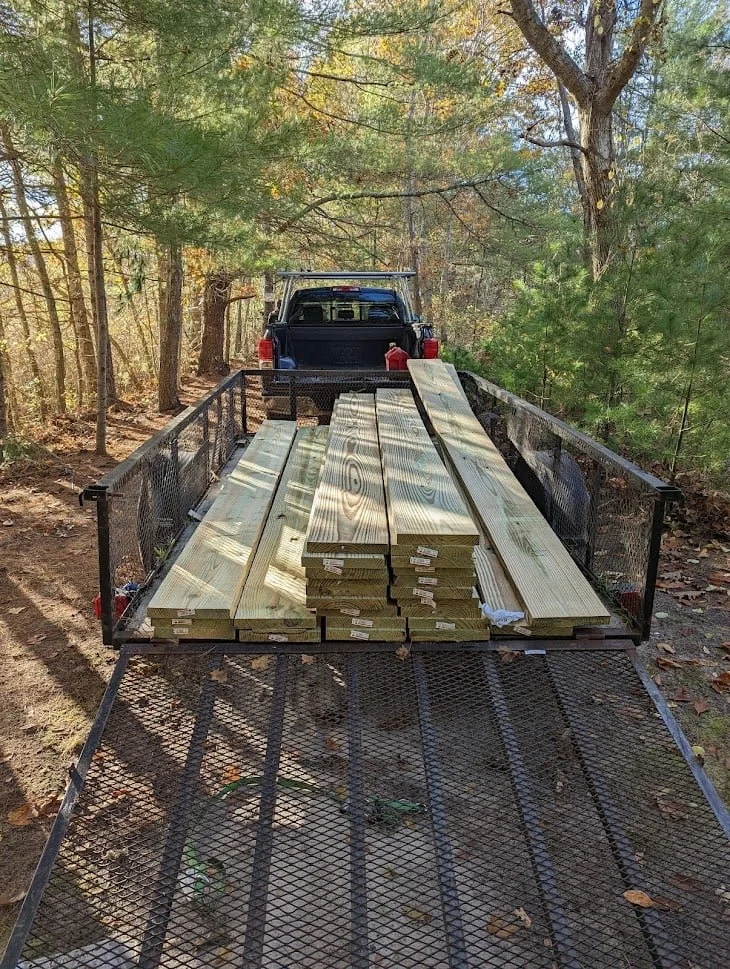
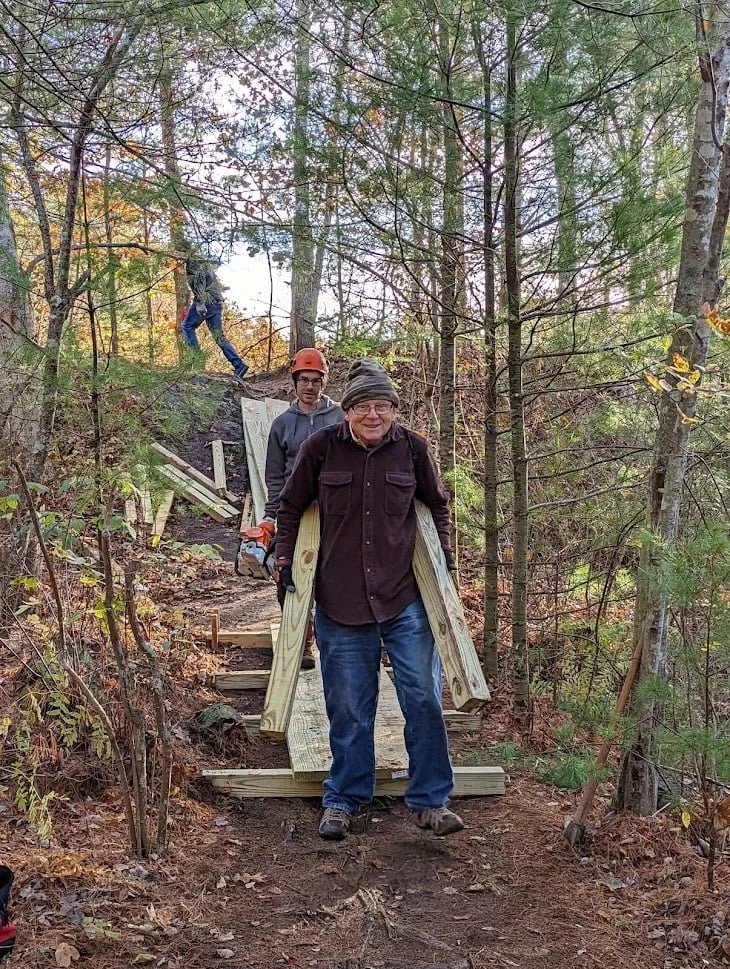
In the years before her death, Pat had been both a Wildlands Trust volunteer and an active member of the Friends of Halfway Pond hiking group. She spent countless hours enjoying nature and the company of friends on the same trails walked in her memory that morning. In 2019, one of Pat’s contributions to Wildlands had been to assist in carrying a volunteer-made wooden bench through the woods to its home along the trail. Its purpose was to provide a resting spot for visitors who traverse the hilly path--a place to pause and appreciate the scenic overlook of Halfway Pond.
Pat had deeply valued Plymouth’s natural spaces and the community of friends who shared her enthusiasm for outdoor recreation. Her family recognized this and, after her passing, presented Wildlands Trust with a generous donation in her memory. As a token of Wildlands’ appreciation for Pat’s many contributions, and for the gift that was received from her loved ones, a memorial plaque was installed on the bench that she had carried, ensuring that her memory will continue to live on in the woods she so enjoyed.
At the dedication ceremony, Pat’s son Mike spoke in remembrance of his mother, as did Wildlands’ President and Executive Director, Karen Grey. Fellow volunteers and hiking friends Marilynn Atterbury and Betsy Hall also eulogized their friend and shared Robert Frost’s poem, “Stopping By Woods on a Snowy Evening,” which is quoted in the plaque’s inscription. Pat's brother Jack highlighted the synchronicity of his sister’s longstanding fondness for beech trees and the towering beech that shaded her bench with yellowing autumn leaves. At the close of the ceremony, participants followed the trail back out of the woods, reflecting on Frost’s words:
The woods are lovely, dark and deep.
But I have promises to keep.
And miles to go before I sleep.
And miles to go before I sleep.
For her friendship and commitment to our community, Wildlands gratefully remembers Pat O’Rourke.


Your Trash is Not Welcome Here!
By Amy Markarian, Senior Copywriter
You look outside your window and see the sun shining, a slight morning breeze cools the air. It’s a perfect day to stretch your legs on your favorite local conservation area trail. Fresh coffee in hand, you arrive with overwhelming appreciation for the beauty that abounds. You step out of your car and approach the trailhead and, in an instant, your splendid surroundings are transformed into a DUMP.

This scenario, unfortunately, is not uncommon in southeastern Massachusetts. For years, local officials, private landowners, and conservation organizations have fought an uphill battle against illegal dumping on undeveloped land. Often, the items dumped on roadsides and in the woods are those that are either expensive to dispose of legally, require a special permit that may not be available to purchase on site (when items are already loaded in a vehicle and ready to be dropped off), or are considered hazardous waste items that are not routinely accepted at transfer stations. In at least some cases--based on where materials have been found-- it seems that polluters’ intentions may have been to properly dispose of the items. But, when doing so was discovered to be costly or inconvenient, a nearby open space was found to drop the load instead. Plymouth’s expanse of undeveloped lands and unmonitored road frontage, sadly, have historically made for easy dumping grounds in these situations.
All too often, according to Wildlands Trust’s Director of Stewardship, Erik Boyer, “it seems, people view conservation land as an easy place to get rid of things.” Sometimes it’s malicious, sometimes it may not be, but it always has a negative impact on the land and those who use it. Because of the harmful implications for wildlife and water sources in areas where dumping takes place, Wildlands Trust is actively taking steps to deter polluters.
In January, Wildlands' stewardship team was alerted to a massive pile of trash that had been left at one of our Plymouth preserves. Located close to a road in a town-managed cemetery, but within the boundaries of Wildlands’ adjacent conservation land, were 40 to 50 bags of household trash and various appliances left in a sprawling heap. The sheer quantity of debris to be removed made it clear that this was going to be a costly cleanup. However, it was discovered that several items had attached mailing labels containing one person’s name and address.
Our stewardship team notified the Plymouth Police, and an investigation led to criminal charges being filed against the responsible party. MA General Law - Part IV, Title I, Chapter 270, Section 16, states:
“Whoever places, throws, deposits, or discharges...trash, bottles or cans, refuse, rubbish, garbage, debris, scrap, waste or other material of any kind on a public highway or within 20 yards of a public highway, or on any other public land, or in or upon coastal or inland waters...or within 20 yards of such waters, or on property of another, or on lands dedicated for open space purposes, including lands subject to conservation restrictions and agricultural preservation restrictions...shall be punished by a fine of not more than $5,500 for the first offense and a fine not to exceed $15,000 for each subsequent offense…”*
In this case, where the responsible party was identified, charges were pressed and the law was utilized to ensure that the burden of time and expenses associated with the cleanup would not be shouldered by a non-profit conservation organization. The Plymouth County District Attorney’s office is currently seeking restitution from the offender for the costs associated with Wildlands’ safe removal of all of the items.
Wildlands Trust hopes that this situation will serve as a reminder to others that dumping is illegal, it is detrimental to our land, water supply, and wildlife, and it will not be tolerated. We will continue to work collaboratively with the Plymouth Police Department to ensure that our community’s natural spaces remain beautiful and safe for all.
(*https://malegislature.gov/Laws/GeneralLaws/PartIV/TitleI/Chapter270/Section16)

Kingston Dam to be Removed Using State-Awarded Funds
By Amy Markarian, Senior Copywriter
KINGSTON– On July 28, Wildlands Trust received a $729,000 state grant to remove the Sylvia Place Pond dam in Kingston, MA. The award will allow the conservation group to improve public safety in the area and to restore fish passage by conducting a breach of this significant hazard, poor-condition dam.
Governor Charlie Baker announced the 2021 Office of Energy and Environmental Affairs Dam and Seawall Program grant recipients from Gloucester’s Haskell Pond Dam on Wednesday. 28 grantees, including the conservation group and 27 cities and towns across Massachusetts, will receive more than $17 million to help repair failing dams, seawalls, and levees. Since the grant program’s inception in 2013, more than $95 million have been provided to address the state’s aging structures.
Wildlands Trust’s Executive Director, Karen Grey, says, “We have to be concerned with how severe storm activity is taking a toll on aging infrastructure. With this funding we can now eliminate the growing public safety issues to residents living downstream of this dam.”
Sylvia Place Pond is nearly surrounded by Wildlands Trust’s 27-acre Stewart/Person Preserve, in Kingston. The Sylvia Place Pond Dam has outlived its usefulness as an historic impoundment for mill power and ice harvesting. It is part of a series of interconnected manmade ponds that were originally constructed to supply power to nearby mills. There is a herring ladder at the north end of the pond that allows fish to complete their annual trek upstream for spawning in nearby Russell Pond. The area is also home to such wildlife as red fox, otter, mink, deer, osprey, and great blue heron.
Wildlands Trust is a non-profit organization dedicated to conserving land and preserving the natural heritage of Southeastern Massachusetts. The organization works to permanently protect and steward important habitats and landscapes, including woodlands and fields, ponds, coastal areas, agricultural lands, and river systems. Founded in 1973, Wildlands Trust has worked to protect nearly 13,000 acres of open space in 48 Massachusetts towns.
