


What’s New at Wildlands
Native Plant Garden in Plymouth Dedicated to Deborah Wood Davis
Read Time: 3 min
By Amy Markarian, Senior Copywriter
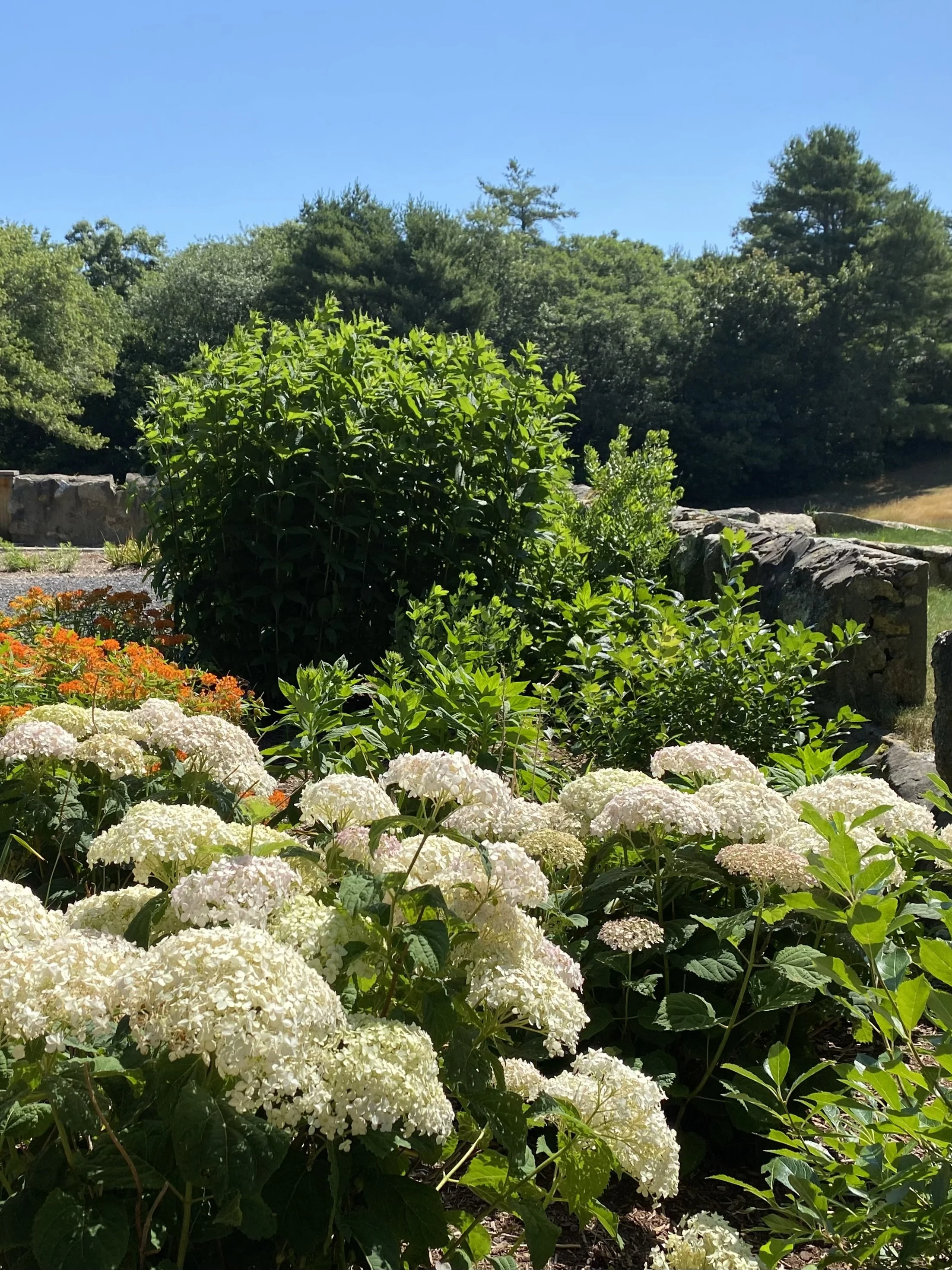
On Saturday, July 9, at 10:30am, before the morning sun invited summer’s characteristic heat and humidity, approximately 70 community members gathered at Wildlands Trust’s headquarters on Long Pond Road to dedicate the property’s native plant garden to a longtime supporter of the Trust’s mission, Deborah Wood Davis.
Deborah Wood Davis married into the family of Howland Davis, the previous owner of the land that is now Wildlands’ Davis-Douglas Conservation Area. Her family recalls Deborah’s great affection for the area and, according to her daughter Caroline Chapin, she was excited by Wildlands’ mission and the way it drew the community together. So, when Deborah’s five daughters were looking for a way to honor their mother and the strong roots and connections she had established here, they came to Wildlands Trust.
Sarah Geer, one of those daughters, approached Wildlands’ President and Executive Director Karen Grey to discuss the idea at just the right time. Wildlands had been struggling with the desire to maintain some component of the property’s historic barn, but its crumbling foundation walls and the steep drop from ground level to its interior depth posed hazards that had to be addressed. Simultaneously, local landscape architect Love Howard had also reached out to Karen with the idea of designing a pollinator-friendly garden using native plant species that would support the local ecosystem, and she was looking for a location where she could bring the idea to life. The Davis family’s gift to honor their mother provided the needed support to begin the process of converting the unsafe barn foundation into a showcase garden and educational tool at Wildlands’ headquarters.
The project, according to Karen, “brought together need with opportunity and allowed us to make meaningful connections for people, which are always the best type of projects.” In the fall of 2020, after structural work was completed, the first plants were added by a group of volunteers—including some of Deborah’s daughters, Wildlands volunteer and Board Member Marilynn Atterbury, and others—under Love’s guidance. Today, Marilynn continues the work, along with Wildlands’ gardener Kim Goggin, carefully maintaining and enhancing what is often called “the foundation garden.”
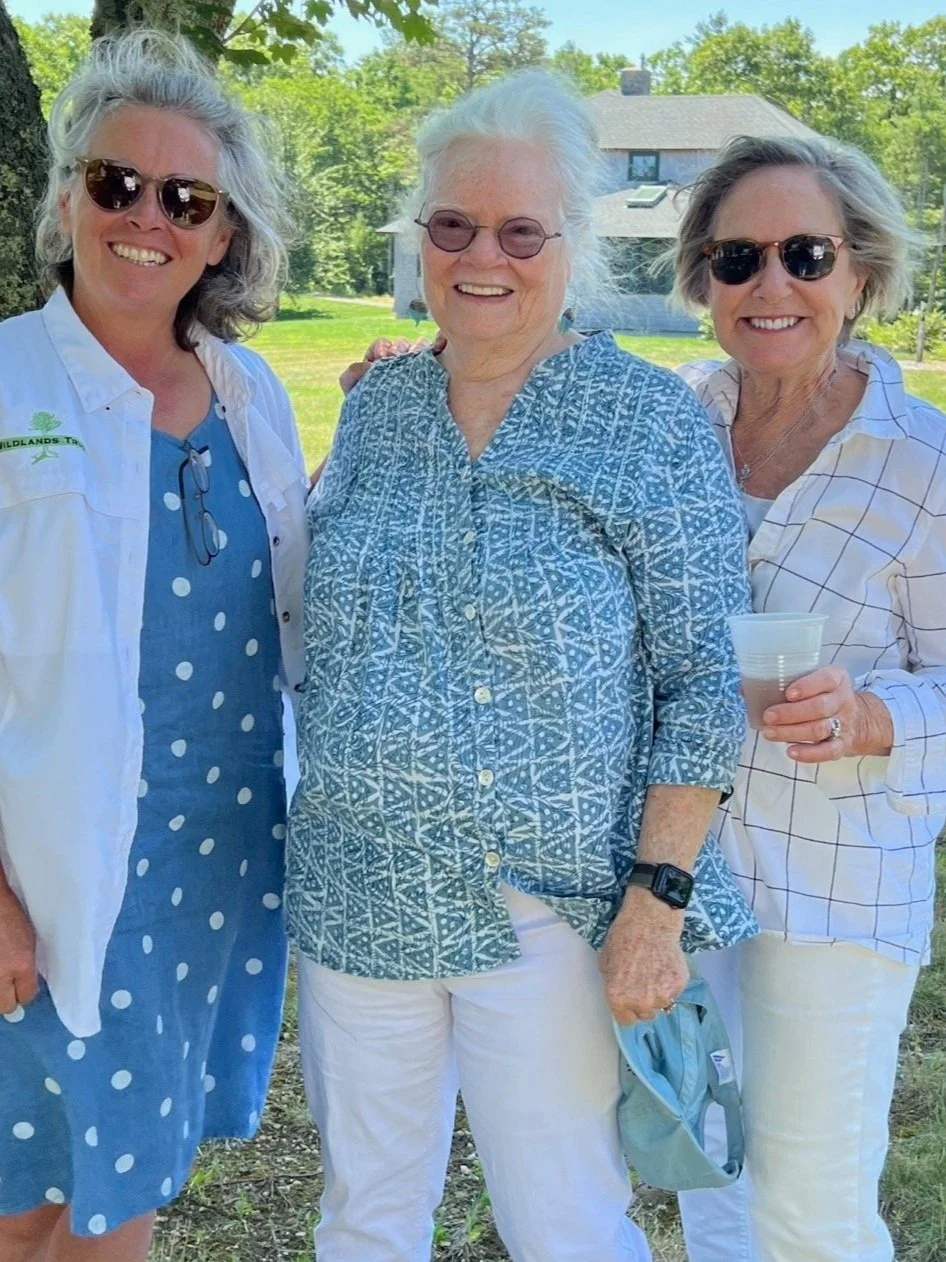
On the morning of the dedication ceremony, the gardening team’s hard work and meticulous care were on full display for the large crowd that had assembled for the occasion. In what would have been Deborah Davis’ 100th year, according to Caroline, the family organized a mini reunion around the dedication ceremony, bringing all five daughters, spouses, children, and almost all of the grandchildren and great-grandchildren together in Plymouth—a gathering of community that would likely have brought the family’s matriarch great pleasure. Also in attendance were several of Wildlands’ staff members, Board members, and supporters. Karen Grey addressed the group with gratitude for all who contributed to the project, Sarah Geer shared reflections of her mother, and Love Howard described her inspiration and plan for the garden’s creation. As the ceremony concluded, with a comfortable breeze under bright blue sky, the flitting of bees and butterflies entertained visitors as they reminisced and explored the newly dedicated Deborah Wood Davis Native Plant Garden.





Spring Has Sprung...Earlier Than Usual?
Read Time: 3 min
By Mitchell Hennings, Land Steward for Wildlife & Habitat
You may have noticed on your outdoor walks and adventures that this year’s trees, shrubs, and flowers began to greet you much earlier in the season, blooming and filling in the gray and brown spaces of the woods with their intricate flowers and leafing patterns. If you noticed this, you might have also wondered why this occurs. Are the plants confused? Are their calendars mixed up? Or is something much larger at play that is influencing plant behavior across the country?
Plants can sense subtle changes within their environment, whether it be early rain or lack thereof, increased photoperiods (longer exposure to the sun), frequent disturbances, or intense weather events. These variables impact how plants progress through their stages of growth to sprouting leaves, fruiting, or developing flowers. Yet, if the timing involved in these processes is off by days or even weeks, like we are now experiencing, there can be untold impacts on the plants whose growth is regulated by it.
This year, plants began to leaf out and fill our forests and roadsides with green earlier than usual, but these growing plants are not naturally occurring in our environment. Plants like Honeysuckle, Bittersweet, Autumn Olive, Multi-Flora Rose, Barberry, and Norway Maple all leaf out much faster than our native plants. These invasive plants had either full leaves or were beginning to bloom before native plants and trees had even begun to produce leaves. The faster phenology of the invasive plants is a clear competitive advantage over the native plants, as they have longer flowering periods and a higher chance of attracting pollinators and going to seed sooner (Kherberger & Holzschuh 2019). This behavior puts increased pressure on native plants to adjust their flowering period earlier in the season, but this may prove to be even more of an issue. If these native plants adjust their flowering period, they could then be impacted by sub-optimal temperatures, low pollinator activity, and a higher chance of dying off (Kherberger & Holzschuh 2019).
Another well measured variable that has been found to contribute to the forward progression of early leaf onset is the decrease in precipitation events. An article published in the journal Nature details a study conducted to understand the impacts of precipitation on native and nonnative plants and how those complex interactions impact leaf onset date, which is when plants produce leaves (Wang et al. 2022). When there are decreased precipitation days, there are also decreased cloudy days to allow for radiation absorption by the plants, which is what signals plants to begin producing leaves (Wang et al. 2022). You don’t need to be a scientist to notice the decrease in rain over the years during the spring season. The adage “April showers bring May flowers” used to ring true ten or twenty years ago, but in today's climate, it looks like flowers bloom in early April, leaving May irrelevant.
Sources:
https://www.nature.com/articles/s41598-019-51916-0
https://www.sciencedaily.com/releases/2022/02/220217155232.htm


Vandalism Threatens Shorebirds at Shifting Lots Preserve
Read Time: 2 min
By Amy Markarian, Senior Copywriter
We are disappointed to report that, for the second year in a row, we are experiencing significant vandalism at Shifting Lots Preserve, in Plymouth. Wildlands' protective fencing that surrounds the shorebird nesting areas, as well as signage informing visitors that dogs are not allowed on the beach, has been damaged and/or removed by visitors on several occasions this spring. The fencing and signs are both critical tools we use to ensure the safety of protected birds on our preserve.
As many of you know, Shifting Lots provides important habitat for Piping Plovers, which are listed as Threatened on both the Massachusetts and Federal Endangered Species Lists, and Least Terns, which are listed as a Species of Special Concern in Massachusetts and are protected under the state Endangered Species Act (MESA).
We know that the Wildlands community cares about local wildlife as much as we do. So, we are asking you to join us in making sure that such acts of vandalism do not continue. If you observe anything unusual and/or see vandalism to our fencing or signage at Shifting Lots Preserve, please take photos and/or videos and reach out to the Plymouth Police Department with the information as soon as possible. We appreciate your support in the protection of these vulnerable species!
(Read Executive Director Karen Grey’s letter to Shifting Lots’ neighbors here.)


Shifting Lots' Shorebirds Are Counting on You!
Read Time: 1 min
By Amy Markarian, Senior Copywriter

The Piping Plovers are back at Shifting Lots for the 2022 season! Protective fencing was installed around the birds’ nesting area at the end of March by staff and volunteers from Wildlands Trust and the Friends of Ellisville Marsh. The shorebirds are expected to begin laying their first eggs in early May, and will remain at the preserve throughout the summer months.
In preparation for the birds’ annual return, Wildlands’ staff and volunteers set up information tables at various times throughout the month of March, talking with visitors and providing informational materials about the value of wild beaches and marshes, the ways we manage the land to support wildlife, and how visitors’ actions can help to protect this important habitat. In case you missed this on-site educational opportunity, our team has created a short summary to provide you with all the “need-to-know” information about Shifting Lots Preserve and its shorebird protection.


A Celebrity in Our Midst: Rare Eagle Spotted in Protected Lands Surrounding the Lower Taunton River
By Amy Markarian, Senior Copywriter
Read Time: 9 min
Chances are, if you’ve seen the news at all over the last several weeks, you may have heard about the now famous Steller's Sea-Eagle that paid a visit to Southeastern Massachusetts in December, and has since been putting on a show in coastal Maine. If you’re not an avid birder, and you haven’t followed this avian saga, you may be wondering why this is big news. After all, our region is fortunate to be home to a number of Bald Eagles and a variety of other spectacular birds. What, then, is so significant about this particular bird and the time it spent along the Lower Taunton River in December? To find out, we turned to two of Wildlands’ own board members, Greg Lucini and Wayne Petersen, who each offer a unique perspective on this remarkable drama that’s got everyone rooting for a magnificent, wayward bird from Russia.
On Saturday, December 18, Greg Lucini looked out his kitchen window at the sweeping view of the Taunton River beyond his yard. A familiar fallen tree branch that rests on the river bottom was visible, as it always is when the tide is low, but the large raptor resting on it was clearly different from the Bald Eagles that often perch there to fish. The enormous size and distinct markings of this bird captivated his attention throughout the weekend, as it set up camp high in the trees on the opposite side of the river and periodically took flight to explore the area’s offerings or catch a meal. Unbeknownst to Greg, some other local bird watchers had also spotted the conspicuous visitor, and had shared the news among local birding networks. When Greg glanced out his window on Monday morning, he was shocked to see what he described as hundreds of people gathered on the riverbank at nearby Dighton Rock State Park. Even if he might have been inclined to dismiss the uncharacteristic crowd of onlookers, their presence from sunrise to sunset on such a chilly winter day piqued his curiosity. He walked over to see what the commotion was all about, observing license plates from Pennsylvania, New York, and all of the New England states.
An excited buzz filled the air as the observers traded information about the bird, its movements along the river, and its unbelievable backstory. They noted that its size dwarfed that of the Bald Eagles sitting on nearby branches, and that the black and white pattern of its plumage and bright yellow-orange toucan-like beak made it stand out like Rudolph in a herd of reindeer – recognizably similar, yet clearly not the same. Curious neighbors mingled with avian enthusiasts and experienced ornithologists, and everyone was friendly and happy to discuss their understanding of the significance of the moment. Greg, who is attentive to the local wildlife surrounding his Berkley home, soon discovered that this unfamiliar visitor that had caught his eye was, in fact, a very long way from home.
What do we know about this bird?
Steller's Sea-Eagles are massive birds of prey that weigh up to 20 lbs. and can have a wingspan of up to 8 feet. In their native habitat, they are coastal birds that feed on fish and small waterfowl, with a preference for large river mouths. They are typically found in the Russian Far East and Southern China, or in northern Japan, where they migrate for the winter. The excitement about this particular bird comes as much from the story of its exceedingly long journey as it does from the unexpected opportunity for the local birding community to see the uncommon species in person. According to Wildlands’ board member, Wayne Petersen, who is the director of the Massachusetts Important Bird Area (IBA) Program for the Massachusetts Audubon Society, several distinctive features of the bird’s plumage indicate that it’s “virtually unequivocal” that it is the same Steller's Sea-Eagle that has been dazzling birders all over North America for over a year!
Countless articles and videos now trace the epic journey that this lone bird has undertaken since it left its distant home last summer. Wayne and others theorize that it may have made its way into North America by island hopping down the Aleutian Island chain from Siberia into mainland Alaska, where it was first spotted along the Denali Highway in August 2020. Seven months later, it is suspected that the same individual was seen and photographed in Texas, before eventually making its way north to New Brunswick, Canada, and then the Gaspe Peninsula on the Saint Lawrence River, in Quebec, this past summer. In November, the adventurous bird was spotted again in Nova Scotia, before it ultimately reappeared in Southeastern Massachusetts in mid-December.
Unconfirmed reports suggest that the eagle may have been in the area of the Lower Taunton River for about a week before the news broke on 12/20/21, but the social media-fueled frenzy about the once-in-a-lifetime sighting took hold among the New England birding community that Monday morning and continued into the days that followed. Since then, word has spread across the country, showing up in local Massachusetts newspapers, on Alaskan radio stations, and in countless media outlets in between– including the Boston Globe, New York Times, Newsweek, CNN and NPR, to name a few.
But, long before most people even realized that they might want to drop everything and make their way to the Taunton River to catch a glimpse of this rare beauty, the Steller's Sea-Eagle had already taken off for parts unknown. By Tuesday morning, when the adoring crowds arrived again, the bird was gone. And though many people searched the skies of Southeastern Massachusetts throughout the week, sadly, the celebrity eagle did not return. (Remarkably, it was spotted again a week later…this time in the vicinity of Georgetown, Maine).
Why did it end up here?
While the unlikely path of this avian odyssey makes for a pretty interesting story in itself, many people are still wondering: why did it end up here? To address that question, Wildlands’ board members offer two explanations: one scientific, the other hypothetical.
Wayne explains that this bird undoubtedly fits the definition of “avian vagrancy,” which is when a bird is found considerably beyond its usual range. He says most cases of vagrancy can be attributed to either storms, such as hurricanes, or a faulty inherited navigation system that causes persistent disorientation for the bird. To explain this, he uses the counterexample of a robin that builds a nest under the same porch year after year. In this case, the bird demonstrates strong home site fidelity and also winter site fidelity, which allows it to find its way back to those two places using a similar path year after year. Given the distance traveled and the probable time elapsed since the vagrant eagle was last in its home territory, Wayne feels confident that the bird most likely lacks the inherent ability to polarize its nesting home territory and its proper wintering location to allow it to navigate back and forth between the two. He adds, “It clearly has an ability to navigate…but simply not to the right places. It likely has a faulty orientation system that didn’t let it know to go to northern Japan in the winter.” Because of this, he says, it is unlikely (though not impossible) that the bird may ever find its way back to where it belongs. It is homeless and appears to be unequipped with the tools needed to correct its course.
And while this reality tugs at the heartstrings of those following the eagle’s journey, all hope is not lost for this bird. It has been determined to be an adult, based on specific characteristics of its plumage. Wayne notes that, “Despite having a serious problem of seemingly not knowing where to go, it clearly has an ability to navigate from place to place, and an ability to catch fish and scavenge carrion along the way.” He adds, “It can’t get to be this age (at least four years-old) without doing so.” Caught up in the bird’s plight, some have asked if it would be possible to catch it and transport it back to where it belongs. Wayne’s answer to this is two-fold. First, he points out, “It’s not as simple as setting up a net at a bird feeder to capture a raptor that’s practically the size of a Volkswagen”-- the task would be challenging. But, beyond that, he says, “Even if it could be done, it might not stay there anyway, and would possibly end up in the same situation again because of its faulty orientation system. We can reasonably assume that it would likely be significantly handicapped in its ability to stay on track in the future.” This eagle is clearly a survivor, however, and authorities have determined that it should best be left to continue on its way without interference. Whatever direction it may go, the bird’s final chapter is probably yet to be written.
Whether the Steller's Sea-Eagle finds its way back to where it started or continues to accumulate worldly adventures is a question that only time will answer. But the matter of where the bird is likely to be seen next brings us back to Greg Lucini’s thoughts about why, of all places, it decided to visit his backyard in Berkley, MA. According to Greg, he can’t help but think that the bird’s chosen location was not entirely arbitrary, and that the Taunton River and its surrounding conservation lands made for an opportune landing spot. In 2009, the river was nationally designated by Congress as a Wild and Scenic River, for its “outstanding resource values,” which include–among others–ecology and biodiversity.
For more than two decades, Wildlands Trust has been instrumental in preserving land around the lower Taunton River, partnering with private landholders, towns, other non-profit organizations, and state entities such as the Massachusetts Department of Conservation and Recreation and the Massachusetts Department of Fish and Game. In the immediate vicinity of the eagle’s temporary home, Wildlands holds a conservation restriction on privately owned land, owns and manages two preserves, including the 77-acre Puddingstone Preserve, contributed to the expansion of neighboring Dighton Rock State Park, and assisted with DCR’s acquisition of what is now Sweets Knoll State Park, located about one mile upstream, in Dighton.
From the perspective of a local landowner who fully appreciates the many natural assets of the Lower Taunton River, Greg believes that the abundance of wildlife – including the presence of several Bald Eagles that have taken up residence along the river in recent years – may have provided somewhat familiar faces to attract the Steller’s Sea-Eagle, while the thriving ecosystem of the undeveloped land offered a conducive environment for the visitor to pause along its journey.
Of course, we’ll never really know why this famous feathered traveler decided to grace us with its majestic presence last month. But we’d like to think, like Greg, that Wildlands’ efforts to preserve ecologically significant landscapes and provide habitat for various wildlife species could have been a contributing factor in the Steller's Sea-Eagle’s decision to visit Southeastern Massachusetts.


