


What’s New at Wildlands
Historic Hanover Field Permanently Preserved
By Amy Markarian, Senior Copywriter
HANOVER – On Friday, July 23, 2021, a months-long collaboration between regional conservation group, Wildlands Trust, and the Town of Hanover culminated with the purchase and permanent protection of Sylvester Field. Encompassing a small pine grove and 660-feet of frontage on Third Herring Brook in Hanover’s Four Corners neighborhood, Sylvester Field’s highly-visible 10-acre meadow and stone wall bordering Washington Street is a cherished part of the town landscape. It has both historical and ecological value, and has long served as an agricultural, recreational and aesthetic resource for the community.
In May, with support from the Hanover Open Space Committee and the Hanover Historical Commission, residents of Hanover unanimously approved the use of $250,000 in Community Preservation Act funds to purchase a permanent Conservation Restriction on the field. With this partnership, along with the generous contributions of 307 individual donors, Wildlands Trust was able to act quickly on the rare opportunity to purchase this highly-valuable parcel of open space in Hanover.
“It was an incredible effort, with hand-delivered mailings, personal solicitations, a farmers market, banners, signs, field tours and more, which continued unabated until the goal was reached!” marveled Sue Chamberlain, Wildlands Trust’s Donor Relations Manager. According to Chamberlain, this grass-roots effort proved critical for the success of the project. A core group of 16 volunteers, led by Four Corners resident, Caleb Estabrooks, raised $150,000 to be combined with a $200,000 matching gift from a generous donor. This community-generated funding supplied half of the total cost of the land in just six months.
Most recently known to many locals as Robinson Field, the last property owner was Clayton Robinson, who died in March 2020. Under his family’s ownership, a mowed path was maintained around the edge of the field, and local residents have long-enjoyed walking past the tall grass, through the pines, and down to the water’s edge. After his death, Robinson’s cousin and estate representative, Debbie Lincoln, was an important advocate among family members for the preservation of the scenic open field and the continued public use of its frequently-visited walking trails.
When presented with the opportunity to preserve this land, Wildlands Trust immediately recognized the ecological value of Sylvester Field. The property is home to numerous wildlife species, both common and rare, and provides an extensive riparian habitat along the Third Herring Brook, an important tributary of the larger North River.
Under Wildlands Trust’s ownership, Sylvester Field will be maintained in its current state. The field-edge walking trails will remain and annual mowing of the field itself will continue. The addition of a small parking area and an informational kiosk will improve accessibility for public enjoyment of the preserve.
Long before European arrival, Native Americans occupied the area, including the field, which lies at a strategic location near the confluence of Third Herring Brook and the North River. In the mid-1600s, it was owned by William Barstow, who is believed to be the first European settler in the area. It later became part of a larger farm, changing hands to the Stockbridge family and then the Sylvester Family. When the Sylvester family sold much of the farm in the 1940s, Betsey (Sylvester) Robinson purchased this parcel to save it from development. The land continued to be used for agricultural purposes for many years, including the grazing of Hornstra Farms cows and the production of hay, before settling into its latest role as a scenic resource for the community.
Wildlands Trust is a non-profit organization dedicated to conserving land and preserving the natural heritage of Southeastern Massachusetts. The organization works to permanently protect and steward important habitats and landscapes, including woodlands and fields, ponds, coastal areas, agricultural lands, and river systems. Founded in 1973, Wildlands Trust has worked to protect nearly 13,000 acres of open space in 48 Massachusetts towns, including: Great River Preserve, in Bridgewater; Brockton Audubon Preserve; Cow Tent Hill Preserve and Cushman Preserve in Duxbury; the Nook in Kingston; Hoyt-Hall Preserve in Marshfield; Willow Brook Farm in Pembroke; and the Davis-Douglas Conservation Area in Plymouth.

Another Important Milestone for the Sylvester Field Project
Thank you to the citizens of Hanover!
On the evening of Tuesday, May 4, 2021, Hanover Town Meeting unanimously approved a request for $250,000 in Community Preservation Act funds for the Historic Sylvester Field preservation project. The town will use the funds to purchase a permanent Conservation Restriction on the field.
Wildlands will use the town’s contribution to help fund its purchase of the property from the Estate of Clayton Robinson. We are working toward a closing in July.
Kudos to Open Space Committee Co-chair Hal Thomas for his outstanding presentation of the project to Town Meeting. Thanks also to Hanover Historical Commission Chair Peter Johnson for his informative presentation evoking the Field’s rich history.
Situated in Four Corners, one of Hanover’s oldest villages, Sylvester Field is one of Hanover’s most cherished scenic, agricultural and historic resources, and a true community touchstone. The Estate of Clayton Robinson has generously afforded Wildlands and the town the opportunity to preserve the field, and our ongoing preservation effort is an example of how public and private partners can collaborate to achieve substantial conservation outcomes.
We also want to thank all of the private donors who have supported the project thus far. There’s still an opportunity for new donors to support the project, as we are working to raise the last $60,000 we need to meet our private fundraising target. You can donate to the project at: https://wildlandstrust.networkforgood.com/projects/124001-save-sylvester-field
Thank you!

Volunteers Cleanup Pembroke, Hanover, Hanson Preserves
On April 24, volunteers led by members of the Indian Head River Coalition banded together to remove trash along the banks of the Indian Head River, Rocky Run, and North River, as well as from the conservation properties they run through.
Volunteers initially met at Luddam’s Ford Park (Hanover) prior to breaking out into groups that would focus on five locations selected at conservation lands in Hanson, Hanover and Pembroke. Volunteers in Hanson cleaned along State Street and Rocky Run, with a notable find being an old TV they pulled out of the river. Three locations were selected in Hanover for groups to canvass, including Water Street, the Luddam’s Ford Park parking lot and Chapman’s Landing. In Pembroke, volunteers cleaned-up Luddam’s Ford Park (Pembroke) and Tucker Preserve.
In total, 25 bags of trash were removed from these areas. Items collected included everything from bottles, cans, mylar balloons, furniture cushions, and even a steel oil tank! Thank you to everyone who volunteered their time and spent the day with the Coalition in order to help keep the river system clean and healthy.


About the Indian Head River Coalition
The Indian Head River Coalition was created in 2017 for the purpose of preserving the historic and natural qualities of the contiguous conservation lands along the Indian Head River and engage the general public in taking advantage of passive recreational opportunities on these properties. The Coalition is composed of Wildlands Trust, the North and South Rivers Watershed Association, and the towns of Hanover, Hanson and Pembroke. In 2018, the group obtained a Recreational Trails Program (RTP) grant to provide trail maintenance, trail markings, amenity improvements, and new kiosks and interpretive signage along the 6-mile trail corridor that runs through and connects each property.
Annual Fencing Goes up at Shifting Lots

In preparation for the expected uptick in visitation at Shifting Lots Preserve, Stewardship Manager Erik Boyer and Wildlands volunteer and board member Marilynn Atterbury spent a day out on the property this past week installing temporary fencing along the dunes. This work is done in tandem with the Friends of Ellisville Marsh, who install fencing along the front portion of the property in order to protect the nesting sites of piping plovers and least turns.
In addition to creating space around the nesting sites to prevent scaring the birds away, the fencing also helps visitors avoid accidentally stepping on their eggs when walking along the shore. Just as we ask visitors to stay on trail at our wooded preserves, we ask that if you visit the property, please be mindful that this area is an important habitat for the survival of these creatures and keep out of the fenced-off areas. As in past years, this fencing will remain up until October.
If you’d like to learn more about threatened shorebirds at Shifting Lots and Cape Cod, you can check out the recording of our recent Zoom presentation on our website: https://wildlandstrust.org/wildlands-online.
Indian Head River Trail Enhancements Continue Thanks to the Efforts of Many
Following centuries of changes along the Indian Head River, the towns of Pembroke, Hanson and Hanover work together with Wildlands Trust to improve the surrounding trail system with a MassTrails Program grant.
By Community Stewardship Program Manager Conor Michaud
Rivers are the multi-tool of the natural world, harnessed by people, they support burgeoning populations and have played a key role in shaping our civilization. Before industrialized society, rivers were free-flowing. Unobstructed by dams and development, these waters naturally deposited nutrients and sediments along the river corridor, housed essential native breeding grounds for migratory fish and provided for a biodiverse ecosystem. Today, free-flowing rivers are globally threatened, with only several remaining in Massachusetts and the North River being the only one in Wildlands’ service region.
What remains of the Waterman Tack Factory dam rest along the shores of the IHR.
The Indian Head River (IHR), a tributary of the North River, was transformed from its free-flowing state centuries ago. Throughout the 17th century and up until the early 20th century, the IHR fueled the local economy and proved an invaluable resource. As industry left the river, mills eventually ceased production, dams collapsed and the forges cooled. The train which once ran along the shoreline is long gone, its former path converted into a nature trail some years ago. For nearly four miles, the river now flows peacefully through Pembroke, Hanover and Hanson, and in many places, large swathes of the riparian corridor and forests have been conserved to help protect this treasured habitat.
In 1993, Wildlands was gifted Tucker Preserve in Pembroke, one of Wildlands’ most popular conservation areas. The northern side of Tucker sits against the IHR, affording hikers stunning views and fishing access, while the southern upland forest showcases shady hemlock stands and old rock walls, vestiges of former agricultural land. The three towns through which the IHR flows — Pembroke, Hanover and Hanson — have each conserved land along its banks and in 2018, Pembroke received funding from the Department of Conservation and Recreation’s MassTrails Program to improve the trail system on the surrounding conservation lands and increase public stewardship along the river. Over the last two years, Wildlands has managed the IHR Trail Project for the town, working with representatives from Pembroke’s conservation commission, Hanover and Hanson’s open space committees, Hanover’s Department of Public Works, and the North and South Rivers Watershed Alliance to enhance the 4-mile trail loop encircling the IHR.
The Indian Head River flowing east from State Street.
Adequately protecting the IHR, its riparian areas and nearby upland forests requires more than trail stewardship though, it requires volunteer contributions and the devotion of local residents who will continue to assist in conservation efforts long after the MassTrails grant is complete. Throughout the IHR Project, Wildlands has focused on public outreach through guided hikes, volunteer trail work events and recruitment of volunteers to our Adopt-A-Preserve program. From these efforts, a tremendous amount of volunteer support has been shown, with over $7,000 of volunteer match time collected. Most recently, local photographer Andrew Lederman generously donated his time and skills to document the preserve’s natural beauty, as well as the remnants of the IHR’s former industrial life (featured in this article). Earlier this spring, Hanover’s Department of Public Works assisted Wildlands in creating a formal parking area along Water Street, a welcome addition as trail usage continues to grow, and this summer, Wildlands will work with a boy scout from Hanover to install new trailhead kiosks and educational signs along the trail system.
Massachusetts has a long industrial history, from the massive farming culture during the 18th and 19th centuries, to mills and factories that dammed our rivers, altered the landscape and ultimately shaped our communities. The IHR Conservation Area and the IHR Trail Project are opportunities for us to study our industrial past and the impacts of having manipulated the formerly free-flowing river. The IHR Conservation Area provides a space to track the native fish species which struggle to navigate the Luddam’s Ford fish ladder, shedding light on the impacts of dams and the benefits of protecting natural free-flowing rivers. Most importantly, the IHR Trail Project demonstrates a collaborative success and the importance of spanning town boundaries to protect what little conservation land remains in our rapidly developing towns.
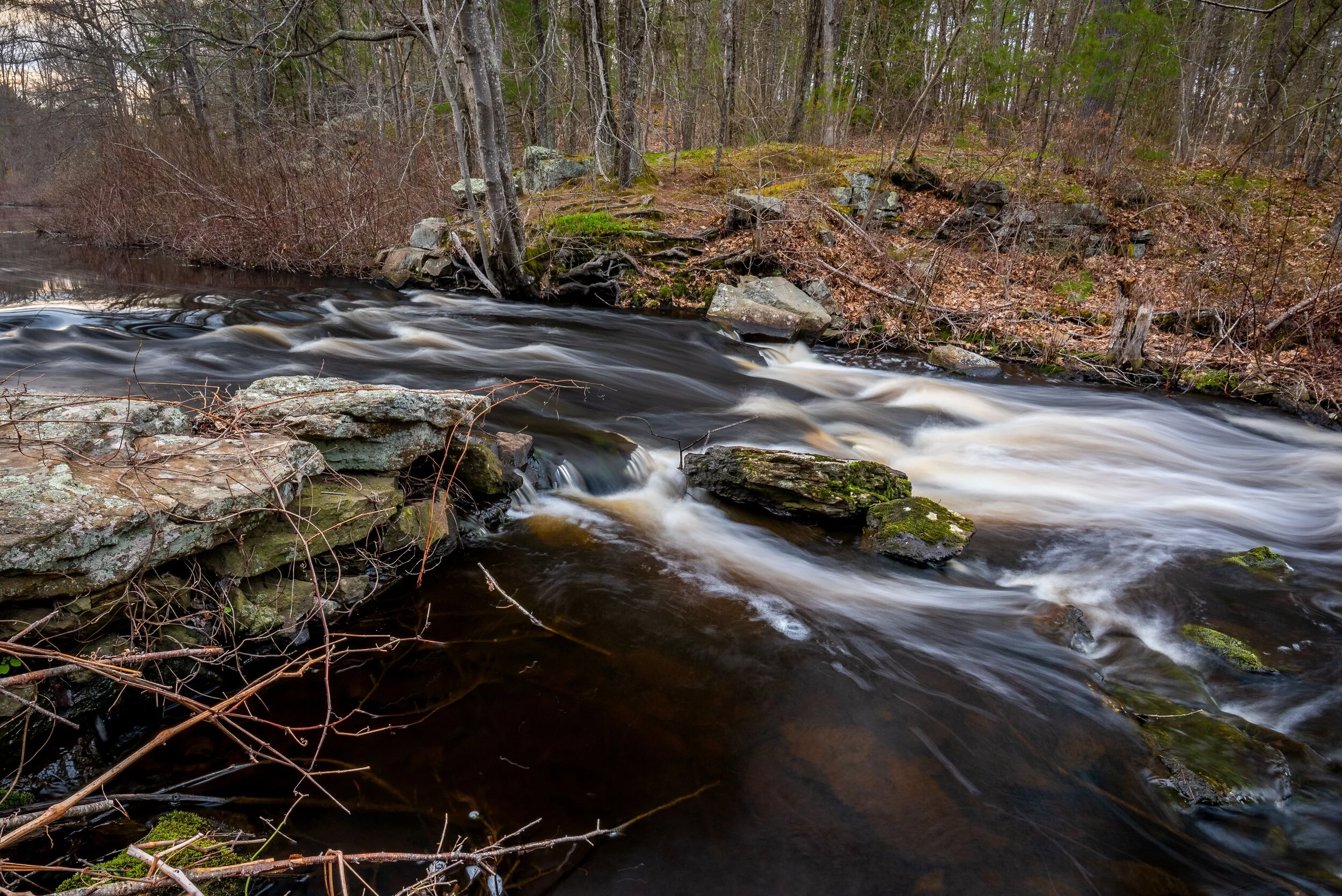

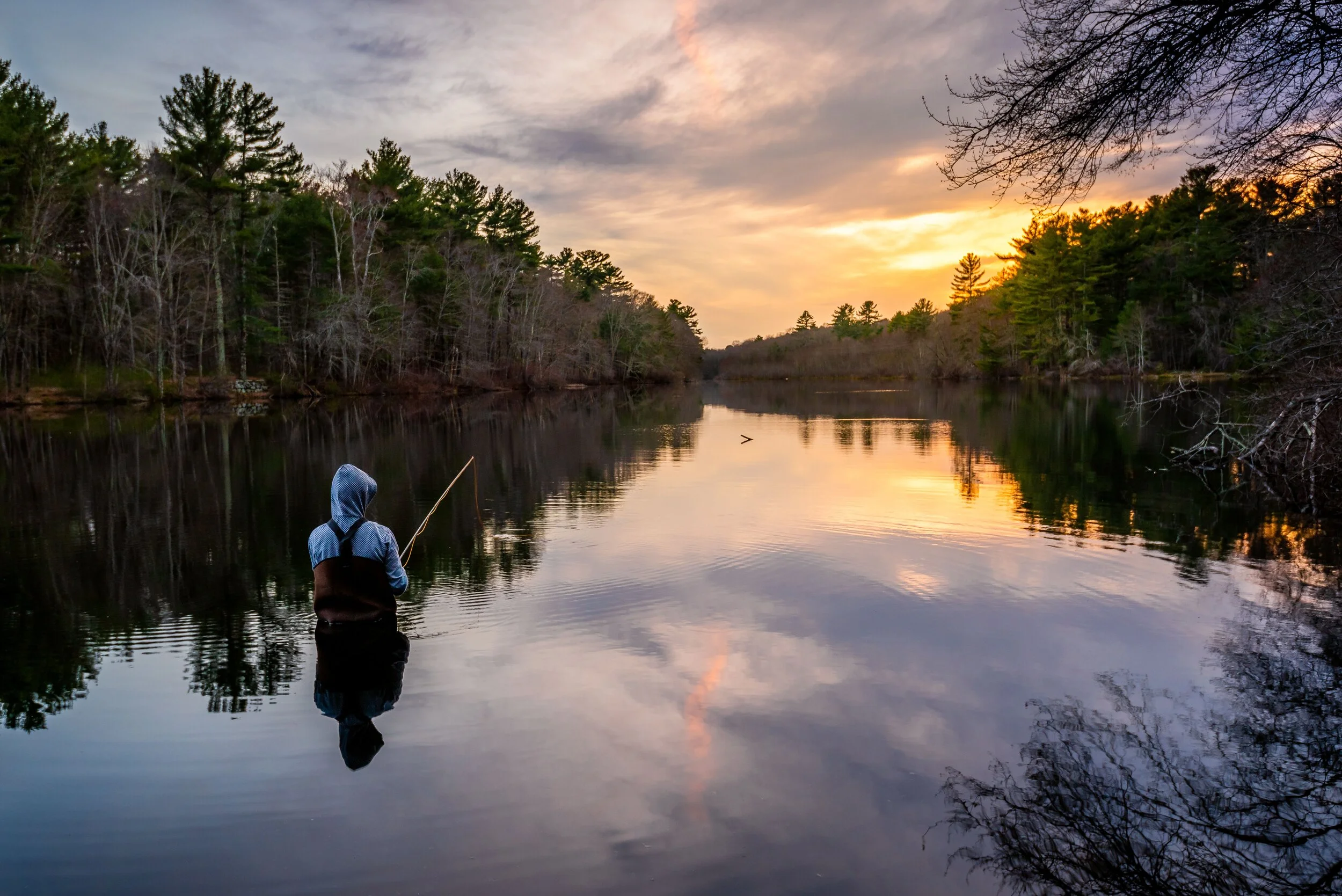
The Indian Head River is an incredible resource and outdoor enthusiasts, anglers and families seek its utilities all year long. Offering miles of trails, fishing, picnicking and water craft recreation, the IHR stands out as a top nature destination in the South Shore. With the recent COVID-19 pandemic, Wildlands has seen a surge in trail users. On weekends, the parking lots are often filled and the shores are lined with hopeful fishermen and women. Wildlands reminds you to please stay on marked trails, pickup and carry out your dog’s waste, and respect fellow hikers by following social distance guidelines. Our work at Tucker Preserve and the IHR is successful because of our dedicated volunteer base and the people who respect these natural spaces. If you are interested in learning how you can help protect your conservation land please send us an email (info@wildlandstrust.org) or give us a call (774-343-5121).