


What’s New at Wildlands
Willow Brook Updates Begin
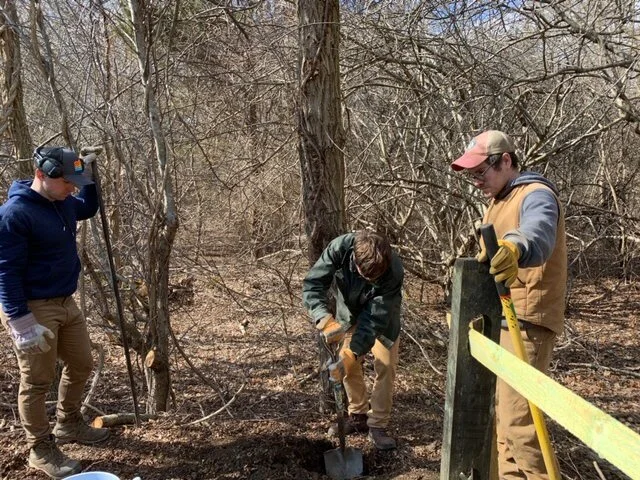
Wildlands stewardship staff, with the help of volunteers, begin improvements at Willow Brook Preserve in Pembroke last month. New split-rail fencing was installed in the parking lot, creating a clear outline of the lot and protecting the surrounding vegetation from vehicles and foot traffic. Funded by a grant through the Recreational Trails Program, the scheduled work will both improve the visitor experience at the preserve and the various habitats throughout the property.
Volunteers also spent time at Wildlands’ headquarters building 10 blue-bird boxes, which will be installed in the coming months in the fields at the 167 acre former dairy farm. Benches and bog boards will also be built and installed along the trail system. The bog boards will lift visitors up off of the more well-used portions of trail, allowing for the restoration of eroded sections and protecting the surrounding habitat.
Also keep an eye out for new educational signage along the trails which will provide information on different plants and animals found on the property. Visitors and groups will be able to lead self-guided nature lessons and have the chance to see the plants and animals while they read about them.
Together with the adjacent Herring Run Historical Park and Misty Meadows Conservation Area, these three contiguous properties comprise nearly 400 acres of public conservation land and provide habitat for a number of plants and animals. The beauty of this preserve makes it a popular spot to visit on the South Shore. We greatly appreciate the dedicated volunteers who have been helping us complete these projects and we are excited for visitors of the preserve to benefit from these improvements in the coming months.
Enhancing the Region Through Conservation
As a regional land trust, Wildlands Trust’s work throughout the South Shore benefits the fabric of our communities in many different ways.
By Membership and Communications Manager Roxey Lay
It’s a new year and with it comes a new year of projects, land acquisitions, public programming and more, all in the name of conservation. Since 1973, Wildlands Trust has committed to conserving and permanently protecting native habitats, farmland and lands of high ecological and scenic value that serve to keep our communities healthy and our residents connected to the natural world. And every year, you and many other supporters like you, make this work possible by renewing your commitment to Wildlands. But why do we do this work? Why are land trusts important?
The state of Massachusetts lists on its website five reasons why land conservation is “critical in preserving and enhancing the quality of life in Massachusetts.” [1] Read on to see how Wildlands’ work directly benefits our region and the residents who call it home.
Protection of water resources
Clean water is essential to any community. Nearly every property within Wildlands’ portfolio contains some type of water resource and a key factor in conserving these ecologically significant properties is that doing so protects against contamination. When water flows over the ground, it can potentially pick up a number of pollutants, “which may have sinister effects on the ecology of the watershed and, ultimately, on the reservoir, bay, or ocean where it ends up.” [2] Those pollutants can also soak into the ground and contaminate groundwater, “where it will eventually seep into the nearest stream…or into underground reservoirs.” [2] By conserving properties that contain and/or abut hydrological resources, Wildlands is able to limit the potential for pollution of those resources and habitat.
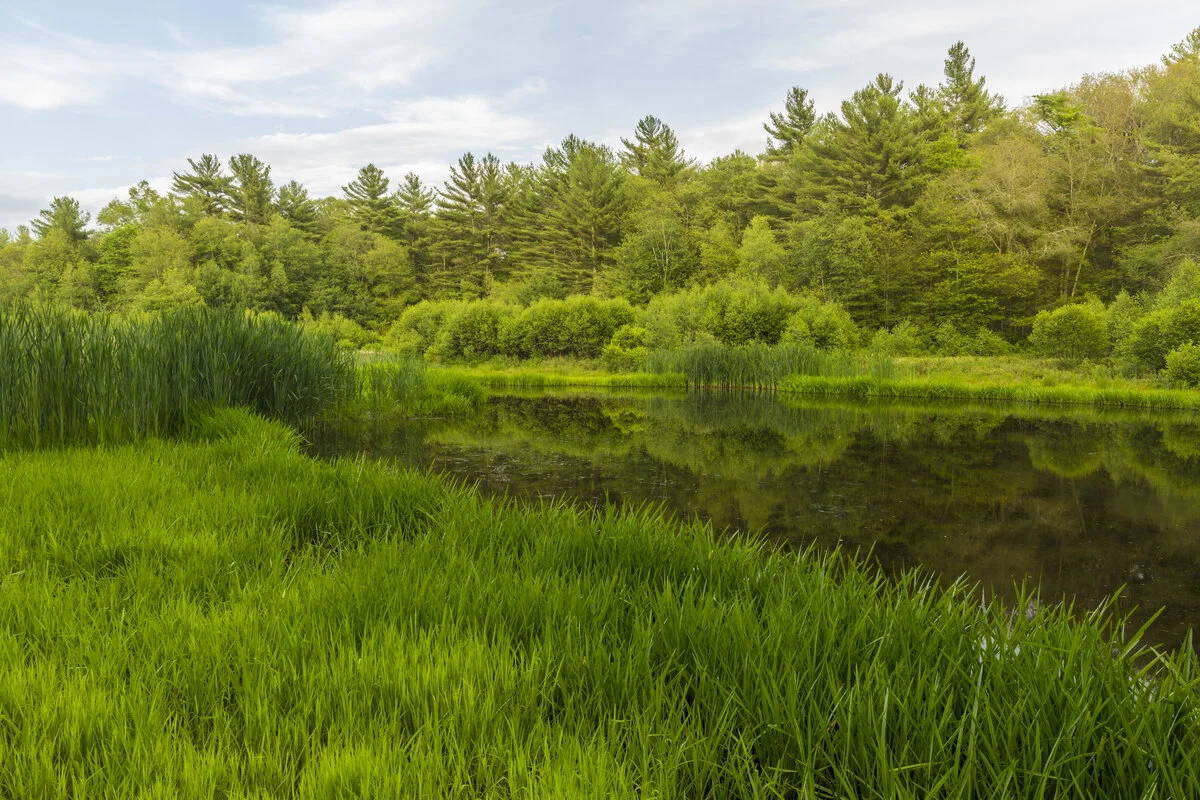
Wetlands at Striar Conservancy, Halifax.
Striar Conservancy in Halifax runs along the Winnetuxet River (identified by the National Park Service as one of the top four priorities for conservation along the Upper Taunton River) and combined with the town of Halifax property on the other side of the river, preserves 250 acres along the Winnetuxet. Striar is also host to vast wetland habitat, which, in addition to providing habitat to a number of local species, filters water running along the ground before it enters the river. “Wetlands are filters for water coming off the land, reducing sediment and chemicals in run off before it gets into open water. These chemicals and sediment could kill fish and amphibian eggs, smother bottom feeding wildlife and plants, and clog waterways.” [3]
If water resource protection is something you feel strongly about, you aren’t alone; clean water is a concern for the majority of Americans. In the 2019 Gallup Environment poll, 53% of respondents worry “a great deal” about the pollution of rivers, lakes, and reservoirs and 56% worry “a great deal” about pollution of drinking water. By supporting Wildlands Trust, you are helping keep critical water resources clean.
Providing open spaces and parks for our urban communities
Wildlands’ service region covers 45 towns throughout Southeastern Massachusetts. In Brockton, Wildlands staff have taken on a number of projects since first acquiring Brockton Audubon Preserve in 2012, ranging from land stewardship, tree planting, and youth education. In 2019, Wildlands worked with the city to restore and manage Stone Farm Conservation Area. Together, these two properties provide residents with 230 acres of open space for outdoor recreation, as well as health and environmental benefits that come with having access to public open space:

Hikers head out on a guided hike at Stone Farm Conservation Area during its grand opening at Brockton Nature Festival. (October 2019)
A sanctuary for escaping high summer temperatures and finding shade under a protective canopy.
Access to an open, living laboratory that provides opportunities for environmental education.
Maintaining habitat species biodiversity in Brockton.
Trees trap and store carbon from the atmosphere, as well as keep the city cooler.
In addition to our growing presence in the city, Wildlands’ community outreach manager, Conor Michaud, has recently been asked to serve on the city’s open space planning committee. Wildlands looks forward to continuing outreach efforts within the city and connecting residents to the land.
Creating and enhancing outdoor recreation opportunities statewide
Wildlands Trust’s monthly programming and events provide residents and visitors throughout Southeastern Massachusetts opportunities to experience the open space we protect. Offering a variety of options, participants can go on a general or themed hike, take a yoga or guided meditation class, get creative with arts and crafts projects, attend an educational presentation, and more.

Attendees watch intently during “Eyes On Owls”, a live owl presentation at Davis-Douglas Farm.
Wildlands’ public preserves are also host to trail systems that are inclusive to visitors of varying abilities. Trails can range from gentle field walks like at Cushman Preserve in Duxbury, to more challenging and hilly terrain like at Halfway Pond Conservation Area. In Bridgewater, the 125 acres comprising Great River Preserve (a vital link in a 1,400-acre stretch of river corridor) contains a handicap-accessible entrance and a wheelchair-accessible path leading from the property’s fields to the Taunton River.
With programs tailored to appeal to a number of interests and preserves with a wide-range of trail systems, Wildlands works to connect everyone to the natural world.
Interested in joining in on the fun? Find upcoming Wildlands programs and events at wildlandstrust.org/events or check out a trail map at wildlandstrust.org/trails
Preserving working farms
Wildlands’ portfolio contains a number of properties with Agricultural Preservation Restrictions (APR). This restriction protects the property from non-agricultural development and ensures it remains in a state of active agriculture. School House Field at Eel River Preserve is an example of how Wildlands partners with local farmers to help them find land while also maintaining the active agricultural status of a property. The most recent partnership on this land is with local brewery owner Paul Nixon, who has been growing hops on the property since 2018.

Cows graze in the fields at Anderson Farm, West Bridgewater.
Wildlands also works with state and town governments on APR projects. In 2004/2005, Wildlands brokered the deal to preserve the 145-acre Historic O’neil Farm in Duxbury. The restriction placed on this property, which has “been in continuous agricultural use since the early 1700’s” [4] and remains as the last working dairy farm in Duxbury, ensures it will continue to operate as a farm in perpetuity. In 2010, Wildlands also helped save the 116-acre Anderson Dairy Farm in West Bridgwater by working with the Massachusetts Department of Agriculture, town of Bridgewater, and the Anderson family to place an APR on the property. The farm’s importance lies not only in its significance to the town’s farming heritage, but also in its location. The property sits along the Town River (a tributary to the Taunton River) and Hokomock Swam (the largest freshwater wetland in Massachusetts), which provides habitat for various wildlife. Most recently, Wildlands is again working with the town of Duxbury, this time to save the 17-acre Herrington Farm.
The connection between Wildlands and local farms extends into its youth programming as well. During the summer, Wildlands’ Green Team members visit local farms like Bay End Farm in Bourne to learn about organic vegetable farming. Team members take part in the entire farming process, helping out with planting, weeding, harvesting and processing various crops. At Soule Homestead Education Center in Middleborough, team members assist in invasive species removal in pastures and learn about animal husbandry.
Protecting wildlife habitat
Prior to Wildlands acquiring a property, there are a number of criteria it must meet, such as outstanding or noteworthy ecological significance. Lands that fit this criterion contain rare or unusual habitat types, provide habitat for rare or endangered species, contribute to local and regional habitat diversity, and/or possess a BioMap Core Habitat or Supporting Natural Landscape designation.
Rich with diverse river habitat, including marshes and seepage swamps, along the Winnetuxet River, Striar Conservancy supports a variety of local species like the uncommon river otter, wood duck, woodcock, and ruffled grouse. The 168 acres of undeveloped land comprising the preserve also provides habitat for deer, fox, over 90 species of birds like the upland sandpiper and barred owl, as well as state-listed rare species, like the bridle shiner, Coopers hawk, and Mystic Valley amphipod.

Halfway Pond peaks through pine trees at Halfway Pond Conservation Area, Plymouth.
Halfway Pond, at Halfway Pond Conservation Area, provides habitat for the federally endangered northern redbelly cooter (formerly known as the Plymouth redbelly turtle), and also supports six mussel species, including two state-listed rare species. Southeastern Massachusetts is also host to the Massachusetts Coastal Pine Barrens, a unique ecoregion which can be found on Wildlands’ Plymouth properties. This specific habitat is critical to the survival of a number of species. In fact, “the Massachusetts Department of Fish and Wildlife has state-listed 182 species of plants and animals in the Pine Barrens ecoregion as endangered, threatened or a species of concern.” [5]
Climate Change
With nearly 10,000 acres of land in Wildlands’ portfolio, it has become increasingly important for Wildlands to consider the resiliency of these lands and the region overall. In 2019, Wildlands added a criterion into the organization’s mission statement which focuses on climate mitigation and the adaptation potential of a property acquisition. The intention of this benchmark is to help the organization identify lands that contain habitats which are expected to be affected by climate change more so than others (cold-water streams, tidal marshes, and vernal pools).
Wildlands has also incorporated this outlook into its current holdings. While creating this new criterion, Wildlands analyzed the properties currently in its portfolio, created a vulnerability assessment for each one, and a hybrid management strategy. Through the direct protection of critical climate-resilient habitats, adjacent land parcels, and modifying current management practices, Wildlands hopes to increase the region’s overall resiliency to climate change.
Supporting land trusts like Wildlands Trust is not just about protecting land, it’s about enhancing the quality of life within your community. The benefits that come from land protection and the organizations that serve that purpose, extend out into multiple aspects of our region and set an example for other parts of the state, country and world. We thank you for your dedicated support and look forward to continuing to enhance the beauty and health of Southeastern Massachusetts for years to come.
How can you help enhance the quality of life in Southeastern Massachusetts with Wildlands Trust?
From Farmland to Grassland
How Wildlands’ management of former farmlands provides a reliable habitat for pollinators and other wildlife throughout the South Shore.
By Membership & Communications Manager, Roxey Lay
When you think of a Wildlands Trust preserve, you may immediately think of trails that lead visitors throughout woodlands to explore the undeveloped pockets of the region. What you may not think of immediately are fields. In addition to the wooded areas Wildlands protects, there are also a number of former farms, managed by stewardship staff to remain as open grasslands. Habitats like these fields tend to disappear in this part of the state, either through development, the installation of solar fields, or through lack of management. “Grasslands don’t want to stay grasslands”, Stewardship Manager, Erik Boyer explains. “Their natural state is forest.” With fewer grassland habitats throughout the region, Wildlands makes it a point to maintain a number of properties like Great River Preserve, Willow Brook Farm Preserve, and Phillips Farm Preserve, as such in order to provide a stable habitat and foraging area for wildlife that rely on vegetation that grows there.
Joe-pye weed, Eutrochium purpureum, grows at Great River Preserve in Bridgewater.
A primary group that rely on these areas are pollinators, like bees. Throughout North America, there are nearly 4,000 native species of bees [1]; however, 14 species in New England are on the decline by as much as 90% [2]. This does not include the European honey bee, which is not native to North America, having been brought over in the 1600s by the colonists. In an attempt to pinpoint the cause of this decline, “scientists have blamed a range of factors including insecticides (neonicotinoids), parasites, disease, climate change and lack of a diverse food supply” [2]. Native flower diversity is a critical part in helping the region’s native bee species as well as having various plants that bloom during different months throughout the year. “Having large open fields that have native plants that provide a continuous food supply to common and specialty bees are important”, explains Plymouth County Entomologist, Blake Dinius. “Many types of bees only forage during certain months out of the year.” A large number of common plants that attract generalist foragers like honey bees and bumble bees aren’t always adequate for specialist species who only feed on specific flowers; if those types of plants aren’t available, these species die off.
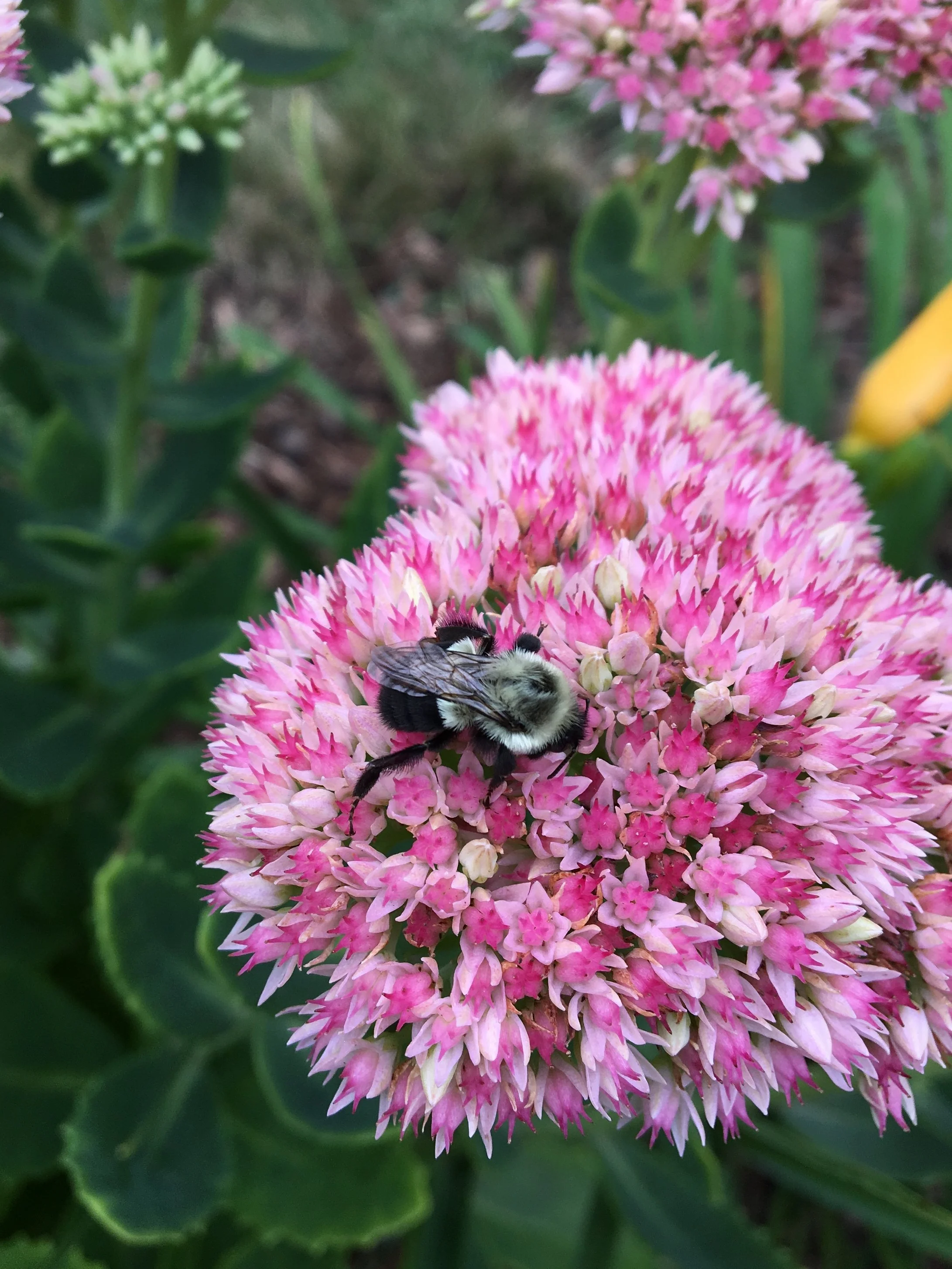
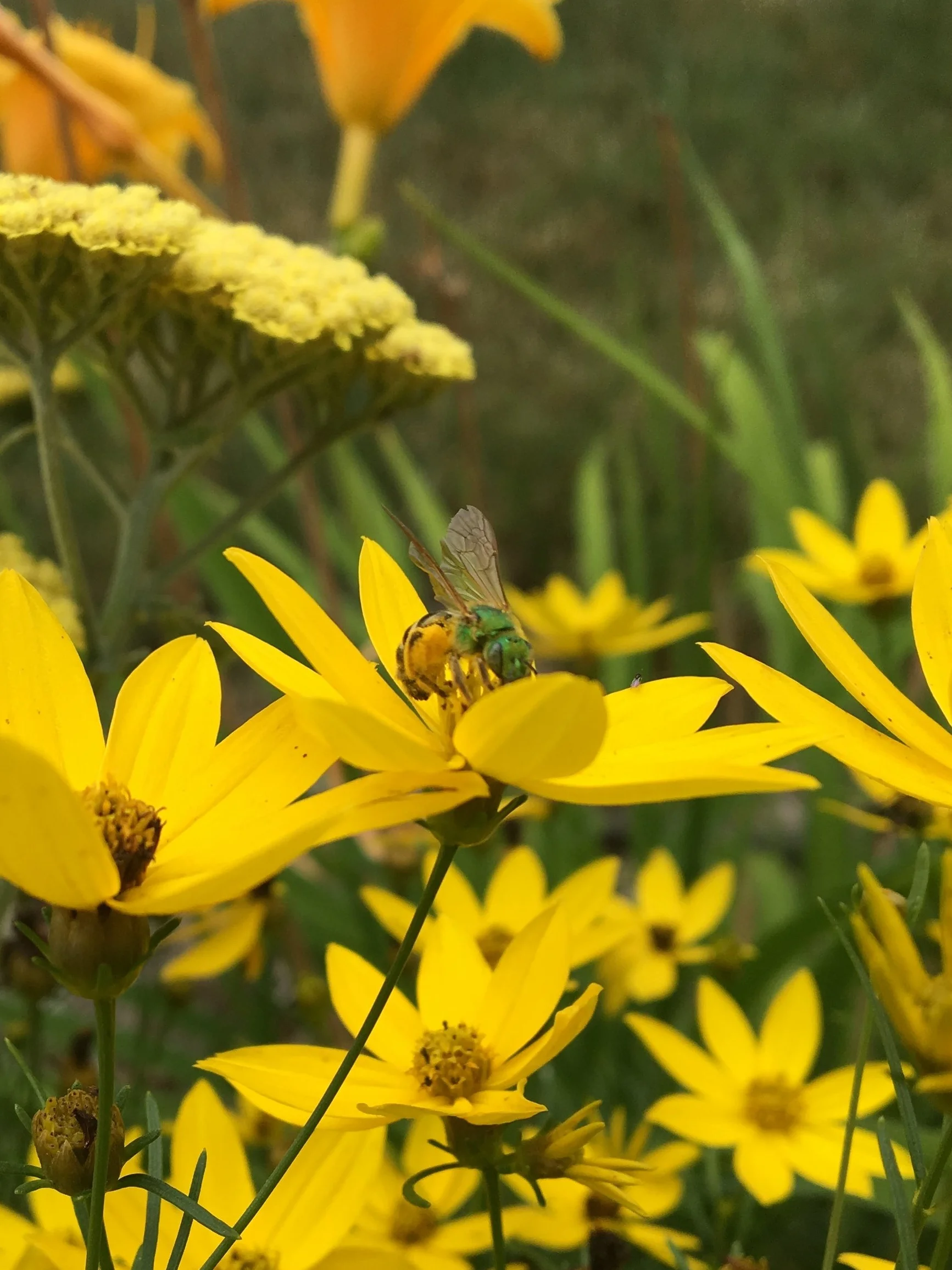

The distance between foraging sites is important as well. “Bees and other insect pollinators require nesting sites (suitable soil, dead wood, abandoned mouse nests, burrows) and floral resources (nectar and pollen) to persist” [3]. Unlike the honey bee, which lives in a hive, 70% of all bees nest underground [4] and viable nesting and foraging sites like open grasslands are at risk due to “row-crop agriculture, grazing and fragmentation of habitat” [3]. While larger species like honey bees and bumble bees travel 2-3 miles (sometimes farther) outside of their nesting location for food, many solitary bees, who are smaller yet “known to pollinate plants more efficiently than honey bees” [5], travel very short distances (typically less than a mile). Maintaining sites that are relatively close together are important in supporting the wide range of needs among various species.
Habitat loss and fragmentation, the process of reducing large tracts of land into smaller pieces via development, “are currently the main threats to terrestrial biodiversity”[6]. Wildlands works to expand continuous areas of ecological significance when acquiring land by identifying parcels that share borders with properties protected by towns and other organizations. This type of collaboration results in the creation of larger wildlife corridors throughout various habitats. Willow Brook Farm in Pembroke is a prime example of this. The roughly 167 acres that compose Willow Brook are nestled between Herring Run Historical Park and Misty Meadows Conservation Area. The shared borders between these three conservation lands results in a much larger protected area and reduces the distance between open spaces.
In short, Wildlands’ preserves which contain managed open fields provide food, a safe place to nest and a pesticide free environment for pollinators and other wildlife who rely on them. While there is much to learn in regards to why bees are facing declining numbers, there’s no doubt these spaces play an important role in their survival and the overall environmental health of the region. Through the preservation of varied habitats that include these grasslands, Wildlands and other land conservation organizations are working together to secure expansive tracts of vital habitat that may otherwise be lost forever.
A map showing the shared borders of Misty Meadow Conservation Area, Willow Brook Farm Preserve and Herring Run Historical Park.
[1] https://www.popsci.com/science/article/2013-06/10-spectacular-native-bees/
[2] https://www.apnews.com/f768748b36c648e49c14b0366fdec7e8
[3] https://www.nap.edu/read/11761/chapter/5#93
[4] https://entomology.cals.cornell.edu/extension/wild-pollinators/native-bees-your-backyard/
[5] https://www.growwilduk.com/wildflowers/bees-pollinators/take-crash-course-solitary-bees
[6] https://www.sciencedirect.com/topics/earth-and-planetary-sciences/habitat-fragmentation
What's Up With Wetlands?
By Roxey Lay, Membership and Communications Coordinator
EPA map displaying coastal wetlands and how far inland they extend (click to enlarge).
Swamps, marshes, bogs, and fens; all ecosystems defined by various sub-types and characteristics with one thing in common: they are all wetlands. World Wetlands Day was February 2, marking the date the Convention on Wetlands was adopted in 1971 and raising awareness of wetlands and their vital role to our planet. Massachusetts was the first state in the nation to adopt wetland protection laws during the 1960s; however, since the Colonial Period, roughly one-third of the state’s wetlands have been destroyed[1]. According to the EPA, “wetlands in coastal watersheds are experiencing disproportionate losses compared to wetlands in the rest of the country, making them particularly important areas for protection”[2]. Wildlands’ work to protect undeveloped land throughout the region includes the protection of wetlands. In fact, nearly all of the properties in Wildlands’ portfolio contain some type of wetland and provide habitat for many different species throughout the region; some of which are rare or endangered, such as the eastern box turtle and northern red-bellied cooter.
Drone view of Raven Brook in Middleborough.
Recently, I spoke with Brad Holmes, manager of Environmental Consulting & Restoration, LLC (ECR) to learn about what wetlands are and how they impact Southeastern Massachusetts. Located in Plymouth, ECR specializes in wetland consulting, permitting and restoration, and Brad, a professional wetland scientist (PWS), has worked with Wildlands at Great River Preserve and most recently, on the ecological restoration project along the shore of Halfway Pond. Read on to learn about wetlands and their significance to our region:
What is a wetland?
A wetland is an area where groundwater is located at or near the surface and where the vegetative community is dominated by plants adapted to live in saturated soil conditions. Wetlands often border on creeks, rivers, streams, ponds, lakes etc., but may also be isolated. Wetlands are [determined] by assessing three specific site conditions that include vegetation, soil, and hydrology. By definition, a wetland must include 2 of 3 conditions: a dominance of wetland vegetation, hydric soils, and/or hydrological conditions.
What is a wetland scientist?
A Professional Wetland Scientist is an individual that has been certified by the Society of Wetland Scientists based on academic and work experience in wetland science. As a PWS we work to assess and manage wetland resource areas throughout Massachusetts. Our work includes field delineation of wetlands based on specific environmental conditions (i.e. vegetation, soils & hydrology) as well as designing and permitting projects through the applicable local, state and federal regulatory authorities.
In addition to your work as a PWS, you are certified by the MA Arborists Association as an arborist, how does this influence your approach to your work?
As an MA Certified Arborist, I approach projects with a special consideration towards the care of trees, specifically when designing wetland restoration or wetland replication projects.
North River in Marshfield.
What are the benefits of wetlands?
Wetlands provide benefits to landowners and the public, [including] protection of public and private water supply, protection of groundwater supply, flood control, storm damage prevention, prevention of pollution, protection of fisheries and protection of wildlife habitat.
Why is important to protect them?
Wetlands act as a first line of defense for floodwater from storms. They also act as a filter to pollutants in our water supply. They [also] provide a specific habitat that many wildlife and fish need to survive.
Do wetlands have any significance to Southeastern Massachusetts?
There are many extensive wetland systems within Southeastern Massachusetts. For instance, the North River system in Scituate, Marshfield, Norwell, and Pembroke. Also consider the Taunton River system, the extensive freshwater ponds and the 250+ miles of coastline in Massachusetts.
It is important for property owners and the general public to be aware of the wetlands in their community and where they can seek guidance in protecting the wetland resource areas.
What is the current state of wetlands in this region? Are they threatened? If so, what can people do to help?
Wetlands in Massachusetts are protected by the Massachusetts Wetlands Protection Act and associated Wetland Regulations. [These] spell out specific performance standards for work within or nearby (buffer zone) wetland resource areas. It is important for property owners and the general public to be aware of the wetlands in their community and where they can seek guidance in protecting the wetland resource areas. Many towns in Massachusetts have a local Conservation Commission that works to protect the resource areas in their community.
What do you think the future of wetlands is?
Wetlands will be protected. The next task is protecting more land buffering wetlands, which is the current struggle.
Wetlands at Striar Conservancy, Halifax
Want to learn more about wetlands and whether there are any near your home? Talk to your local Conservation Commission, go to the State’s website on wetlands, or, if there is a Wildlands property near you, ask us what type of wetland is on the property and how you can help in maintaining its integrity for the benefit of your town and the animals that rely on its habitat. I’d like to thank Brad for taking the time to answer my questions and providing some great insight on the importance of wetlands and their impact on our region.
Land Projects Heat Up as the Weather Cools Down
By Scott MacFaden, Director of Land Protection
Often a productive time of year for land preservation projects, this November proved particularly so for Wildlands. We completed a purchase in Plymouth and a land donation in Halifax that expanded two of our largest preserves, Halfway Pond Conservation Area and Striar Conservancy.
In Scituate and Plymouth, partnership projects reached a critical juncture and a closing, respectively. In Scituate, town meeting voters approved the purchase of MacDonald Farm, a beloved local landmark on 1st Cliff, and the town of Plymouth purchased an 88-acre property that includes one of the town’s highest-elevation landforms, the striking Hio Hill.

Early morning mist at Halfway Pond.
Halfway Pond Conservation Area Addition | Plymouth
A few days before Thanksgiving, Wildlands completed the purchase of an 11.4-acre parcel on Halfway Pond in Plymouth from the Waltham-based Advaita Meditation Center. This acquisition complements recent acquisitions we have made over the past several years near Halfway Pond and further expands Halfway Pond Conservation Area, one of our oldest, largest, and most beloved preserves.
A rectangular-shaped parcel with varying topography, this property is primarily wooded upland and includes over 470 feet of frontage on Halfway Pond. It is integral to our ongoing effort to pursue ecological restoration efforts along the pond’s shore that will allow for the revegetation of native species. Wildlands now owns almost all of Halfway Pond’s western shoreline.
A generous private donor supplied all of the funding for this acquisition. Wildlands is fortunate to enjoy the support of such donors who share our belief in the importance, indeed the imperative, of preserving our region’s natural heritage.

A snowy owl at rest at MacDonald Farm.
Photo courtesy of Jim Petit.
MacDonald Farm | Scituate
On November 14, voters at Scituate’s special town meeting voted to approve the town’s purchase of MacDonald Farm, the last remaining undeveloped parcel on 1st Cliff and one of the few remaining along the town’s 21-mile coastline.
MacDonald Farm includes 600 feet of frontage on Scituate Harbor, abuts other open space parcels and NOAA’s Stellwagen Bank National Marine Sanctuary headquarters, and is a significant component of the vista from multiple vantage points in Scituate Harbor. In decades past, saltmarsh hay and Irish moss were harvested from its shores.
The town will use Community Preservation Act (CPA) funds to acquire the property and, in keeping with CPA requirements, will grant a Conservation Restriction on the property to Wildlands following the closing.
MacDonald Farm has been a long-time preservation priority for local stakeholders, including 1st Cliff resident and abutter Mary Jenkins, and NOAA. Mary co-sponsored the application we submitted to the Scituate Community Preservation Committee last summer and was integral to the process of advancing the application through the review and approval process that culminated in the town meeting vote. NOAA representatives, Ben Haskell and Anne-Marie Runfola, provided invaluable support throughout that review and approval process. Wildlands is pleased to have had the opportunity to join the project in its latter stages and collaborate with these local stakeholders, town officials, and volunteers toward advancing the preservation effort.
Hio Hill Preserve | Plymouth
On November 29, the town of Plymouth acquired 88 acres off the east side of Old Sandwich Road in southeast Plymouth. The town used $1.1 Million in CPA open space funds and a $50,000 contribution from Wildlands to purchase the property, also known as Hio Hill Preserve. We were able to provide this critical complementary funding courtesy of a generous private donor.
Hio Hill Preserve is entirely wooded upland, with notably diverse topography. Its most prominent feature is its namesake hill, one of the highest elevation landforms in all of Plymouth. Hio Hill’s broad summit plateau offers views of Cape Cod Bay as well as much of the surrounding landscape. It directly abuts other open space parcels, including town-held land, and sits just across Old Sandwich Road from a 450-acre open space assemblage comprising multiple town open space parcels and our Richard F. Wynn Preserve. It is partially within a Zone II wellhead protection area and helps protect a town drinking water well situated three-fifths of a mile to the southeast.
Wildlands will hold a CPA Conservation Restriction on this outstanding new addition to the town’s portfolio of municipally-owned conservation land.
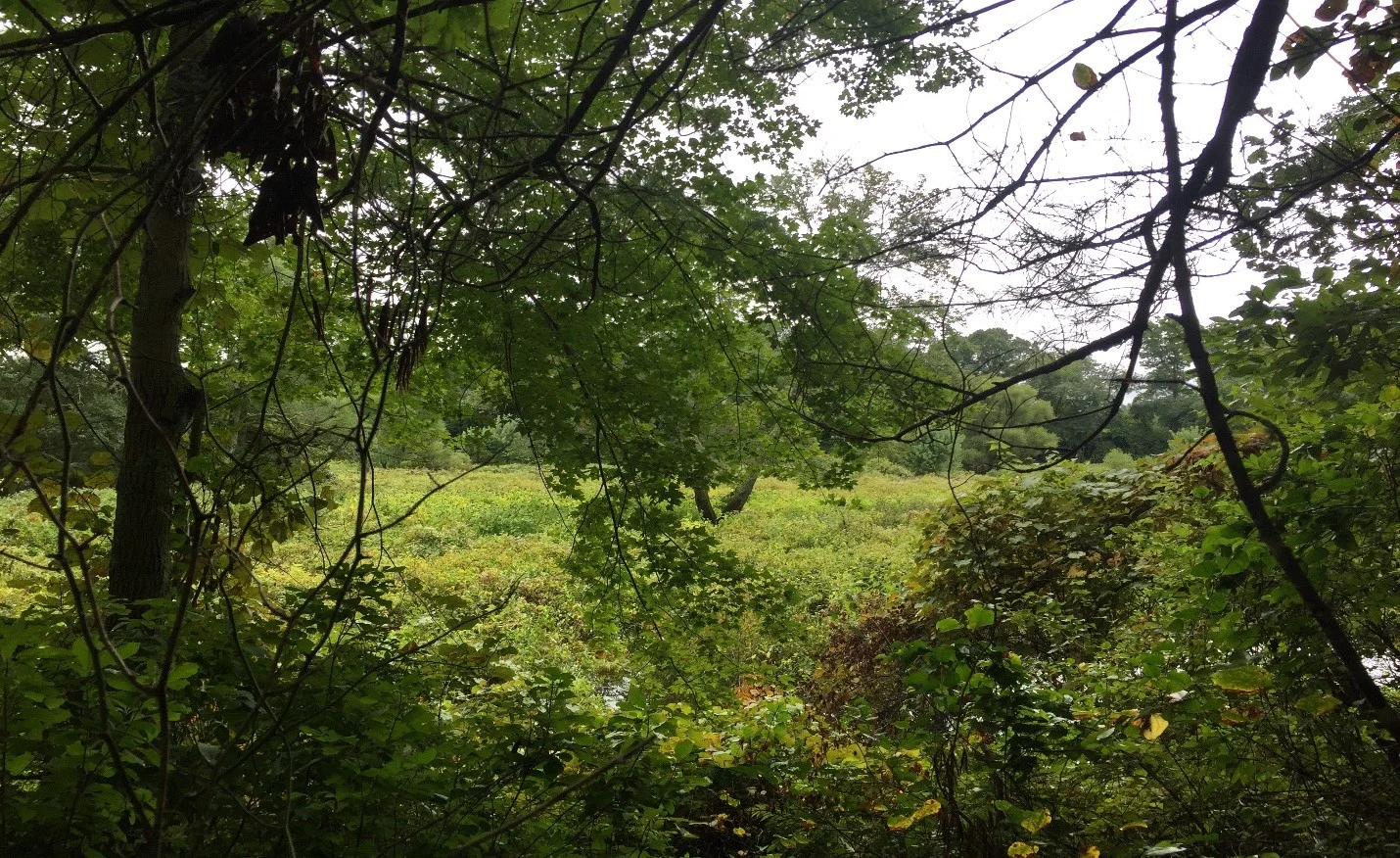
Along the Winnetuxet River in Halifax.
Striar Conservancy Addition | Halifax
Courtesy of the Stevens family, the last of our November projects included the donation of a 3.6-acre parcel along the lower Winnetuxet River in Halifax. Comprising primarily riparian wetlands, the parcel directly abuts and expands Striar Conservancy, our largest preserve in Halifax, and sits across the Winnetuxet’s expansive floodplain from the town of Halifax’s Randall-Hilliard Preserve, upon which Wildlands holds a Conservation Restriction.
Clyde and Gladys Stevens acquired the property in 1963. With the 2015 passing of Gladys Stevens, the property descended to her heirs, Ernest Stevens and Jeanne (Stevens) Wilson Baum, who graciously donated the parcel to Wildlands. We thank Mr. Stevens and Ms. Baum for their donation of this important component of the Winnetuxet River corridor.