
By Justin Cifello
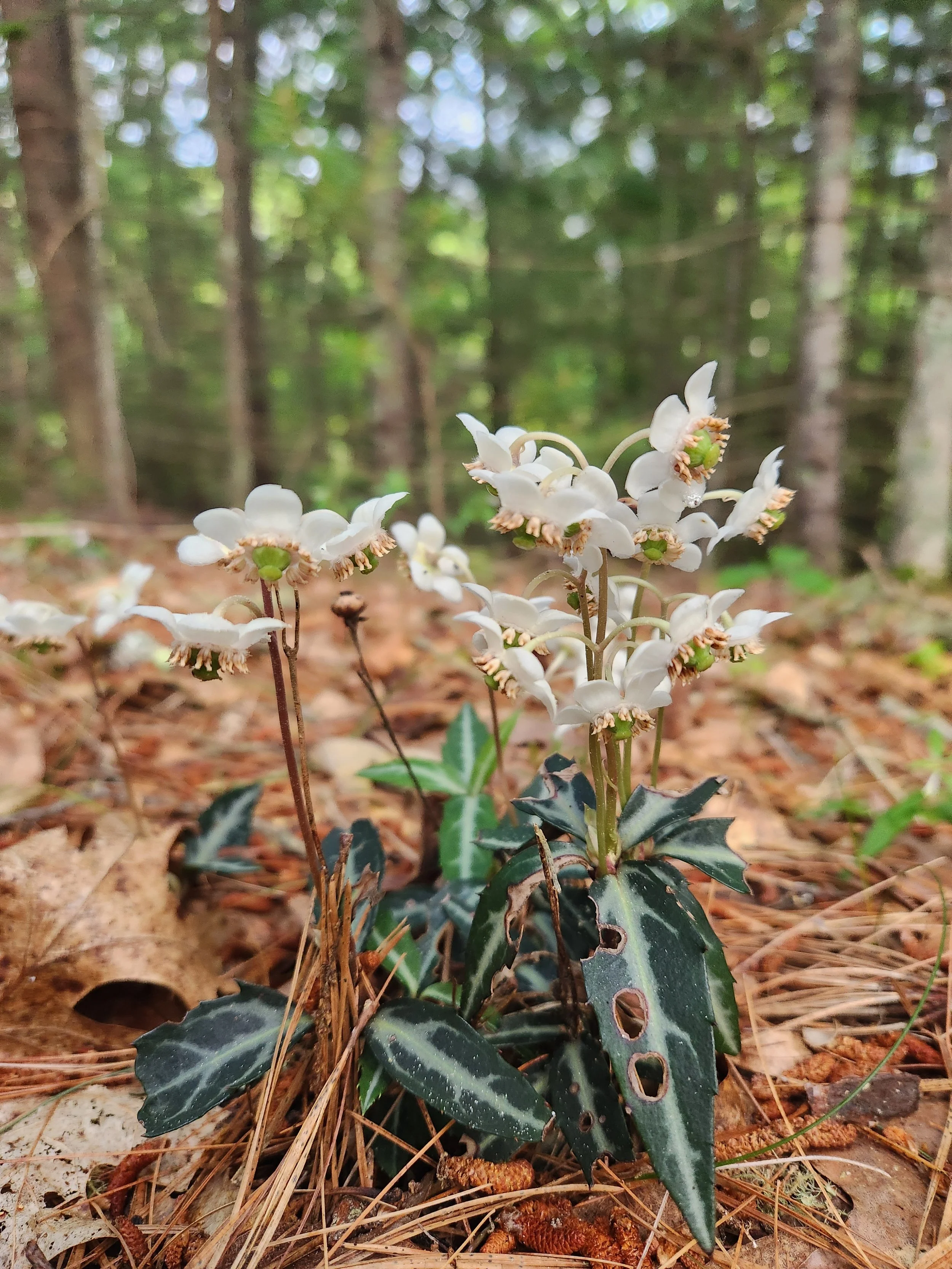
Spotted wintergreen prefers sandy shade, avoiding excessive light with its waxy, patterned leaves. Photo by Justin Cifello.
In times of intense heat, we flock to water and shade, put electrolytes into our water bottles, and, if fortunate, turn on the air conditioning. Plants, however, are sessile, incapable of movement; they have to deal with temperature extremes wherever they happen to have taken root. As passive as they may appear, they have a suite of sophisticated structural and chemical adaptations that enable them to withstand harsh conditions.
The ideal temperature for photosynthesis is between 68°F and 86°F. At higher temperatures, plants begin to suffer physical damage as they struggle to keep their extremities hydrated. The movement of water is key to plant survival, accomplished through a process called transpiration. Water enters the roots, drawn up in part by water tension, the same way water climbs up a straw. Leaves are perforated by tiny holes called stomata, through which excess water evaporates, creating a siphon that pulls water up the plant. Plants use about 95% of their water just to power this elevator, which is lost to the air. Wind blowing over these ports forces the process into overdrive and can account for more drying than sunlight alone.
The broad leaves of poison ivy wilt to avoid the full force of the sun. Photo by Justin Cifello.
The structure of a leaf, down to its cell walls, is primarily carbon. Though strong, it needs to be inflated with adequate water, or turgor pressure. Without water, it deflates, which we see as wilting. Some degree of wilting is protective; by drooping or curling, the leaf exposes less of itself to the evaporating effects of sunlight and wind. Too much wilting, though, leads to collapse, and the plant may be unable to recover. Extreme conditions can outpace a plant’s rate of transpiration, causing it to wilt even with sufficient groundwater. [1]
Since plants lack nervous systems, internal chemical distribution is ruled by properties of water. Chief among these is osmosis, the process by which a substance disperses evenly to areas of lower concentration. Plants utilize compounds called osmoprotectants that change the osmotic potential of the water, letting plants bend the rules a bit to keep water where they need it. Antioxidants, such as salicylic acids, found in willow, birch, and wintergreen, protect cells from the hazardous byproducts of stressful conditions. [2]
Pitch pine, with its waxy leaves and sparse canopy, is more drought tolerant than its cousin, the white pine. Photo by Justin Cifello.
The most visible adaptations against heat and drought are structural. Small leaves, like on bearberry, or narrow leaves, like pine needles, require less water to maintain turgidity. Both of those plants also have waxy cuticles to keep water in and reflect some sunlight. These features are seen in many of our pine barrens plants, like bayberry, wintergreen, and inkberry; their sandy environment doesn’t retain much water, so they need to hold every drop they can. Succulent plants store water in their thick stems. Though they are most associated with deserts, New England is home to a native cactus, the eastern prickly pear, which lives on dunes and dry ledges. Pale, silvery foliage helps deflect sunlight, as can be seen on water-hungry willows and jewelweed. Hairs on the leaves of sunflowers and goldenrods, trap moisture and slow down evaporating wind. [3]
Deep roots, like those of milkweed and false indigo, are obvious ways to access water. Many plants also form intimate partnerships with mycorrhizal fungi, which can forage farther than roots alone. In addition to providing soil structure, some of these fungi produce compounds that increase water retention. The organisms communicate through hormones, exchanging nutrients and compounds as needed. [4]
Some plants beat the heat with behavioral adaptations. Spring ephemerals leaf out and flower early, before temperatures climb. Drought-stressed perennials can abandon flowers to conserve resources. Annual plants will bolt at the first sign of heat, insuring they can seed the next generation. Jewelweed, an annual, has developed an ingenious adaptation. When stressed, it stops producing its showy orange flowers, forgoing insect pollination. Instead, it produces modified cleistogamous flowers, fully enclosed and devoid of nectar. These can fertilize themselves, not ideal in the long-run, but insures that at least some seeds will be produced. [5]
An eastern prickly-pear cactus grows alongside bearberry. Coastal plants must adapt to the drying effects of salt in addition to wind and sun. Photo by Justin Cifello.
In deep forest, where canopy cover provides shade and fallen leaves trap humidity, plants can afford more profligate growth, sporting broad and tender leaves. Heat and drought adaptations are easily seen in sunny, exposed places like open fields and coastlines. Ironically, they are also found in wetlands; these plants have high water needs and must be ready for seasonal fluctuations. We can employ these same strategies in our own gardens, applying mulch and letting fallen leaves remain to protect and cool the soil. This is another reason to plant native species, as they have spent millennia learning how to live here.
[1] Transpiration: https://durhammastergardeners.com/2016/08/25/why-plants-wilt/
[2] Heat Stress: https://cid-inc.com/blog/plant-responses-to-heat-stress/
[3] Heat Tolerance: https://www.piedmontmastergardeners.org/article/characteristics-of-drought-tolerant-perennials/
[4] Mycorrhizal Relationships and Drought: https://pmc.ncbi.nlm.nih.gov/articles/PMC9298553/
[5] Jewelweed Cleistogamy: https://riwps.org/rwips-blog/jewel-weed-lessons/
[6] Native Plants: https://apcc.org/our-work/education/native-plant-initiative/