
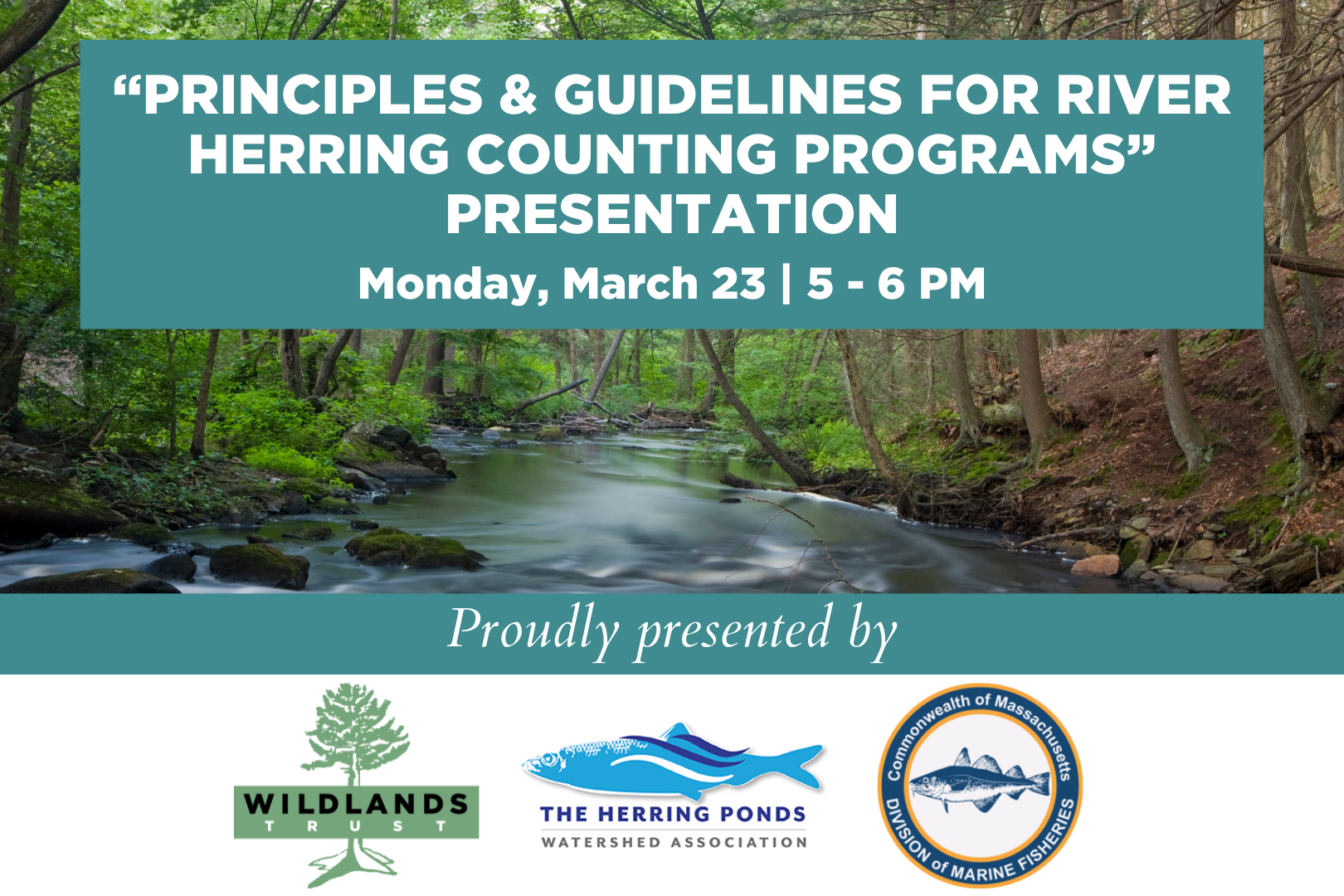
Join Wildlands Trust and Herring Pond Watershed Association in hosting John Sheppard, Division of Marine Fisheries’ Diadromous Fisheries Biologist, as he presents “Principles and Guidelines for River Herring Counting Programs in Massachusetts with an Emphasis on Volunteer Visual Counts.”
River herring are comprised of two species (alewife and blueback herring) whose life history involves migrating between freshwater and marine environments to fulfill critical life cycle requirements. They serve critical roles in freshwater and marine foodwebs as forage species for both aquatic and terrestrial predators, as well as vectors for transferring nutrients from one environment to another. Since the turn of the century, river herring populations have declined significantly coastwide, prompting states to close commercial and recreational fisheries and to initiate biological monitoring programs to enhance both state and federal stock assessments. In recent years, public interest in counting river herring populations has increased, and volunteer counting groups have contributed to various aspects of river herring monitoring and management in Massachusetts.
This presentation will provide an overview of river herring life history, management and monitoring efforts in Massachusetts with an emphasis on the principles and guidelines for establishing visual counts. This presentation will also review methodologies for conducting visual counts and run size estimation, as well as applications and limitations of visual counts.
Join us virtually to learn more about some of these exciting efforts and outcomes. This presentation will be recorded. Registration is required for this FREE event.
Registration closes on Monday, March 23 at 5 PM. Want to sign up after registration closes? Please email: events@wildlandstrust.org
What to Expect:
A virtual presentation with John Sheppard, Division of Marine Fisheries’ Diadromous Fisheries Biologist
Question and answer period to follow!
This presentation will be recorded
Restrictions:
All ages are welcome
Maximum 100 attendees
Cancellations and postponements will be announced online and registered attendees will be notified via email.
Questions? Please email: events@wildlandstrust.org
Presenter Bio:
John Sheppard (Tiverton, RI) grew up in Boston and is a life-long fisherman and outdoor enthusiast. His passion for fishing and his favorite movie, “Jaws” led him to pursue a career as a fisheries biologist. He earned his Bachelor’s Degree in Fisheries Science at the University of Rhode Island in 1996 and then earned his Master’s Degree in Marine and Fisheries Science at the University of Aberdeen in Scotland in 1999. His professional career began while working during college as a summer employee for the Massachusetts Division of Fisheries and Wildlife. He then went to work for the Fisheries Observer Program at the National Oceanic and Atmospheric Administration in 2000, and then began working for the Massachusetts Division of Marine Fisheries in 2001 in the Fisheries Dependent Investigations Project. In 2005, he transferred to the Diadromous Fisheries Biology and Management Project and now oversees several monitoring and restoration programs for diadromous species in southeastern Massachusetts.