


What’s New at Wildlands
Giving Tuesday: Support Our Brockton Youth Programs

UPDATE: Thanks to your generosity, we have raised $2,200 for our Brockton youth programs. There’s still time to help us meet our $5,000 goal! In addition to your annual giving, please consider supporting this campaign to build the next generation of environmental leaders.
There are so many causes worthy of your attention this Giving Tuesday and holiday season. Many charities give prospective donors one of two options: drive meaningful change today or make a lasting impact for the future. At Wildlands Trust, we ask: why not both?
By design, our work delivers both immediate and long-term benefits to the people and wildlife of Southeastern Massachusetts. We only invest in solutions that endure across landscapes and generations because we simply cannot afford to lose progress toward our vision of a healthy, beautiful, diverse, equitable, and resilient region for all.
Land protection is our highest-profile example of this strategy. But to truly realize and sustain our vision, we must always have people with the knowledge, skills, and passion to steward and advocate for our shared natural spaces. We can ensure this by providing youth with opportunities to explore nature early and often.
For over 10 years, Wildlands Trust has cultivated the next generation of local conservation leaders by engaging Brockton-area youth in community service and environmental learning. The Brockton High School Outdoor Club, formerly known as the Envirothon Team, is an after-school program that inspires students to explore nature and solve environmental problems together. In the summer, Brockton-area teens can pursue their interest in conservation through Green Team, a paid service-learning program primarily at D.W. Field Park. Both programs are co-led by Wildlands and Manomet Conservation Sciences. (Click here for a Green Team 2025 recap.)
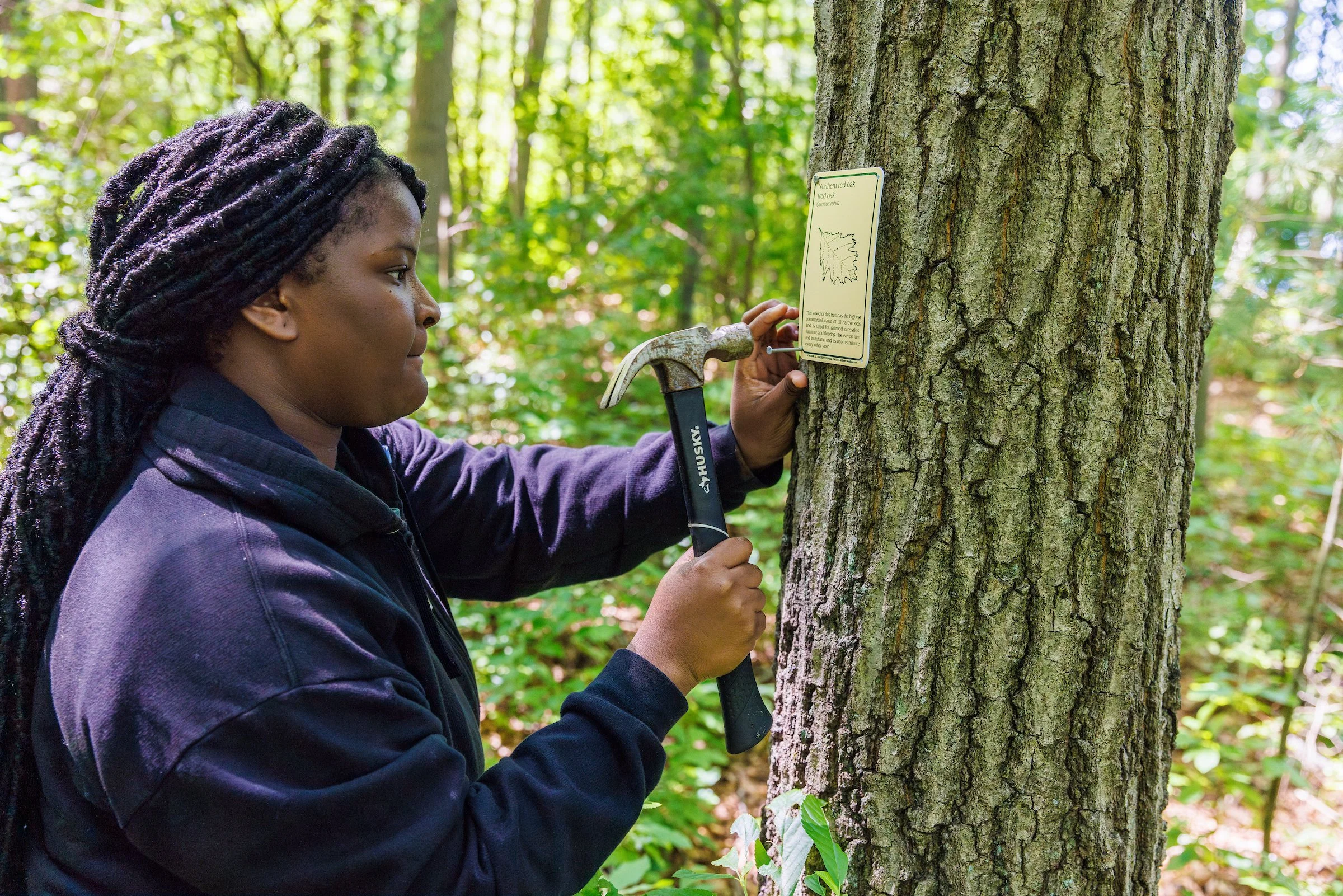
The impact of these programs is best told by the participants themselves. In a post-program survey, this summer’s Green Team members shared how the experience provided them with an immediate sense of accomplishment and an enduring sense of purpose:
“It had a big influence on what I wanted to do. It made me want to pursue a career in something involving the outdoors.”
“I was most proud of making my community cleaner and better for others. Hopefully it sets an example for others around me.”
“I learned to be brave, resilient, and a bit more outgoing.”
This Giving Tuesday, please consider donating in support of our Brockton youth programs. Our goal is to raise $5,000. Together, we can expand our investment in the next generation of environmental leaders, for the benefit of us all.
Leaders for Land: Wildlands Launches Corporate Giving Program
Making the Business Case for Saving Land For Everyone, Forever

Paula and Bill Harris, co-founders of WH Cornerstone, joined Leaders for Land to support the maintenance of Wildlands Trust’s headquarters, Davis-Douglas Farm in Plymouth.
Many forward-looking businesses today identify conservation as a core value. Business leaders with this mindset see land stewardship as a strategic investment—a way to fulfill their brand promise and build a stronger connection with their communities. This mindset inspired Wildlands Trust’s exciting new corporate partnership program, Leaders for Land.
Leaders for Land allows mission-driven businesses to make a lasting impact on local and regional communities by investing in the care of a public preserve in Wildlands’ growing portfolio of protected land across Southeastern Massachusetts. By supporting Wildlands, businesses elevate their profile and demonstrate leadership in their commitment to protecting our region’s natural resources for generations to come.
“A clear trend shows that customers, employees, suppliers, and all other business stakeholders favor conservation-conscious investments in the community and in this region we call home,” Donor Relations Manager Rob Kluin said. “Wildlands’ mission is relevant to everyone, and in a world so often divided, it’s heartening to see how that leads us to common ground.”
To learn more about Leaders for Land, visit wildlandstrust.org/corporate or contact Rob Kluin, Donor Relations Manager, at rkluin@wildlandstrust.org.
Leaders for Land Spotlight: WH Cornerstone Investments

Based in Duxbury, WH Cornerstone Investments is a trusted financial planning and investment advisory firm with over four decades of experience helping clients build wealth and secure a strong financial future. At WH Cornerstone, financial planning is about more than crunching numbers; it’s about empowering clients to navigate life’s unexpected curveballs with confidence.
WH Cornerstone Investments appreciates the value and purpose of Leaders for Land and made the decision to come aboard with a multi-year commitment.
“I first connected with Wildlands Trust over 20 years ago when I served on the Duxbury Open Space Committee, working to preserve the Historic O’Neil Farm,” said Paula Harris, co-founder of WH Cornerstone Investments. “We love the work Wildlands Trust is doing to protect our land and connect people with nature. Supporting their mission feels so natural to us. It aligns with our values.”
Wildlands is grateful for WH Cornerstone’s pioneering support as our inaugural Leader for Land.
Leadership Council Unites Over Nature, Hope, Chowder at Fall Supper
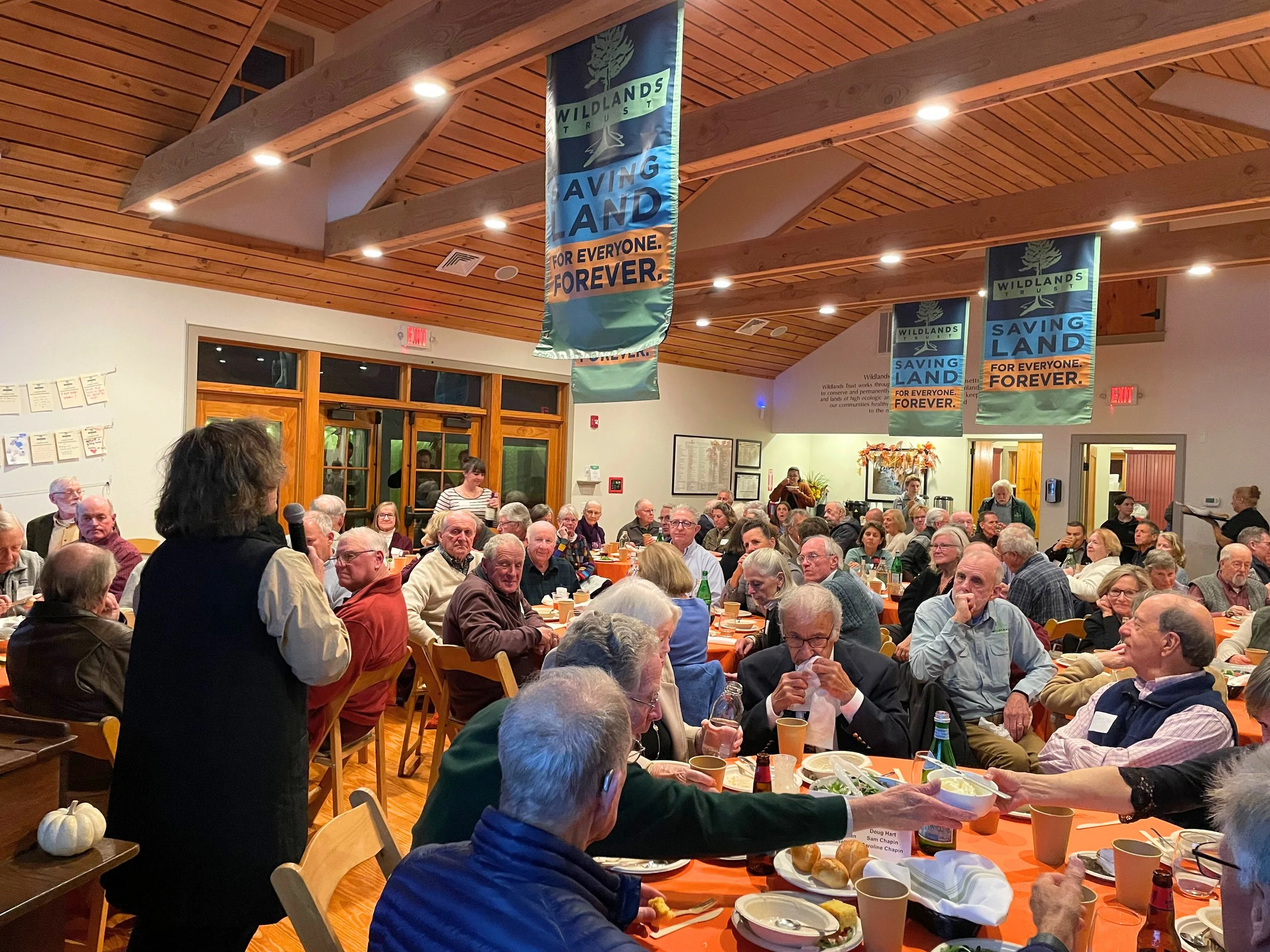
Wildlands President Karen Grey addresses the Leadership Council at the 2025 fall supper.
By Thomas Patti, Communications Coordinator
In late October, nearly 100 of Southeastern Massachusetts’ most influential conservation champions gathered at Davis-Douglas Farm in Plymouth to celebrate the work Wildlands Trust has accomplished in the past year. Wildlands hosts the Leadership Council fall supper each year to thank and unite the generous individuals who provide upper-level donor support to our mission.
It was a gorgeous autumn evening for the event. Under a tent outside the Community Conservation Barn, Leadership Council members were treated to an artisan charcuterie board, a raw oyster bar hosted by Island Creek Oysters, wine and beer from Pioppi’s Package Store, and handcrafted chocolates donated by Stuzzi Café & Sweet Shop. Inside the barn, attendees were served clam and corn chowder, and for dessert, apple and pumpkin pie. Each attendee also received a gift bag of fresh cranberries donated by the Gilmore Cranberry Company, along with a Wildlands Trust ceramic coaster.
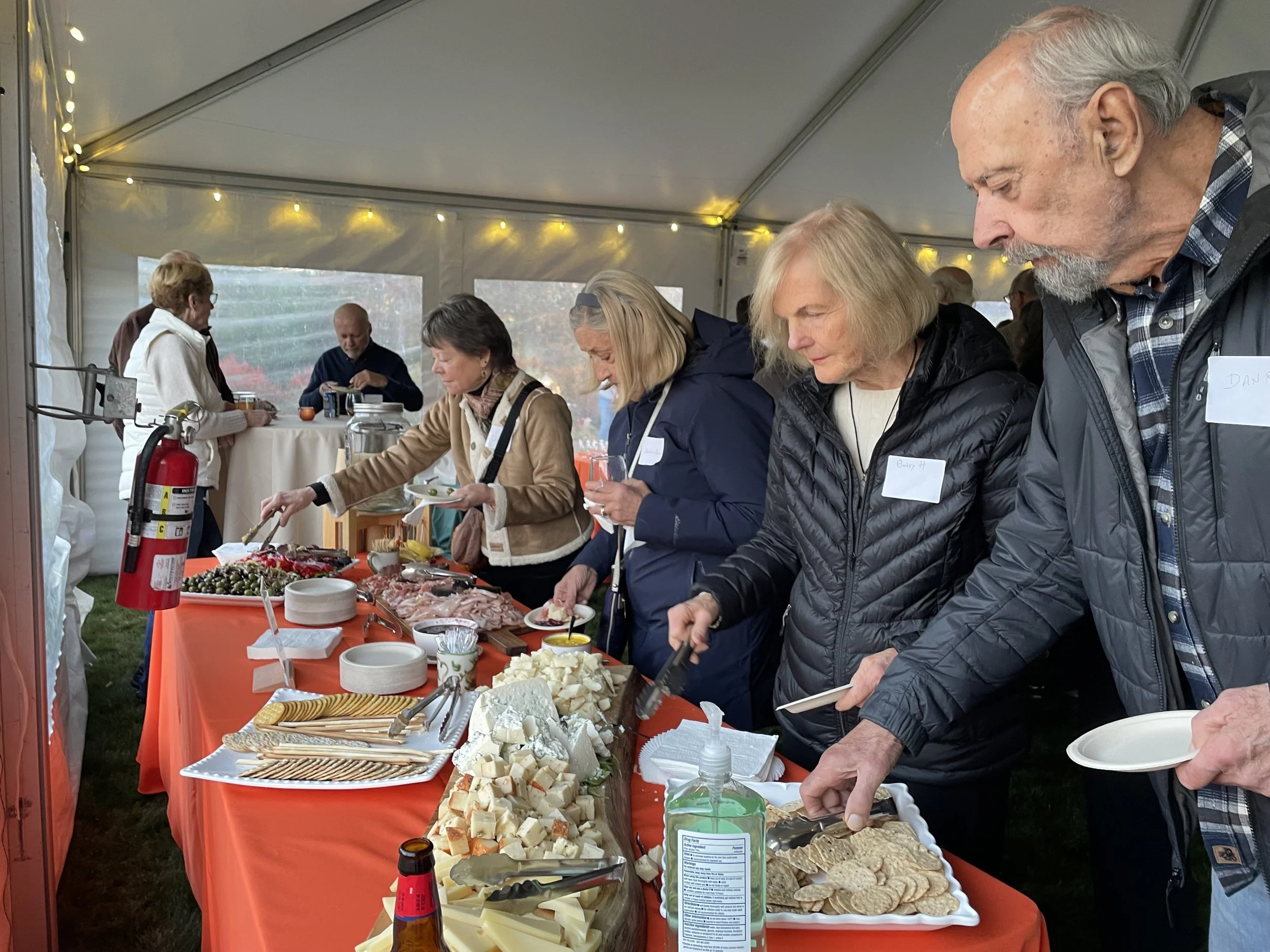
Leadership Council members enjoy the charcuterie board at the fall supper.
Yet the highlight of the evening was neither the food tasted nor gifts bestowed, but the stories told and the company shared. Two guest speakers, invited and introduced by Wildlands President Karen Grey, commended Wildlands’ unassuming yet vital work at a critical moment in local and global environmental history.
“It is an honor of my job to know so many of you and to understand the different ways each of you helps to advance our mission. You are essential partners in our work to protect land across the region, and we could not do it without you .”
First, conservation photographer Jerry Monkman reflected on his 30-year career, capturing the places and people at the heart of New England’s natural heritage. As owner of EcoPhotography and Reel Quest Films, Monkman has provided Wildlands with breathtaking photo and video content for almost two decades. To open his remarks, Monkman noted that amid a chaotic upbringing, it was his ability to roam the forests, fields, and rivers near his northern Illinois childhood home that kept him healthy and whole. Years later, when a cancer diagnosis put his adventurous career on hold, it was the nature of his own backyard in Portsmouth, New Hampshire, that saved him again. Monkman has been cancer free for over 10 years.
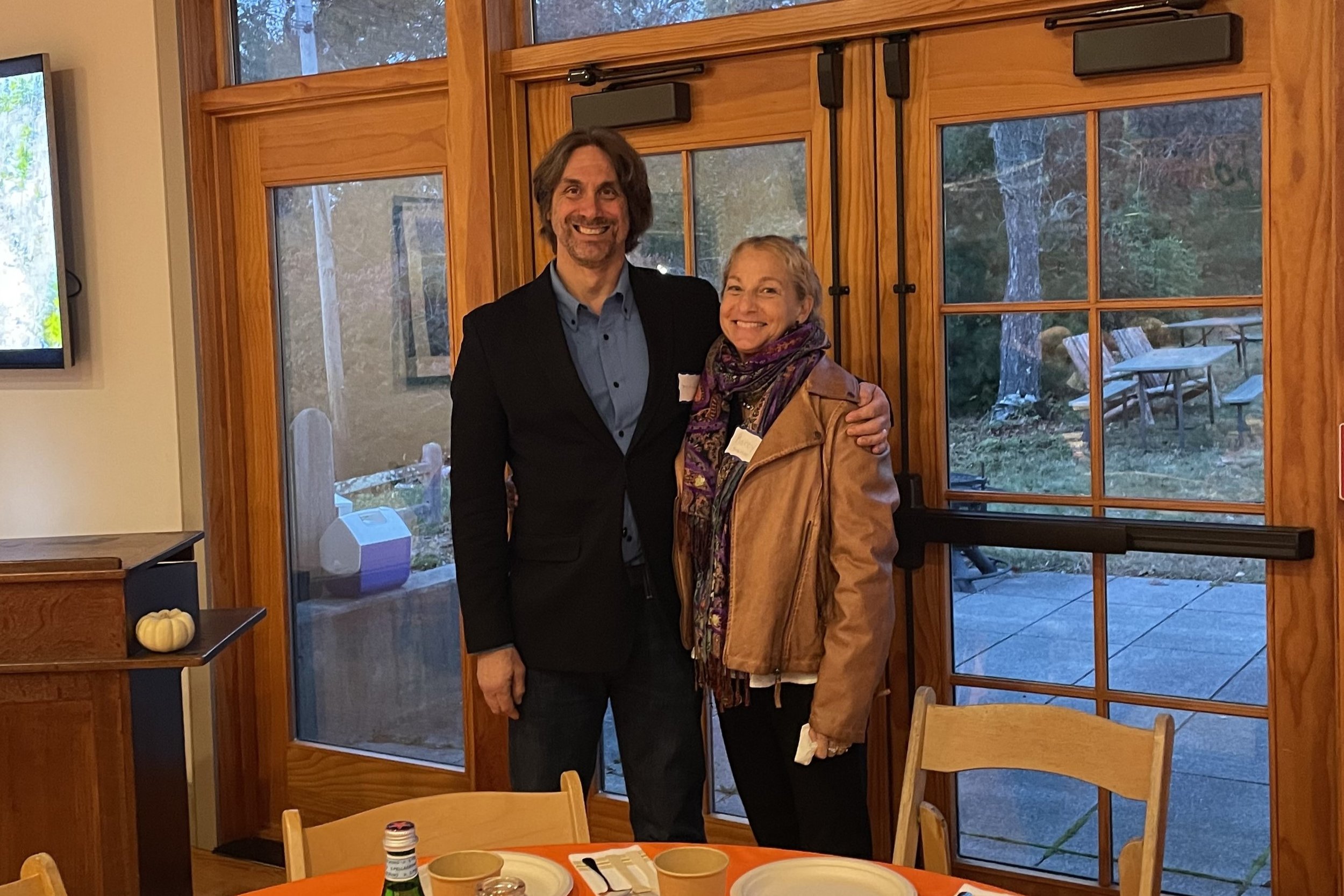
Jerry Monkman and his wife, Marcy.
“Having easy access to open space close to home, where I could go within a few minutes while I was sick and just spend an hour listening to the surf or meditating in the woods, I really believe had a strong impact on my recovery,” Monkman said. "I came to believe that easy access to open space is a basic human right, and we should all think of it that way.”
Monkman then recounted his mutually beneficial relationship with Wildlands.
“I just love working with Wildlands Trust,” he said. “They're awesome, fun people to work with. I've worked with environmental organizations from small land trusts all the way up to some of the biggest international organizations in the world. And I've got to say, Wildlands Trust is definitely one of the better-run organizations. They know how to get stuff done.”
Monkman then debuted his latest project for Wildlands, a promotional film narrated by President Grey centering on the theme, Saving Land for Everyone, Forever. Watch the film here.
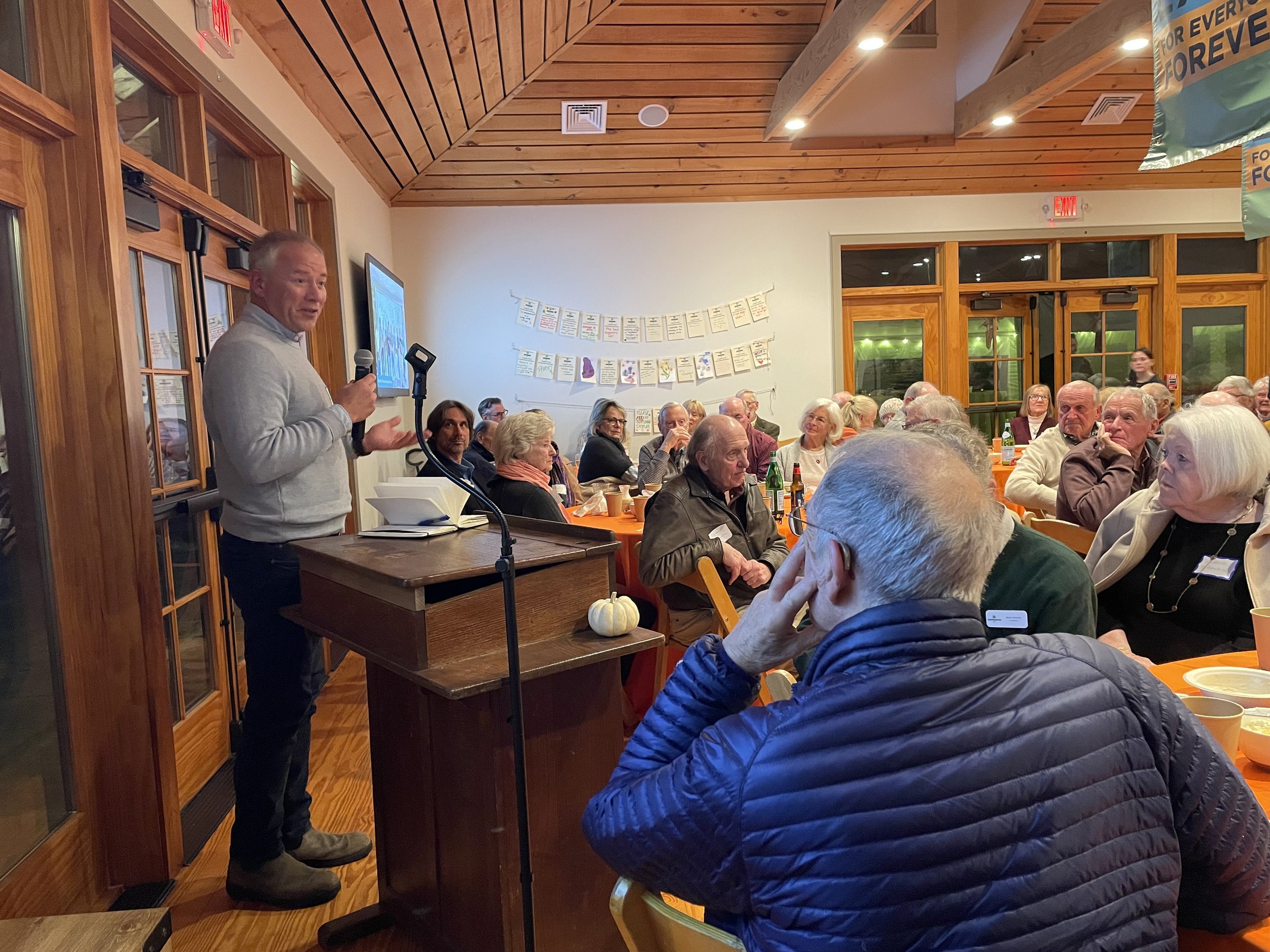
Mass Audubon President David O’Neill addresses the Leadership Council.
The final speaker of the night was David O’Neill, President of Mass Audubon. “This is what community looks like,” he marveled at the start of his address, scanning the packed room. Amid turmoil and uncertainty at the federal level, O’Neill emphasized the importance of investing in local, tangible improvements to social and environmental well-being.
“Focusing on the negative is too easy,” O’Neill said. “I'm like, ‘Look, what can we do about this? What is in our agency to make a difference today?’ It's the work that's happening in communities all across the country to do great things as a bulwark against what's happening in D.C. What Wildlands Trust is doing each and every day is what we all have to do. And we have to magnify that more than we've ever done before.”
O’Neill concluded by highlighting the Nature for Massachusetts campaign, which is advocating for the state to dedicate $100 million of existing tax revenue each year to advance land and water conservation, outdoor recreation, and climate resiliency. Spearheading the effort is the Nature for Massachusetts Coalition, a group of over 50 environmental organizations, including Mass Audubon and Wildlands Trust.
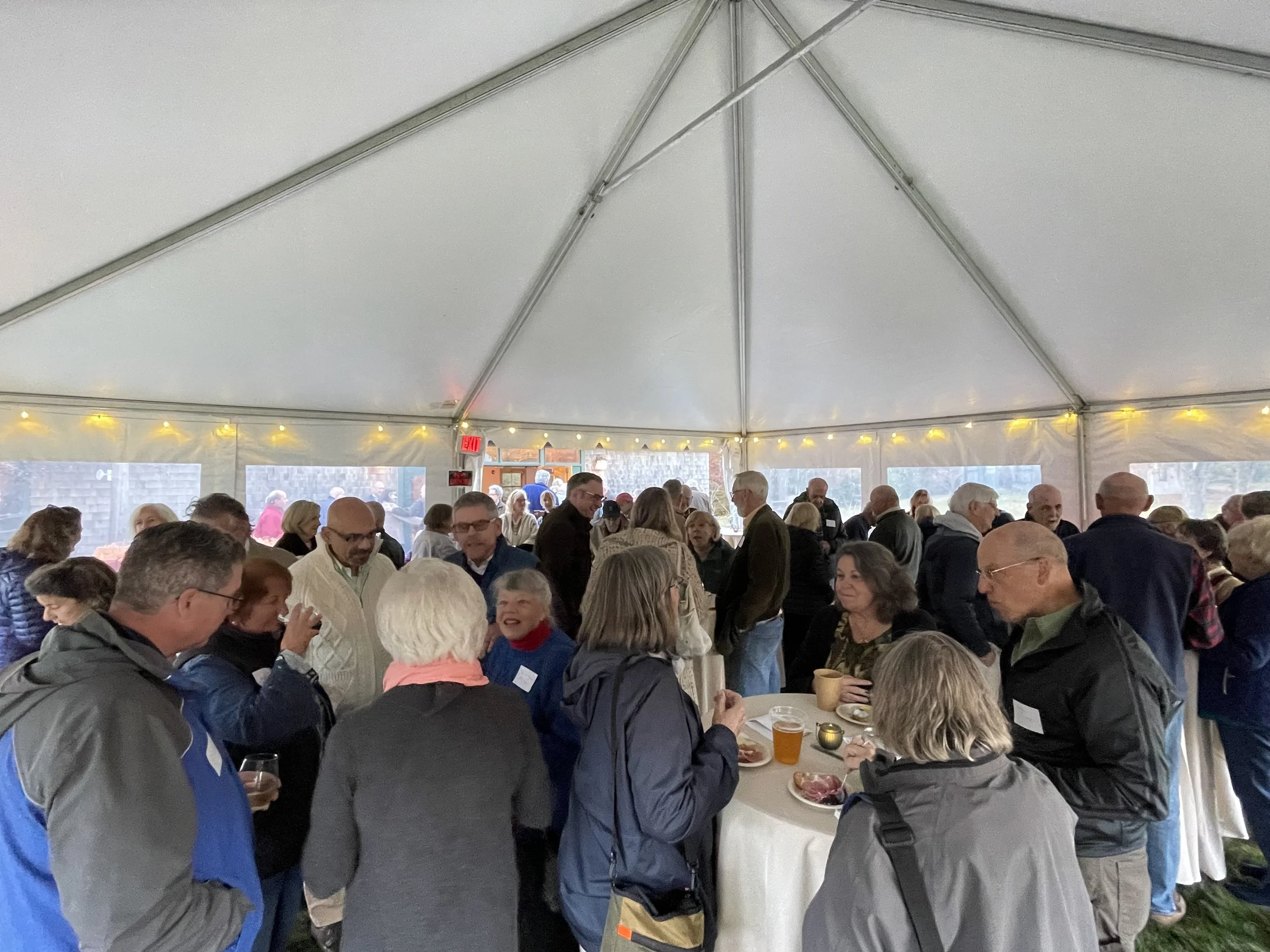
The Leadership Council enjoys light refreshments and good company under a tent outside the barn.
“Nature is a unifying force,” O’Neill added. “It should not be a political issue. It should be something that brings us together, and it does each and every day. And we need more of it. We need to protect it, and in places that don't have it, we need to offer it.”
Through laughter, stories, handshakes, and hugs, the unifying force of nature was on full display at last month’s fall supper. We extend our deepest gratitude to the generous members of the Leadership Council, who make our work possible.
Wildlands hosts two Leadership Council appreciation events each year, the fall supper and a spring preserve tour. Learn more and join the Leadership Council at wildlandstrust.org/leadership-council.
Human History of Wildlands: Old Field Pond Preserve
Like the Winslows in last month's history of Hoyt-Hall Preserve and the Barkers of Willow Brook Farm, Old Field Pond Preserve’s history is as much about a family as it is about a parcel of land. Whenever a family is associated with a landscape over a long period of time, their imprint is palpable. You'll see this clearly in the story of the Ingersolls.
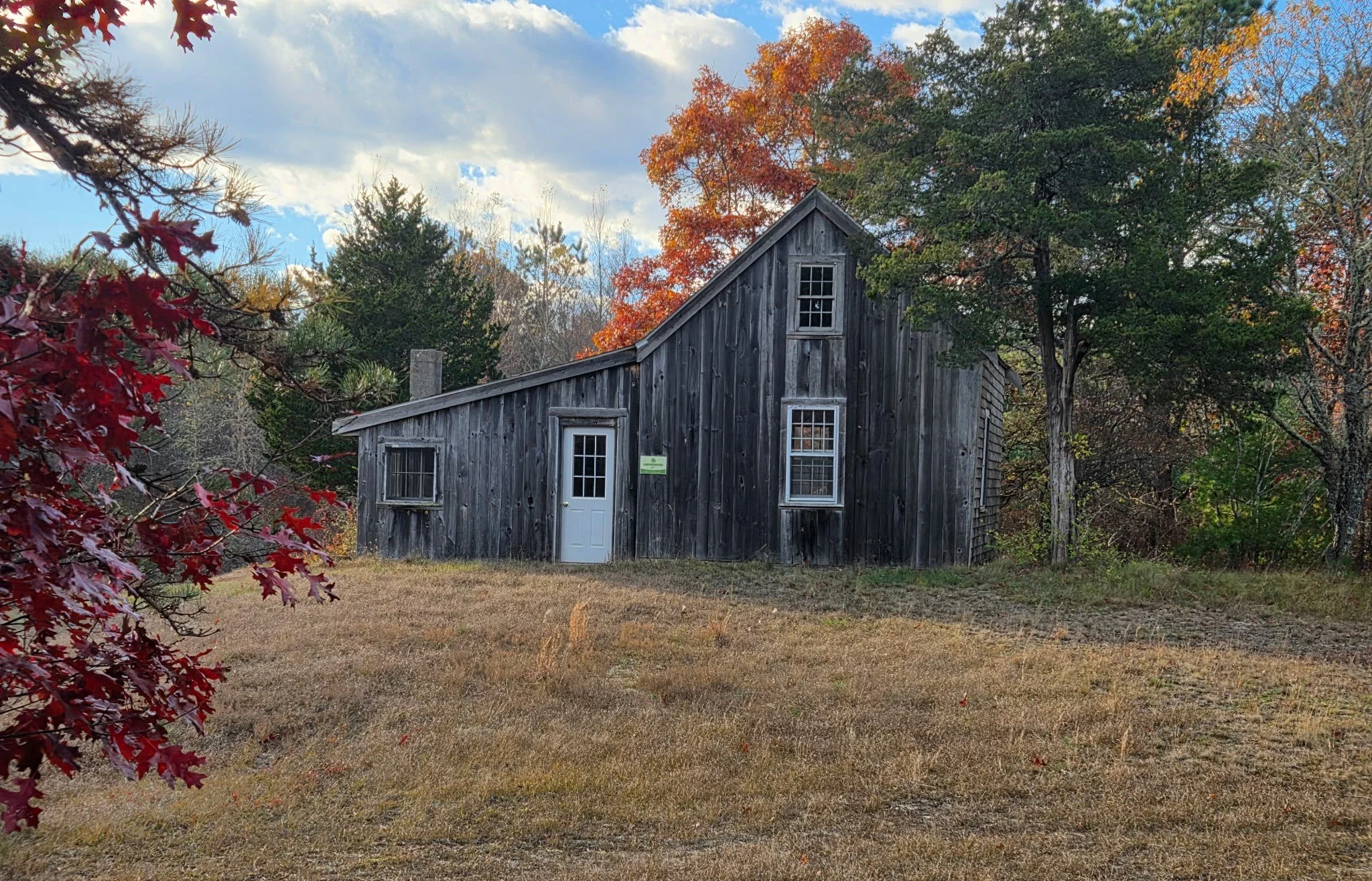
The cranberry shack at Old Field Pond Preserve once housed the bog supervisor.
By Skip Stuck, Key Volunteer
Old Field Pond Preserve is a 145-acre property on Bournedale Road in the town of Bourne. It boasts a wide variety of features—ponds, fields, wetlands, and forests. Wildlife including waterfowl, deer, coyotes, small game, and endangered northern red-bellied turtles are abundant. Rare plant life, such as the Plymouth gentian and carnivorous sundew, find refuge here. It is a truly wonderful place.
Readers who are familiar with Wildlands’ properties might never have visited or even heard about Old Field Pond Preserve. Although it is one of Wildlands’ most beautiful properties, it has no open public access, so Wildlands does not highlight it on its website. The preserve is "landlocked" by private property. Although there is no parking and visitors may not walk in on their own, there are many opportunities to enjoy the property. More on this later.
Like the Winslows in last month's history of Hoyt-Hall Preserve and the Barkers of Willow Brook Farm, Old Field Pond Preserve’s history is as much about a family as it is about a parcel of land. Whenever a family is associated with a landscape over a long period of time, their imprint is palpable. You'll see this clearly in the story of the Ingersolls.

Hike & Hops at Old Field Pond Preserve in November 2023.
Early history
As the glaciers retreated about 12,000 years ago, meltwater flowed south and created a myriad of rivers and streams in the outwash plains. Native Americans soon took advantage of the opportunities for fishing and shellfish and settled the area that they called Comassakumakanit. What was known as the Manomet River by the Natives and Monument to the English flowed from Great Herring Pond into Buzzards Bay. As its name indicates, Great Herring Pond was rich in herring, and its banks were moist and fertile to farm. The area was and still is home to the Herring Pond Wampanoag Tribe.
The Tribe continues to own 400 acres near Old Field Pond Preserve. Chamber Rock, Burying Hill, Wishing Rock, and Sacrifice Rock are all local features of cultural and historical significance to the Tribe. This year, scientists used ground-penetrating radar to locate old Wampanoag burials at Burying Hill, providing new evidence in support of the Tribe’s oral history dating back centuries. The Herring River Trail, now called Herring Pond Road, and Bournedale Road are important ancient thoroughfares still in use today.

Historical plaque at Burying Hill, near Old Field Pond Preserve in Bourne. In addition to a burial ground, the area was the site of the first meeting house for Native Americans in Plymouth Colony.
European settlement
At the mouth of the Monument River, about a mile from Old Field Pond Preserve, is the Aptuxet Trading Post, founded in 1627 by the Dutch from New York and the Plymouth Pilgrims. It is reputed to be the first such post in New England and the site of the earliest recorded use of "Wampum," beads made from quahog clam shells as currency.
As Plymouth Colony expanded south to Cape Cod, the first town to be established was Sandwich in 1637. The area now known as Old Field Pond Preserve was in the western section of town. Among its first settlers was Colonel John Bourne, patriarch of a family influential in the area for the next 250 years. In 1695, the Herring River Grist Mill was built. Timber, shipbuilding, farming, salt hay production, fishing, and glassmaking were the principal industries for the area, with cranberry production becoming increasingly important along the way.
In the 1780s, the main house on the Old Field property was built and occupied by the family of Jonathan Bourne. It was also the site of the West Sandwich post office. By the late 19th century, other businesses grew in the area, including the Holway Axe Factory and the Keith Car Works. A railroad line also served the area. The growing community soon decided to break away from Sandwich, and in 1884, the town of Bourne was incorporated.
At about this time, the area surrounding Old Field consisted of a large section of woods and farmland. It was known as Colonel Horton's Fishing Club, a private enterprise catering to the emerging summer tourist industry. Change was on the horizon. The Monument River was to disappear as work on the long-contemplated Cape Cod Canal began. Completed in 1914, the canal split Bourne in half, putting the area's fishing industry in jeopardy. So that the Cape wouldn't become an island, three bridges were built, one for trains and two for ground transport. The Bourne Bridge will soon come into play in this history.
The Ingersoll era
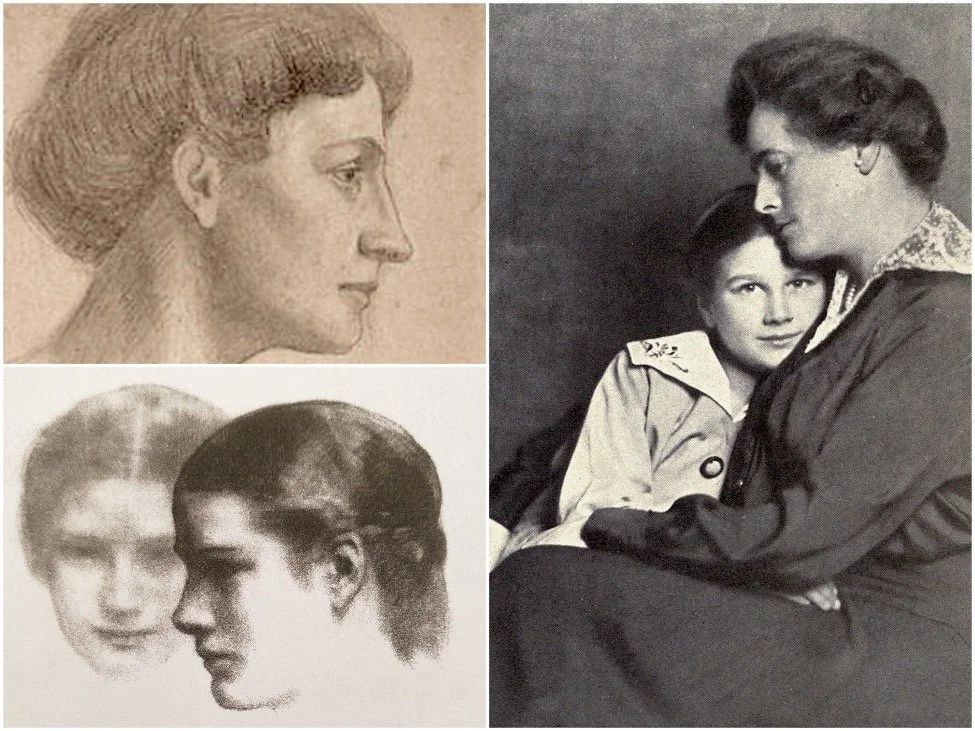
Kahlil Gibran’s sketches of 14-year-old Hope Ingersoll while staying at Bay End Farm in 1918. Via kahlilgibran.com.
In 1906, the fishing club was sold to the Garland-Ingersoll family, led by Mary Tudor Garland Ingersoll, who immediately transformed the 900-acre lot into Bay End Farm.
Mary and her husband were wealthy socialites. Mary was a well-known and passionate patron of the arts. She immediately set out to create a place for artists to stay, inspire each other, and create. She had prefabricated cottages built for artists of all kinds to visit, several of which are still in use today. Mary, a close friend of painter Georgia O'Keeffe, played host to many notable figures of her time, including Mark Twain and artist and writer Kahil Gibran, who wrote part of his famous book The Prophet while residing at the farm. The artist's colony flourished until the 1950s. The property was also made available to provide housing for military officers during World War I.

Postcard depicting Bay End Farm in the early 1900s.
Mary's other passion, and one carried on and championed by her daughter, Hope Garland Ingersoll, was the preservation of their farm, one of the last large properties in the area. At some point, Hope changed the name of Bay End Farm to Grazing Fields Farm. The property became well-known for its progressive land use, eschewing pesticides and herbicides, and for its livestock breeding, famous for its prize-winning Welsh ponies, Guernsey cattle, Montdale sheep, and Sealyham Terriers.
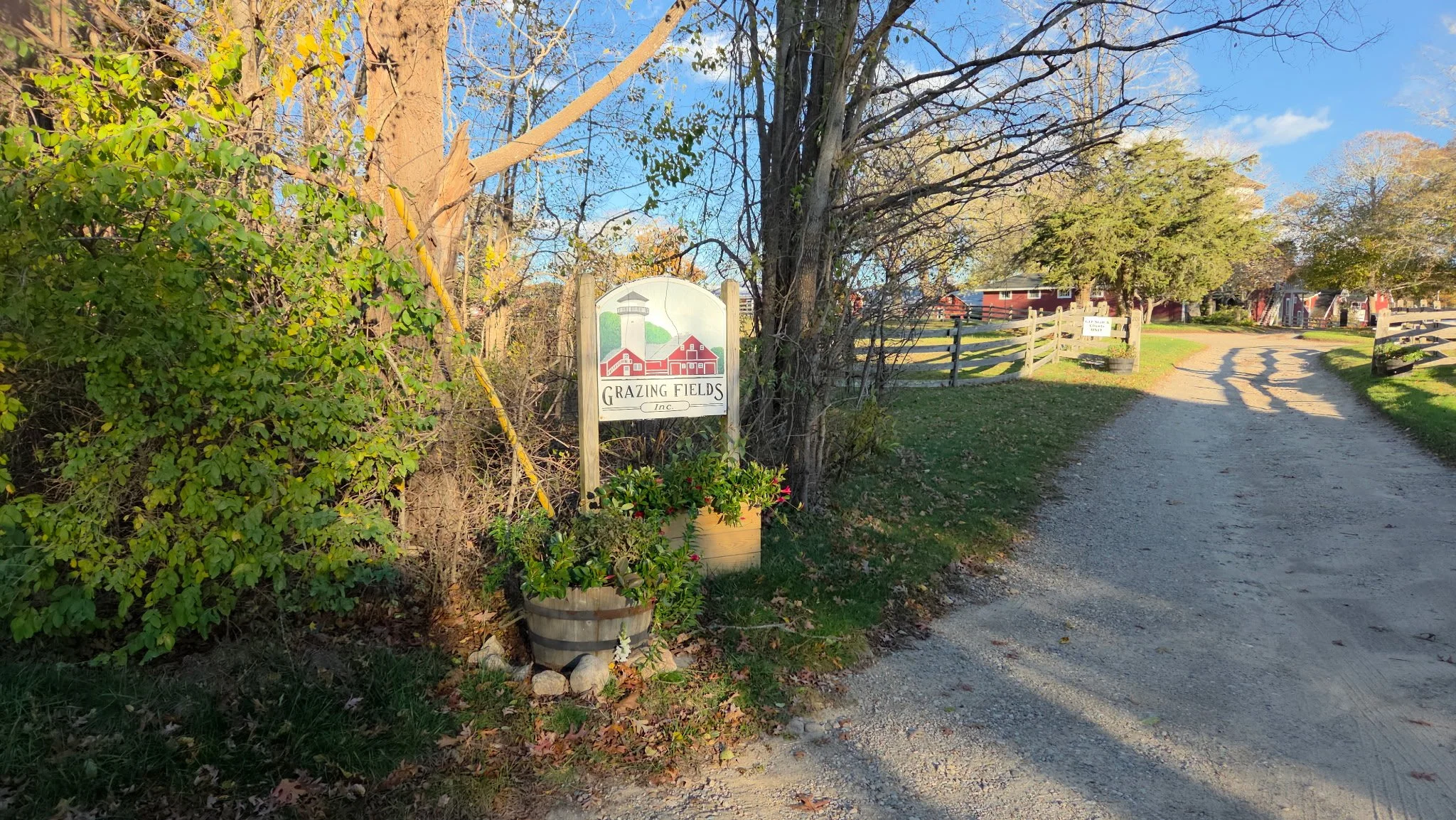
Grazing Fields Farm exists today as a horse farm on a portion of the Ingersolls’ original property.
Grazing Fields Farm operated in this manner until 1957, when Hope Ingersoll gained local and even national fame during her 25-year fight to save the property from a state highway expansion. The project’s goal was to speed up summer automobile access to the Bourne Bridge. Officials would have invoked eminent domain to break up the Ingersoll property. Hope contested the state's architectural plan and privately paid architects to design an alternative route plan. In 1982, aided by new federal environmental regulations, Hope prevailed. The story gained recognition throughout the environmental movement and in the news, including the New York Times, whom Hope told, “I think it’s true that you can fight City Hall. But you’ve got to have a lot of persistence, and help—and luck. We started this long before anyone was worried about the environment. … We have always been concerned with protecting the land.”

Hope Ingersoll. Photo courtesy of Kofi Ingersoll.
Old Field Pond Preserve
In 1983, the Ingersoll family decided to donate 145 acres in the middle of their property to Wildlands Trust so it could be protected in perpetuity. This was the beginning of Old Field Pond Preserve. The name Grazing Fields Farm applies today to the horse farm on the southeast side of Bournedale Road. The rest of the historic Ingersoll land, abutting Old Field Pond Preserve on the northwest side of Bournedale Road, has reclaimed the name Bay End Farm. Hope’s grandson, Kofi Ingersoll, owns and operates this organic produce farm. In partnership with the Ingersoll family, Wildlands uses Old Field Pond Preserve in several ways. Wildlands and Bay End Farm staff and volunteers guide hikes on the property throughout the year. The farm also provides environmental education to Wildlands’ Green Team, Envirothon Team, and other youth programs, and assists Wildlands staff in the maintenance, trail trimming, and haying of the preserve.
We hope you will join us for our next guided hike or volunteer event at Old Field Pond Preserve. Sign up for our E-News and visit wildlandstrust.org/events to stay updated on the latest opportunities to explore this special place. You will not regret it.

Kofi Ingersoll. Photo by Drew Lederman.
Learn more
Resources utilized in researching this history include:
The Herring Pond Wampanoag Tribe: herringpondtribe.org
Bourne Historical Society: bournehistoricalsociety.org
American Aristocracy: americanaristocracy.com
Grazing Fields Farm: grazingfields.com
Kahil Gibran website: kahlilgibran.com/latest/132-the-house-of-the-prophet-gibran-at-mrs-garlands-farm
"Farmer Wins 25 Year Fight over Cape Road," New York Times, 10/10/82: nytimes.com/1982/10/10/us/farmer-wins-25-year-fight-over-cape-road.html
50 Remarkable Years, 50 Remarkable People, “The Ingersoll Family,” Wildlands Trust: wildlandstrust.org/anniversary-book-blog/2024/4/9/ingersoll-family
Interview with Kofi Ingersoll, 10/31/25.
A special thanks to Kofi Ingersoll for his recollections and photos, and to Thomas Patti for editing this history.
Local Lens: Q&A with Wildlife Photographer Peter Yekhtikian
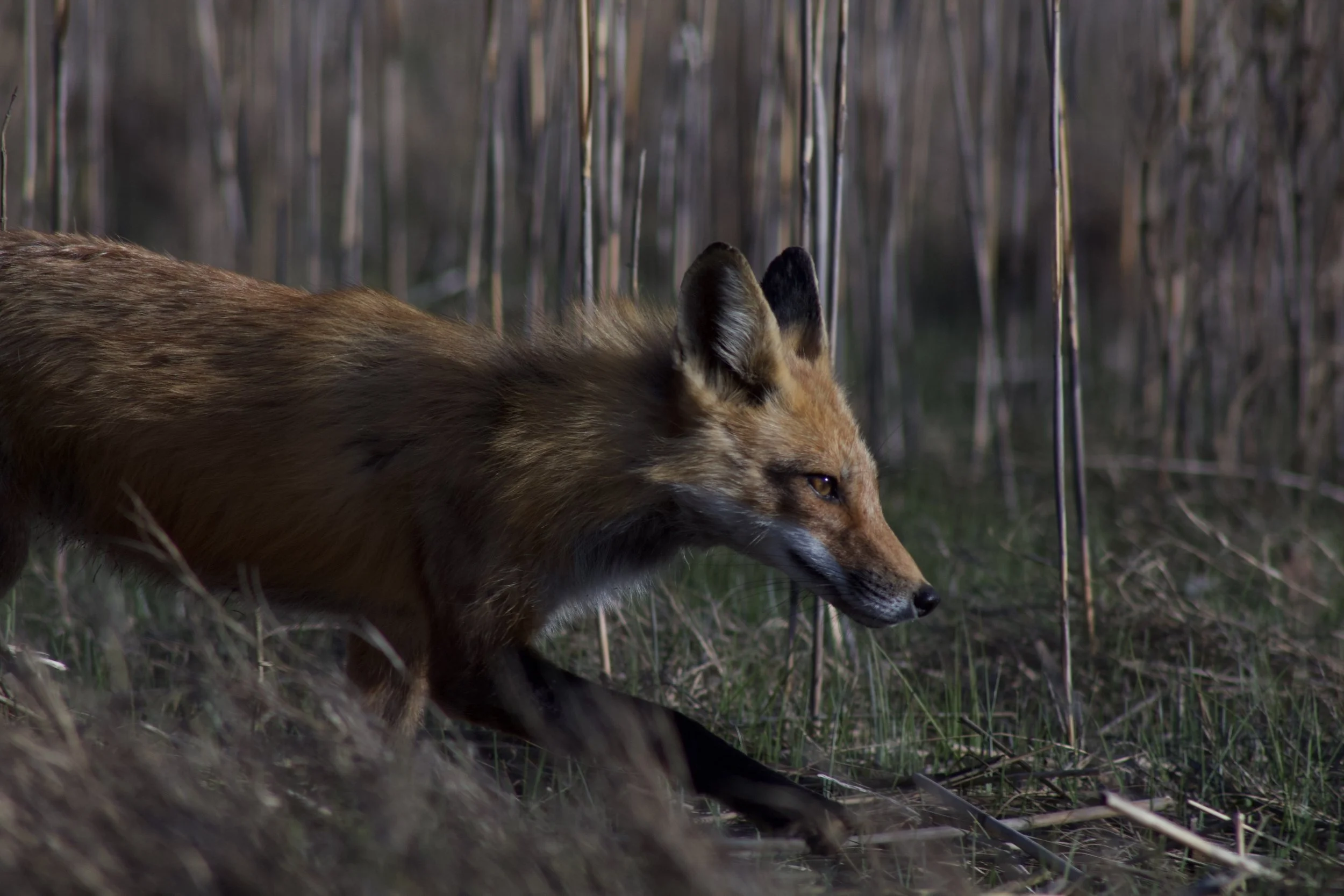
Red fox at The Nook Preserve in Kingston. Photo by Peter Yekhtikian.
By Thomas Patti, Communications Coordinator
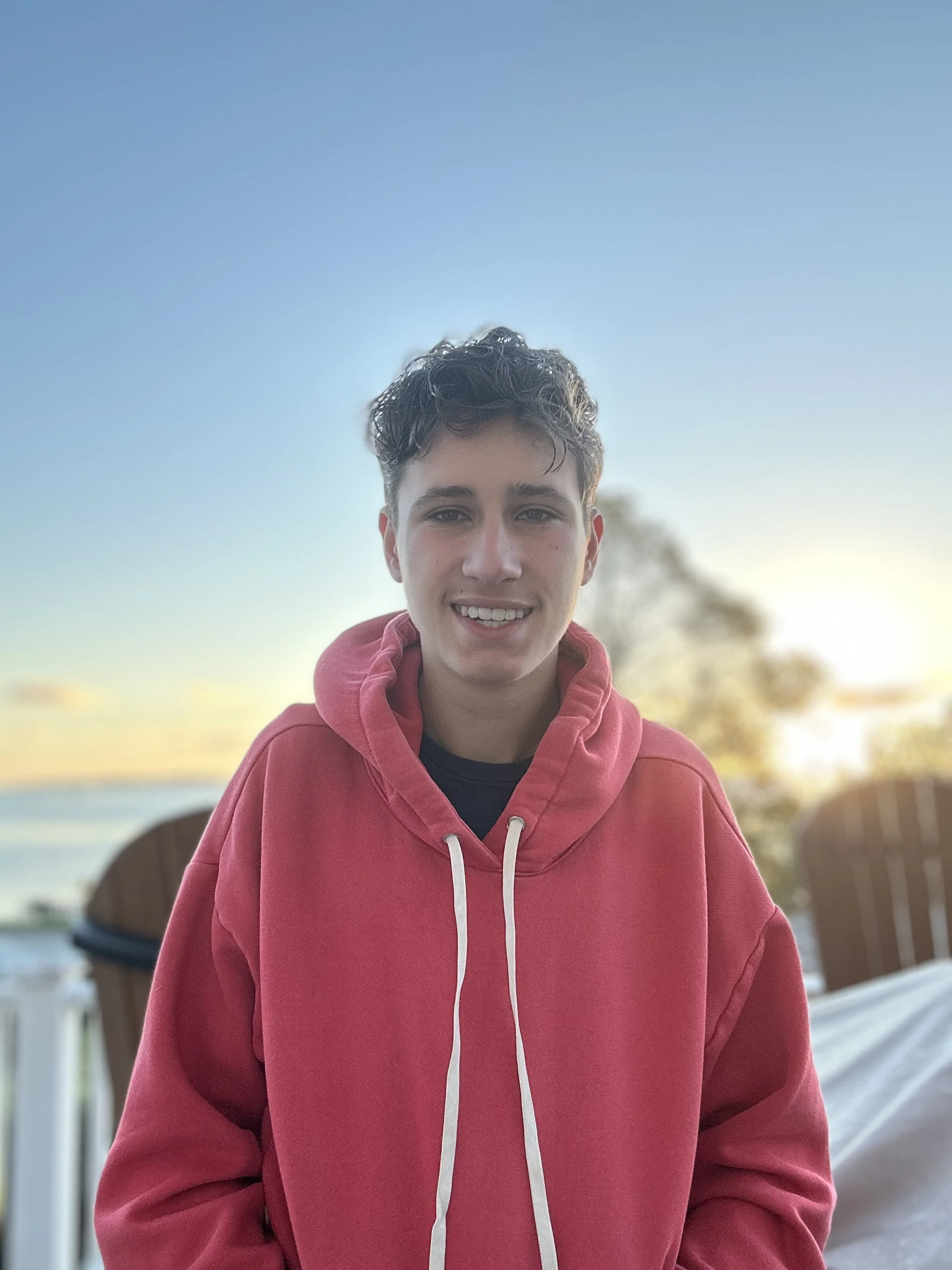
Peter Yekhtikian.
Many pursue wildlife photography as a retirement hobby. For Peter Yekhtikian of Kingston, it’s anything but. For starters, Peter is 16 years old, a junior at Rising Tide Charter Public School. Wildlife photography is also more than a hobby for Peter. Already, he has leveraged his keen observation skills and prodigious naturalist knowledge to spotlight and protect his local natural areas—including The Nook Preserve in Kingston, where he volunteers as a Wildlands Trust Adopt-a-Preserve trail monitor. I spoke with Peter about what spurred this passion and why everyone should spend more time on their neighborhood trails.
This conversation has been edited for length and clarity.
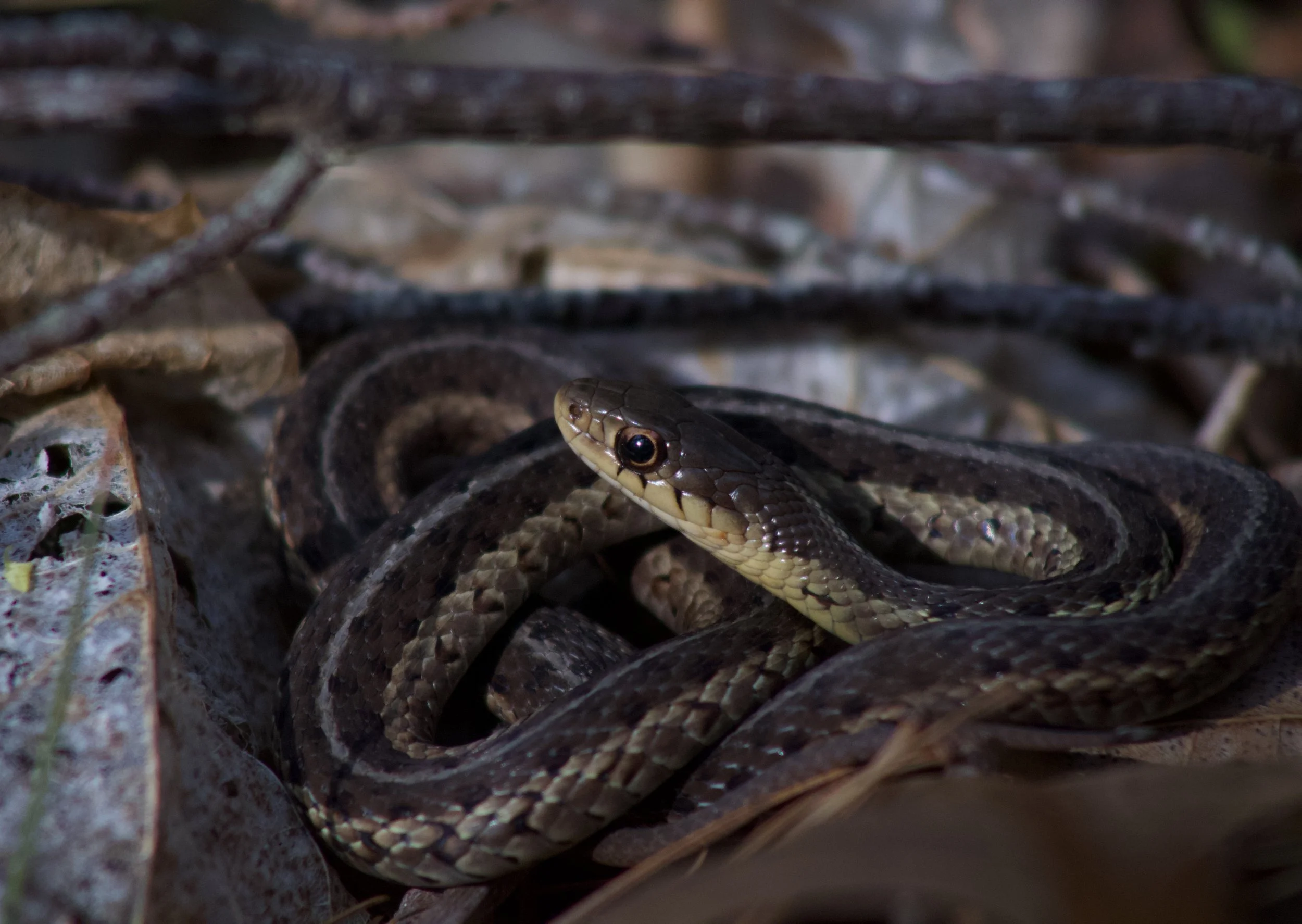
Eastern garter snake at The Nook Preserve in Kingston.
Thomas Patti: How did you get into wildlife observation and photography?
Peter Yekhtikian: I got into wildlife when I was about six. I loved watching Nat Geo documentaries and reading books about different animals.
When I was in fifth grade, we were watching the Bruins and heard screaming outside. We ended up figuring out where it was coming from and finding a fisher cat. It was crazy to see that in our neighborhood. That struck my interest in local wildlife.
Then, I got a camera for my birthday. One day, we had a Ring-necked Pheasant in our yard, and our little dog was chasing it. I was like, ‘Oh, this is really funny and cool. What if I try photography?’ And I just started taking photos of anything flying overhead.
From there, I got into using eBird so I could document some of the stuff I was seeing. I'd go out into our woods and take photos of anything I could find, and then I'd try to identify it and put it on [community science platforms] iNaturalist and eBird. It’s kind of like a game: how many species can I see today?
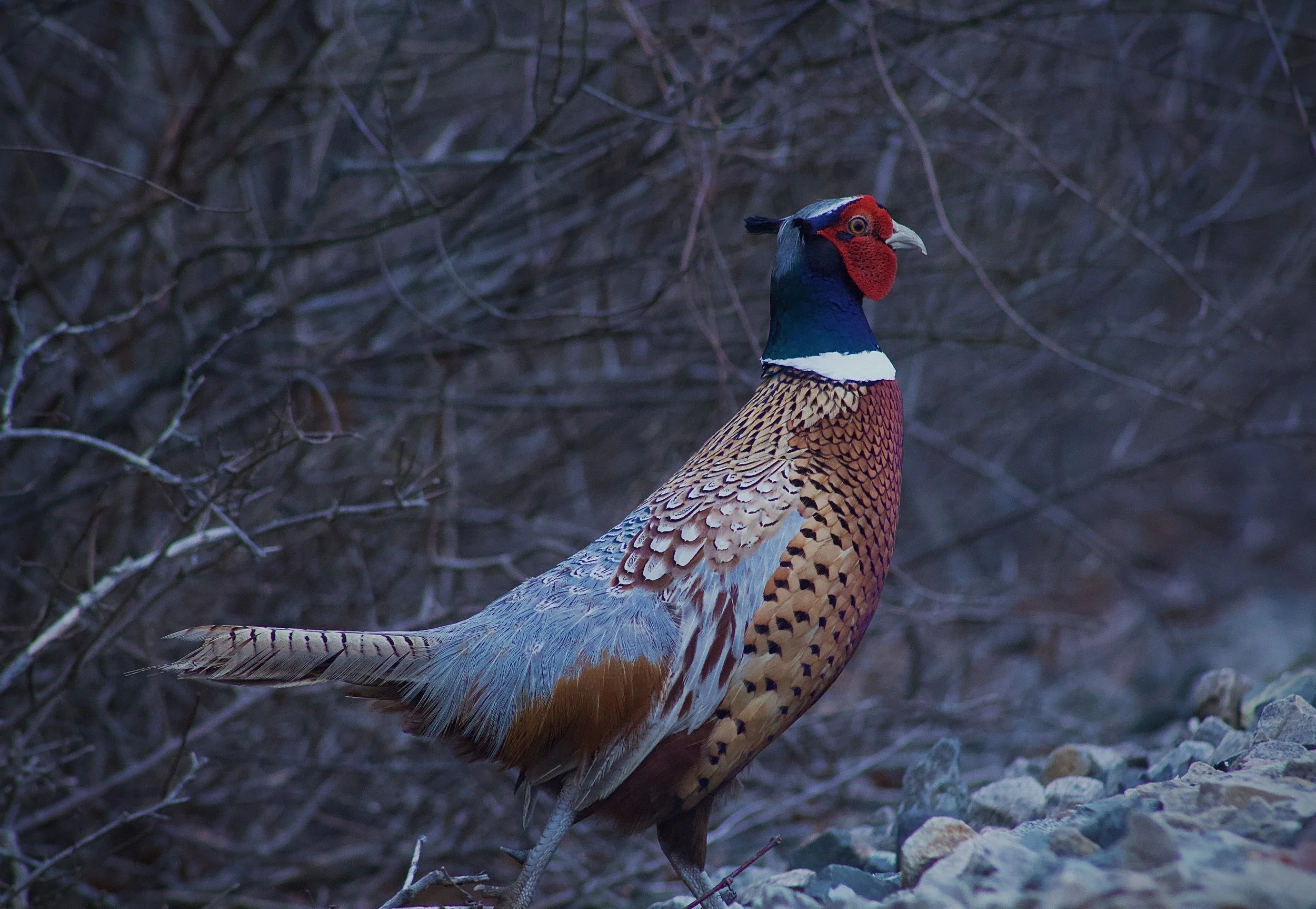
Ring-necked Pheasant in Rocky Nook, Kingston. Photo by Peter Yekhtikian.
You seem content documenting wildlife in your own backyard—often literally. Why is that?
Kingston is just as important as anywhere else. Because of all the habitats here—freshwater and saltwater marsh, the open bay, forest, wetlands, fields—we get species that other places don’t. I think my record was 73 species observed in one day. That was awesome.
I feel like Kingston is underrepresented in terms of wildlife data. If I can show people how much stuff we have here, it may inspire them to explore local preserves that aren’t appreciated enough. I’ve met people at The Nook who said they had never known about the preserve until they saw an eBird checklist I submitted. It feels really nice to know that what I’m doing is inspiring people to go to these places.
This summer, I interned with the Kingston Conservation Commission as a wildlife monitor. One day, I was checking the marsh in Rocky Nook, and I saw something fly out of the marsh. It was a sparrow, but it didn't fly like a Song Sparrow. It looked totally off. I was like, ‘Huh, what could this be?’ I ended up getting a photo, and I noticed a yellow streak on the eye. I was like, ‘Oh, wow. This is a Saltmarsh Sparrow.’ Mass Audubon’s most recent survey noted that Saltmarsh Sparrows had increased in population everywhere in Massachusetts except the South Shore, where there was no breeding activity at all. So, it was cool to see that they were breeding in our marshes. I don’t think anyone had ever checked, because no one really goes out there.
The Town of Kingston wanted to get a grant for adding more salt marsh hay into the marsh to attract Saltmarsh Sparrows. Now that we have evidence that they’re already breeding here, it’s going to be a lot easier to get that grant.
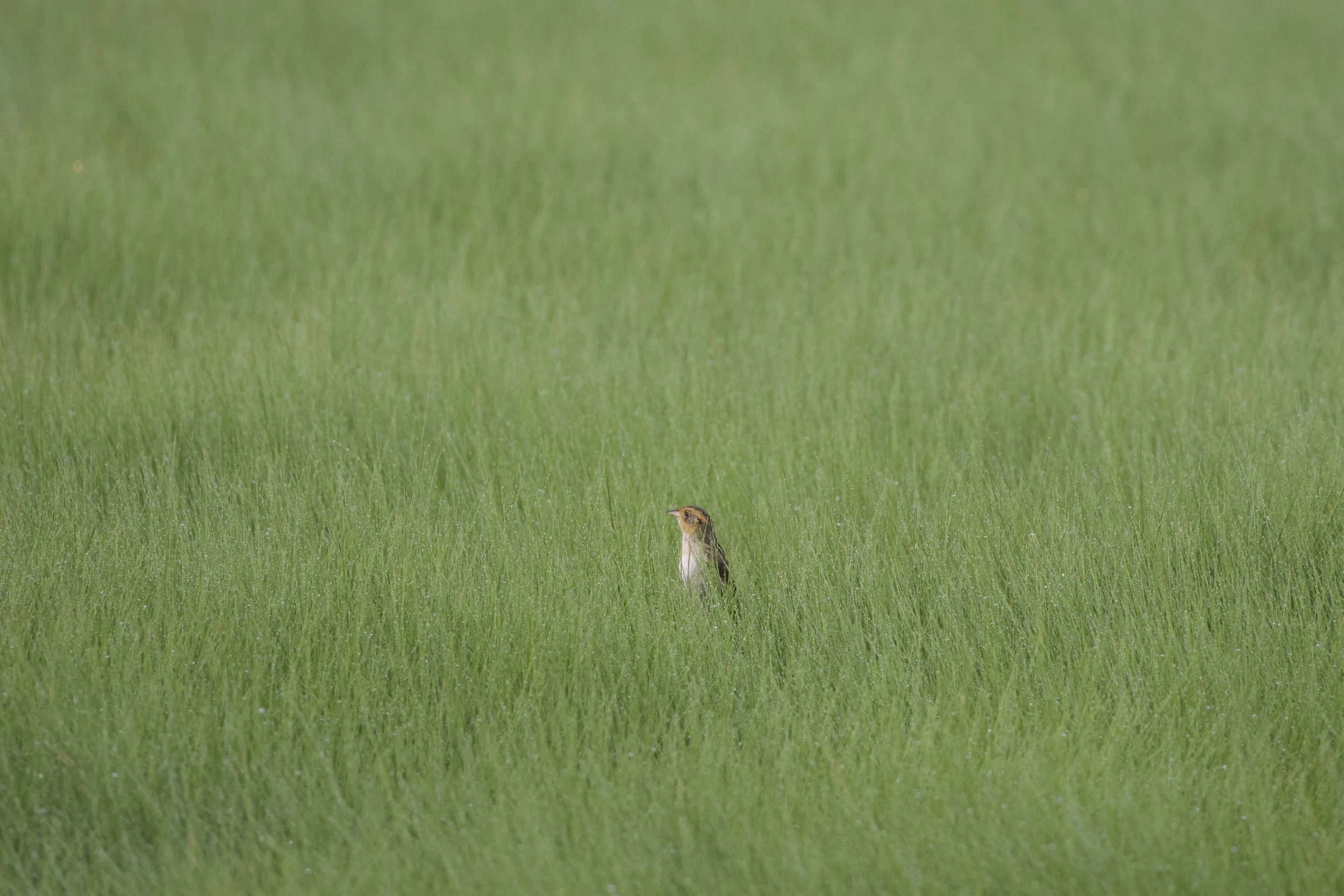
Saltmarsh Sparrow in Rocky Nook, Kingston. Photo by Peter Yekhtikian.
That is a great example of why communities should know and care about their local environment. What story do you hope to tell with your photos and videos?
The message is just to get outside and explore. Everyone should at least try to go into the woods. Just observe what’s around you. Everything is so fast-paced nowadays. Sometimes it’s nice to just slow down and get somewhere peaceful, where you’re not always on your phone, scrolling on TikTok or something.
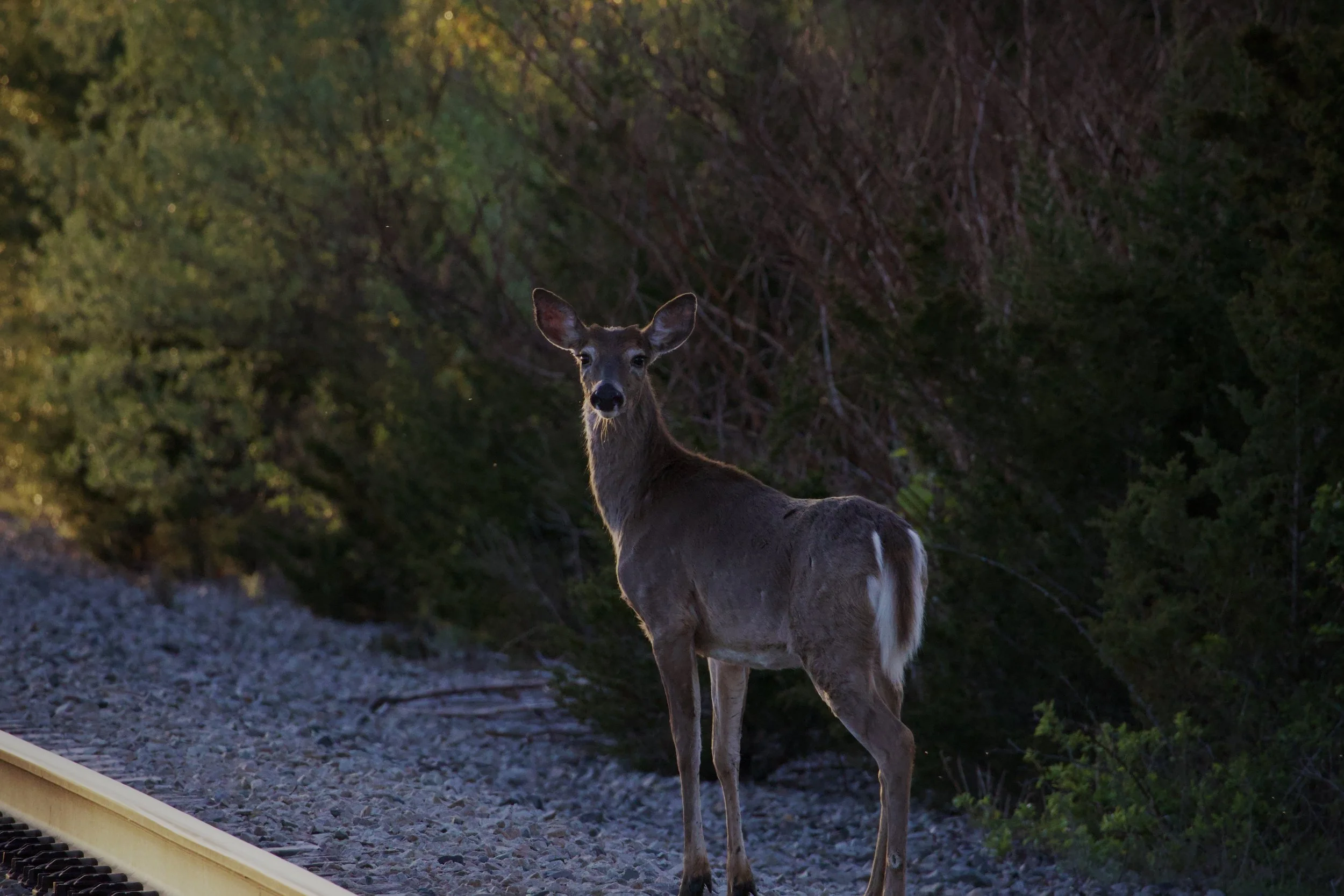
White-tailed deer in Rocky Nook, Kingston. Photo by Peter Yekhtikian.
You also serve as an Adopt-a-Preserve trail monitor. Why do you volunteer with Wildlands?
My dad is a member of Wildlands Trust. Last year, he got an email from Wildlands asking for volunteers at certain preserves, and one of them was The Nook. And it just kind of struck me that I already go there so much. Why not help out more officially with the organization?
I also went to Wildlands’ birdhouse building workshop at the Stewardship Training Center last spring. I really enjoyed it. Afterwards, my Uncle Ken and I wanted to build more birdhouses for Kingston. So, we met with the Town of Kingston’s Conservation Agent, Matt Penella, to decide where we should put them. That meeting led to my summer internship with the Town. So, Wildlands Trust is very connected to my conservation story.
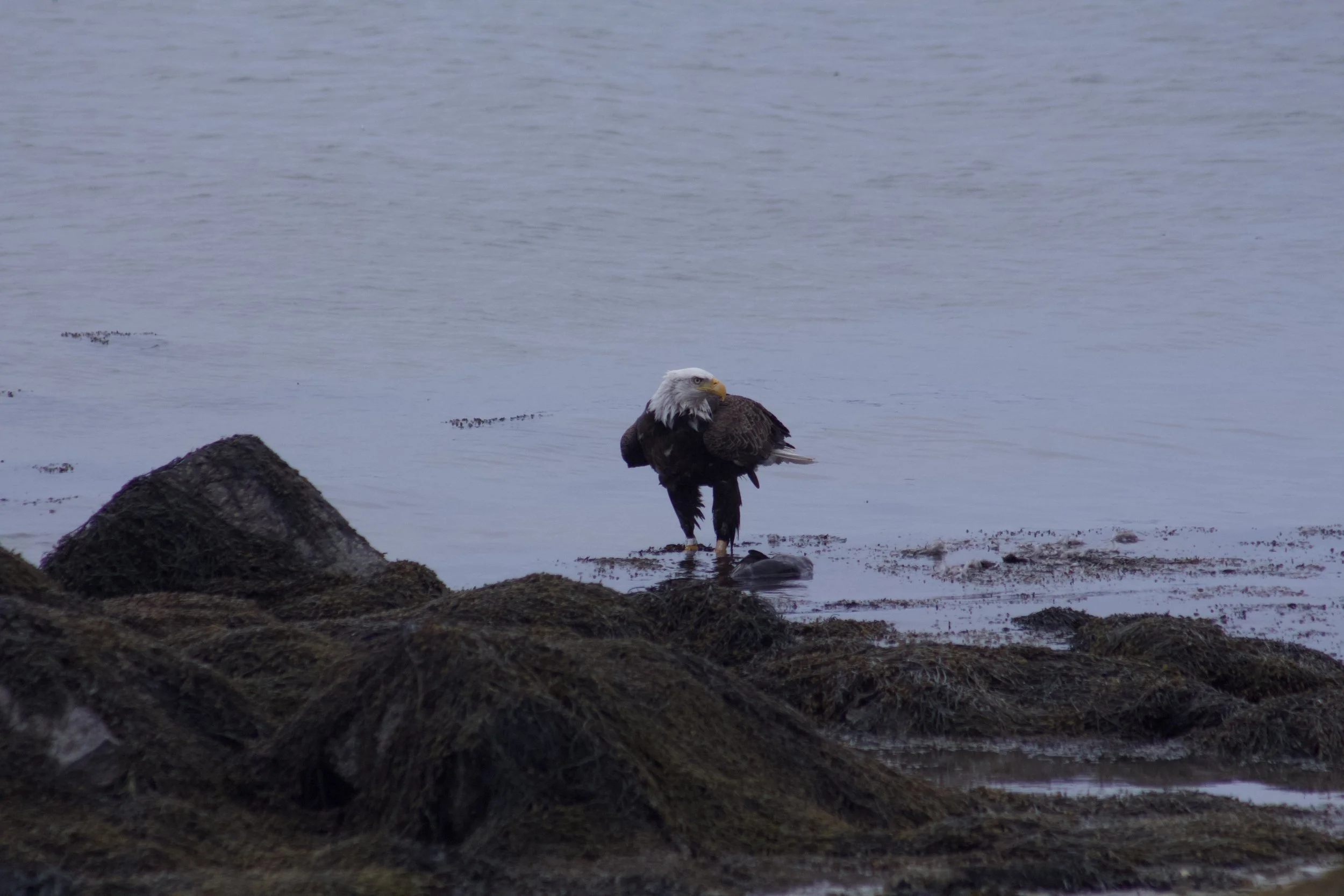
Bald Eagle in Rocky Nook, Kingston. Photo by Peter Yekhtikian.
Any other memorable wildlife experiences?
Last year, I was walking in the marshes, and I saw something that caught my eye. It was a fox running around the marshes. He was pretty far away, but then he kept getting closer and closer. I think he got within three feet of me, which was really, really, really cool to see. And he was almost playful with me. He was rolling around near me. It was just this wild animal, right next to me.
What’s next for you? Do you see a future in the conservation field?
I definitely want to do something revolving around conservation—either preserving nature or helping people work with it. I’m interested in going to college for environmental engineering.
In addition to photography, Peter captures video footage of Kingston wildlife using motion-activated trail cameras. Watch the video below for a compilation of Peter’s breathtaking work. View more on Peter’s YouTube channel, “Rocky Nook Trail Cameras.”