


What’s New at Wildlands
What's Up With Wetlands?
By Roxey Lay, Membership and Communications Coordinator
EPA map displaying coastal wetlands and how far inland they extend (click to enlarge).
Swamps, marshes, bogs, and fens; all ecosystems defined by various sub-types and characteristics with one thing in common: they are all wetlands. World Wetlands Day was February 2, marking the date the Convention on Wetlands was adopted in 1971 and raising awareness of wetlands and their vital role to our planet. Massachusetts was the first state in the nation to adopt wetland protection laws during the 1960s; however, since the Colonial Period, roughly one-third of the state’s wetlands have been destroyed[1]. According to the EPA, “wetlands in coastal watersheds are experiencing disproportionate losses compared to wetlands in the rest of the country, making them particularly important areas for protection”[2]. Wildlands’ work to protect undeveloped land throughout the region includes the protection of wetlands. In fact, nearly all of the properties in Wildlands’ portfolio contain some type of wetland and provide habitat for many different species throughout the region; some of which are rare or endangered, such as the eastern box turtle and northern red-bellied cooter.
Drone view of Raven Brook in Middleborough.
Recently, I spoke with Brad Holmes, manager of Environmental Consulting & Restoration, LLC (ECR) to learn about what wetlands are and how they impact Southeastern Massachusetts. Located in Plymouth, ECR specializes in wetland consulting, permitting and restoration, and Brad, a professional wetland scientist (PWS), has worked with Wildlands at Great River Preserve and most recently, on the ecological restoration project along the shore of Halfway Pond. Read on to learn about wetlands and their significance to our region:
What is a wetland?
A wetland is an area where groundwater is located at or near the surface and where the vegetative community is dominated by plants adapted to live in saturated soil conditions. Wetlands often border on creeks, rivers, streams, ponds, lakes etc., but may also be isolated. Wetlands are [determined] by assessing three specific site conditions that include vegetation, soil, and hydrology. By definition, a wetland must include 2 of 3 conditions: a dominance of wetland vegetation, hydric soils, and/or hydrological conditions.
What is a wetland scientist?
A Professional Wetland Scientist is an individual that has been certified by the Society of Wetland Scientists based on academic and work experience in wetland science. As a PWS we work to assess and manage wetland resource areas throughout Massachusetts. Our work includes field delineation of wetlands based on specific environmental conditions (i.e. vegetation, soils & hydrology) as well as designing and permitting projects through the applicable local, state and federal regulatory authorities.
In addition to your work as a PWS, you are certified by the MA Arborists Association as an arborist, how does this influence your approach to your work?
As an MA Certified Arborist, I approach projects with a special consideration towards the care of trees, specifically when designing wetland restoration or wetland replication projects.
North River in Marshfield.
What are the benefits of wetlands?
Wetlands provide benefits to landowners and the public, [including] protection of public and private water supply, protection of groundwater supply, flood control, storm damage prevention, prevention of pollution, protection of fisheries and protection of wildlife habitat.
Why is important to protect them?
Wetlands act as a first line of defense for floodwater from storms. They also act as a filter to pollutants in our water supply. They [also] provide a specific habitat that many wildlife and fish need to survive.
Do wetlands have any significance to Southeastern Massachusetts?
There are many extensive wetland systems within Southeastern Massachusetts. For instance, the North River system in Scituate, Marshfield, Norwell, and Pembroke. Also consider the Taunton River system, the extensive freshwater ponds and the 250+ miles of coastline in Massachusetts.
It is important for property owners and the general public to be aware of the wetlands in their community and where they can seek guidance in protecting the wetland resource areas.
What is the current state of wetlands in this region? Are they threatened? If so, what can people do to help?
Wetlands in Massachusetts are protected by the Massachusetts Wetlands Protection Act and associated Wetland Regulations. [These] spell out specific performance standards for work within or nearby (buffer zone) wetland resource areas. It is important for property owners and the general public to be aware of the wetlands in their community and where they can seek guidance in protecting the wetland resource areas. Many towns in Massachusetts have a local Conservation Commission that works to protect the resource areas in their community.
What do you think the future of wetlands is?
Wetlands will be protected. The next task is protecting more land buffering wetlands, which is the current struggle.
Wetlands at Striar Conservancy, Halifax
Want to learn more about wetlands and whether there are any near your home? Talk to your local Conservation Commission, go to the State’s website on wetlands, or, if there is a Wildlands property near you, ask us what type of wetland is on the property and how you can help in maintaining its integrity for the benefit of your town and the animals that rely on its habitat. I’d like to thank Brad for taking the time to answer my questions and providing some great insight on the importance of wetlands and their impact on our region.
Spring Will Bring Trailhead Improvements at Davis-Douglas Farm
By Roxey Lay, Membership and Communications Coordinator
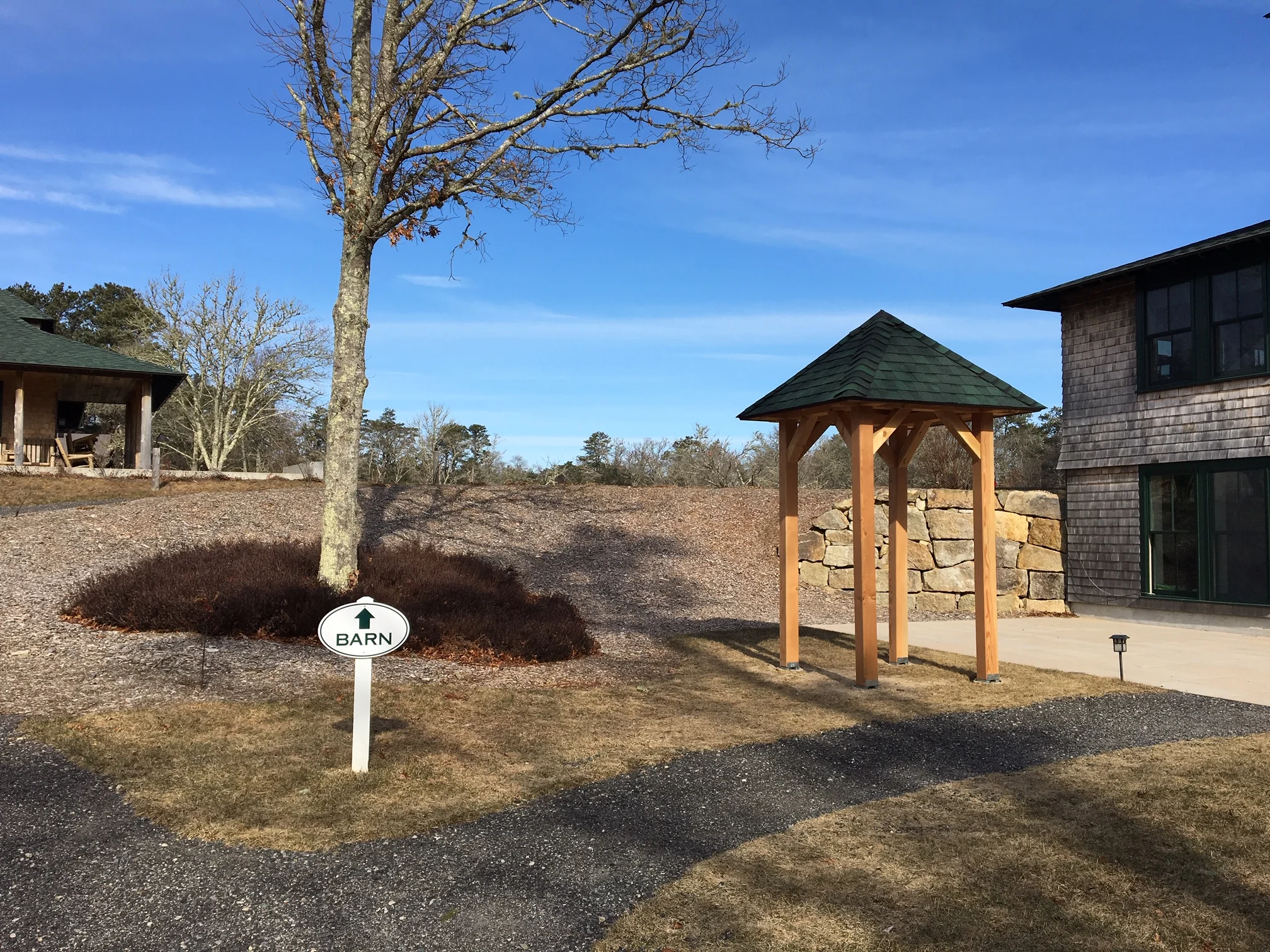
The Davis-Douglas Farm kiosk, mid-construction.
Long before Davis-Douglas Farm (DDF) became Wildlands Trust’s headquarters, it was where the Davis and Douglas decedents created memories together. One such memory, involves a newly paved Long Pond Road during the 1950s. Story goes; the boys of both families would get together and place tin cans on the road and with their ears to the ground, listen for the rumble of an approaching car. Traffic was so light, they would have to wait and hope one would come along. Eventually, their patience would pay off and after scurrying off to the side of the road, they would motion to the passing vehicle to run over the can and flatten it, much like a penny on a train track.
Fast forward to 2019 and you don’t need to wait long to hear a car on Long Pond Road. In fact, crossing from DDF to the looped trail system across the street has been described as feeling “like a squirrel dodging traffic”. Over the last few years, we have welcomed more and more visitors to the DDF property for both programs and general leisure, and with safety being a top priority at Wildlands, the Davis-Douglas Farm trailhead is getting a revamp!

A new crosswalk across Long Pond Road features lights to alert drivers of pedestrians crossing.
Set to be complete this spring, visitors arriving at DDF will first notice a newly built kiosk at the base of our office building. This eight-sided wonder will be loaded with information on trail maps, programming, Wildlands and DDF history, town ecology and property highlights! Following the path up, past the Community Conservation Barn and down the center driveway, visitors will find a new footpath leading them from the end of the driveway, directly to a new pedestrian operated crosswalk; eliminating the need to walk along the road. The crosswalk, outfitted with Rectangular Rapid Flashing Beacons to alert drivers, will make it both easier and safer to access the trail system connecting Emery Preserve West with Six Ponds East Preserve through the town conservation land.
Matt Luongo, Wildlands’ land stewardship research assistant, has spent the last few months researching and writing content for the kiosk, as well as working with graphic designer, Cory DePasquale on the panel designs. Along with the DDF kiosk update, Matt is also working to update six other kiosks at five of our other preserves: Halfway Pond Conservation Area, Striar Conservancy, Great River Preserve, Willow Brook Farm, and Stephen C.L. Delano Memorial Forest. Lucas Nichols, of Long Pond Custom Builders, is currently in the process building the DDF kiosk and the town of Plymouth is installing the crosswalk and crossing signals.
With these improvements, Davis-Douglas Farm will continue to serve as a place for families and friends to gather and create memories together, safely.
I’d like to thank Sam Chapin for sharing the story of the Davis and Douglas boys with me, originally shared by one of the Bongiovanni bothers at a Wildlands event.
Echoes of Conservation in Stoughton
By Scott MacFaden, Director of Land Protection

A great blue heron ponders the shores of Glen Echo Pond.
Wildlands welcomed another community into our portfolio of Community Preservation Act (CPA) partners with a recent completion of an 80-acre CPA Conservation Restriction (CR) in Stoughton.
Situated a short distance from busy Route 139, yet possessed of a feeling of remoteness, the Glen Echo property includes extensive frontage on Glen Echo Pond, a highly scenic and mostly undeveloped hidden gem straddling the Stoughton/Canton boundary, multiple vernal pools, woodland hiking paths, and rocky bluffs that afford striking views of the pond and the surrounding landscape. A small portion of the property extends into neighboring Canton.
The town used CPA funds to acquire this long-time preservation priority in 2011. Prior to the town’s acquisition, the Glen Echo site enjoyed a long and colorful history. For much of the 20th century, it hosted the Glen Echo Resort which offered boating on the pond, band concerts, bowling, swimming, and for a time, benefited from a trolley connection to Route 139. In its heyday urban dwellers seeking relief from the summer heat flocked to the pond’s pristine shores. Following the resort’s demise, the Glen Echo site sat dormant for many years, awaiting its next incarnation.
With its resort past now safely in the historical domain, the Glen Echo property has an exciting future as one of Stoughton’s premier open space reserves. Our CR ensures that most of the property will remain in perpetuity as protected open space available for a wide range of passive recreational pursuits, including hiking, nature study, kayaking, and cross-country skiing. The six acres not covered by our CR will eventually host facilities for active recreational pursuits, likely to include tennis courts and soccer fields.
Congratulations to all of the Stoughton officials and volunteers who worked diligently to ensure that the Glen Echo’s next chapter as an open space treasure will endure for centuries to come.
First CPA CR in Middleborough Completed
By Scott MacFaden, Director of Land Protection

A woodland path at Oliver Estate.
Our last completed project of 2018 was also a first of its type, our first Community Preservation Act (CPA) Conservation Restriction (CR) in Middleborough, the 43-acre Oliver Estate CR.
The town of Middleborough used CPA funds to purchase the 50-acre property in 2015. Situated at the junction of Route 44 and Plymouth Street, and just across from the town’s well-known Oliver Mill Park, Oliver Estate possesses considerable ecological significance. It includes over 3,000 feet of frontage on the Nemasket River, a major tributary of the Taunton River, multiple vernal pools, scenic woodland paths, and habitat for multiple state-listed rare species, including the eastern box turtle. The property is also historically significant, as it includes the historic Oliver Homestead and grounds, dating from the mid-eighteenth century. To learn more information on the Property’s fascinating human history, visit: http://discovermiddleborough.com/discover/oliver-estate
Our CR covers most of the property whereas a Historical Preservation Restriction held by Historic New England protects the seven-acre historic homestead portion. At some point in the relatively near future, the town intends to create a new trailhead parking area that will provide direct access to the property’s hiking paths.
Since our initial foray into protecting land in the Taunton River watershed in the 1990’s, in addition to prioritizing land protection along the river’s mainstem, we and our conservation partners have also afforded priority to preservation efforts along the Taunton’s tributaries and in headwaters areas. The Oliver Estate project is a prime example of a tributary-based project. Thanks, as always, to Middleborough Conservation Agent Patricia Cassady for her invaluable assistance in advancing this CR to completion, and for all of her ongoing efforts toward preserving Middleborough’s natural treasures.
Land Projects Heat Up as the Weather Cools Down
By Scott MacFaden, Director of Land Protection
Often a productive time of year for land preservation projects, this November proved particularly so for Wildlands. We completed a purchase in Plymouth and a land donation in Halifax that expanded two of our largest preserves, Halfway Pond Conservation Area and Striar Conservancy.
In Scituate and Plymouth, partnership projects reached a critical juncture and a closing, respectively. In Scituate, town meeting voters approved the purchase of MacDonald Farm, a beloved local landmark on 1st Cliff, and the town of Plymouth purchased an 88-acre property that includes one of the town’s highest-elevation landforms, the striking Hio Hill.

Early morning mist at Halfway Pond.
Halfway Pond Conservation Area Addition | Plymouth
A few days before Thanksgiving, Wildlands completed the purchase of an 11.4-acre parcel on Halfway Pond in Plymouth from the Waltham-based Advaita Meditation Center. This acquisition complements recent acquisitions we have made over the past several years near Halfway Pond and further expands Halfway Pond Conservation Area, one of our oldest, largest, and most beloved preserves.
A rectangular-shaped parcel with varying topography, this property is primarily wooded upland and includes over 470 feet of frontage on Halfway Pond. It is integral to our ongoing effort to pursue ecological restoration efforts along the pond’s shore that will allow for the revegetation of native species. Wildlands now owns almost all of Halfway Pond’s western shoreline.
A generous private donor supplied all of the funding for this acquisition. Wildlands is fortunate to enjoy the support of such donors who share our belief in the importance, indeed the imperative, of preserving our region’s natural heritage.

A snowy owl at rest at MacDonald Farm.
Photo courtesy of Jim Petit.
MacDonald Farm | Scituate
On November 14, voters at Scituate’s special town meeting voted to approve the town’s purchase of MacDonald Farm, the last remaining undeveloped parcel on 1st Cliff and one of the few remaining along the town’s 21-mile coastline.
MacDonald Farm includes 600 feet of frontage on Scituate Harbor, abuts other open space parcels and NOAA’s Stellwagen Bank National Marine Sanctuary headquarters, and is a significant component of the vista from multiple vantage points in Scituate Harbor. In decades past, saltmarsh hay and Irish moss were harvested from its shores.
The town will use Community Preservation Act (CPA) funds to acquire the property and, in keeping with CPA requirements, will grant a Conservation Restriction on the property to Wildlands following the closing.
MacDonald Farm has been a long-time preservation priority for local stakeholders, including 1st Cliff resident and abutter Mary Jenkins, and NOAA. Mary co-sponsored the application we submitted to the Scituate Community Preservation Committee last summer and was integral to the process of advancing the application through the review and approval process that culminated in the town meeting vote. NOAA representatives, Ben Haskell and Anne-Marie Runfola, provided invaluable support throughout that review and approval process. Wildlands is pleased to have had the opportunity to join the project in its latter stages and collaborate with these local stakeholders, town officials, and volunteers toward advancing the preservation effort.
Hio Hill Preserve | Plymouth
On November 29, the town of Plymouth acquired 88 acres off the east side of Old Sandwich Road in southeast Plymouth. The town used $1.1 Million in CPA open space funds and a $50,000 contribution from Wildlands to purchase the property, also known as Hio Hill Preserve. We were able to provide this critical complementary funding courtesy of a generous private donor.
Hio Hill Preserve is entirely wooded upland, with notably diverse topography. Its most prominent feature is its namesake hill, one of the highest elevation landforms in all of Plymouth. Hio Hill’s broad summit plateau offers views of Cape Cod Bay as well as much of the surrounding landscape. It directly abuts other open space parcels, including town-held land, and sits just across Old Sandwich Road from a 450-acre open space assemblage comprising multiple town open space parcels and our Richard F. Wynn Preserve. It is partially within a Zone II wellhead protection area and helps protect a town drinking water well situated three-fifths of a mile to the southeast.
Wildlands will hold a CPA Conservation Restriction on this outstanding new addition to the town’s portfolio of municipally-owned conservation land.
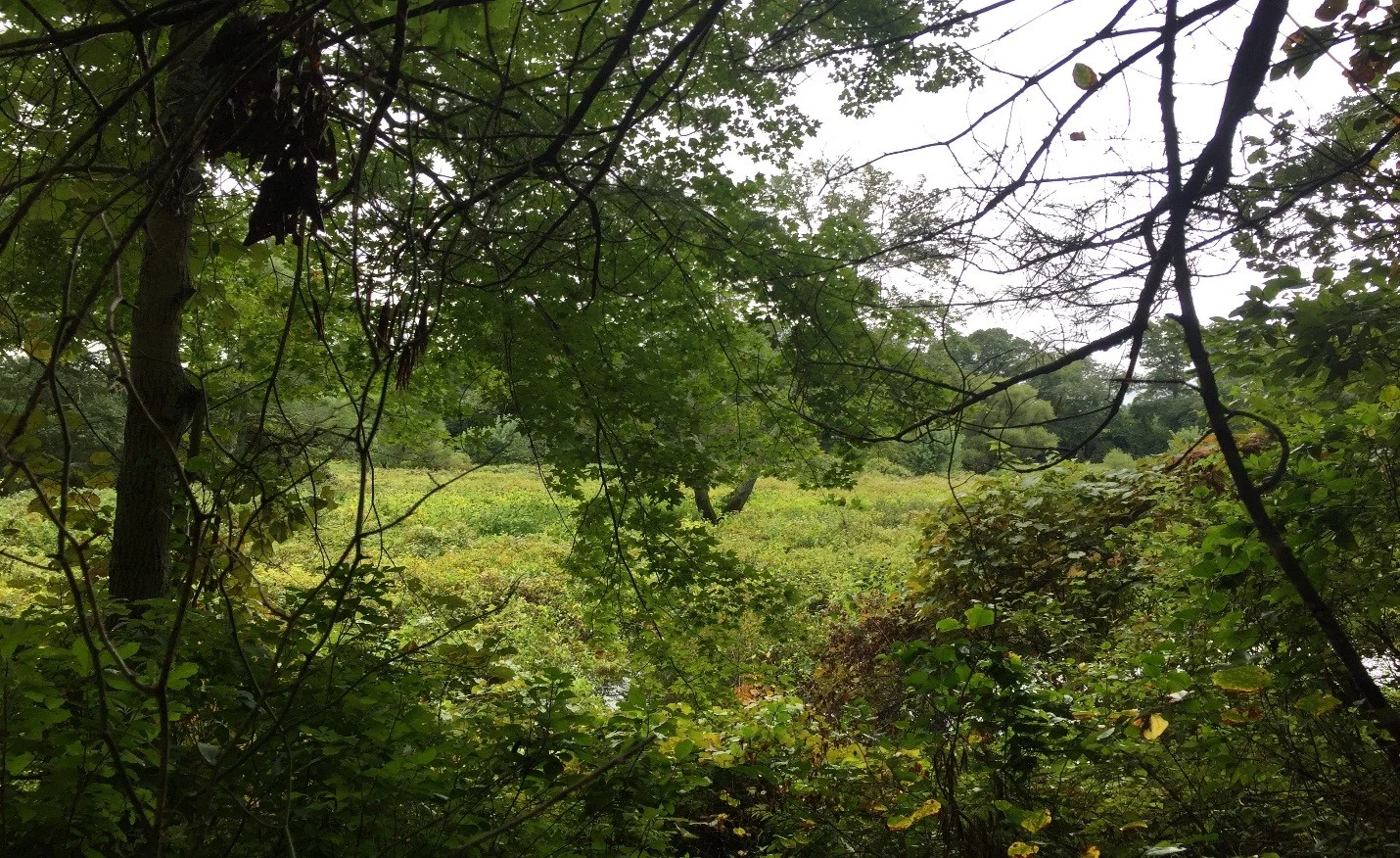
Along the Winnetuxet River in Halifax.
Striar Conservancy Addition | Halifax
Courtesy of the Stevens family, the last of our November projects included the donation of a 3.6-acre parcel along the lower Winnetuxet River in Halifax. Comprising primarily riparian wetlands, the parcel directly abuts and expands Striar Conservancy, our largest preserve in Halifax, and sits across the Winnetuxet’s expansive floodplain from the town of Halifax’s Randall-Hilliard Preserve, upon which Wildlands holds a Conservation Restriction.
Clyde and Gladys Stevens acquired the property in 1963. With the 2015 passing of Gladys Stevens, the property descended to her heirs, Ernest Stevens and Jeanne (Stevens) Wilson Baum, who graciously donated the parcel to Wildlands. We thank Mr. Stevens and Ms. Baum for their donation of this important component of the Winnetuxet River corridor.