


What’s New at Wildlands
Quest for Cotton Pond Trail
By Erik Boyer, Property Manager
About a year and a half ago while running errands after work, a cashier saw my Wildlands Trust logo and started talking about a preserve that he used to love hiking at when he lived on Ship Pond Rd. He described a walk that consisted of some hilly topography and that concluded at a little kettle pond. He hadn’t been there since moving to the Cape a couple of years earlier, but asked me how that property was looking currently.
At that point I had only worked with Wildlands for a couple of months and had yet to visit many of our properties. However, the passion and detail with which he described the property led me to pin down the Emery East Preserve, the smaller of our two Emery Preserves and one of the Trust’s first pieces of conservation land.
I spent the next day bushwhacking through a thicket of huckleberry and green briar to eventually make my way to Cotton Pond, a beautiful little kettle pond at the end of the overgrown trail. Two other features stood out: a very distinctive steep hill about half way through the hike – the type of hill that, during my days of running cross country, would have been honored a name, and an old sand pit that had become the dumping grounds for an assortment of old debris ranging from old computers, bed frames, and piles of misshapen scrap metal. I flagged out the old trail route and then didn’t visit the property for a while.
That is, until this past summer of 2016. On the hottest, most humid week of August, a group from the Sierra Club arrived at Wildlands Trust for a working vacation. This presented the perfect opportunity to reestablish the trail at Emery East Preserve. During this week, twenty plus volunteers re-blazed the old footpath, added more colorful trail markers, and removed a large portion of the debris that existed on site. To conclude this week of hard work, the trail was officially re-opened, reaching all the way from Ship Pond Rd. to Cotton Pond.

Sierra Club volunteers blaze a trail in the hot August heat!
However, the work wasn’t quite finished. We spent two Trailblazer Saturdays, one in September and one in December, with dedicated volunteers helping to install natural steps and a rope hand rail on the steep portion of the hill. Now hikers will be aided by foot and hand holds on the return trip from the pond, as well as by a bench built by the Sierra Club work group awaiting at the peak of the hill.
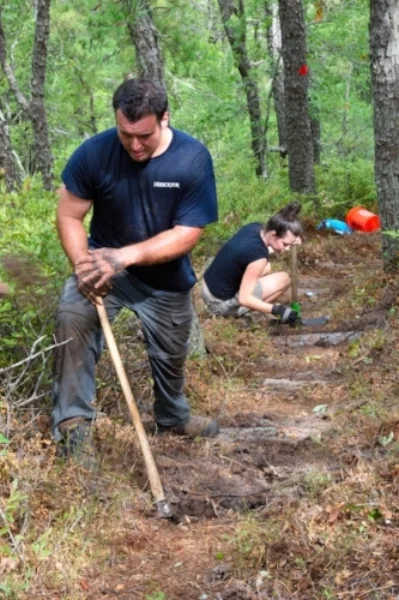
September Trailblazers put in natural stairs on the steep hill.
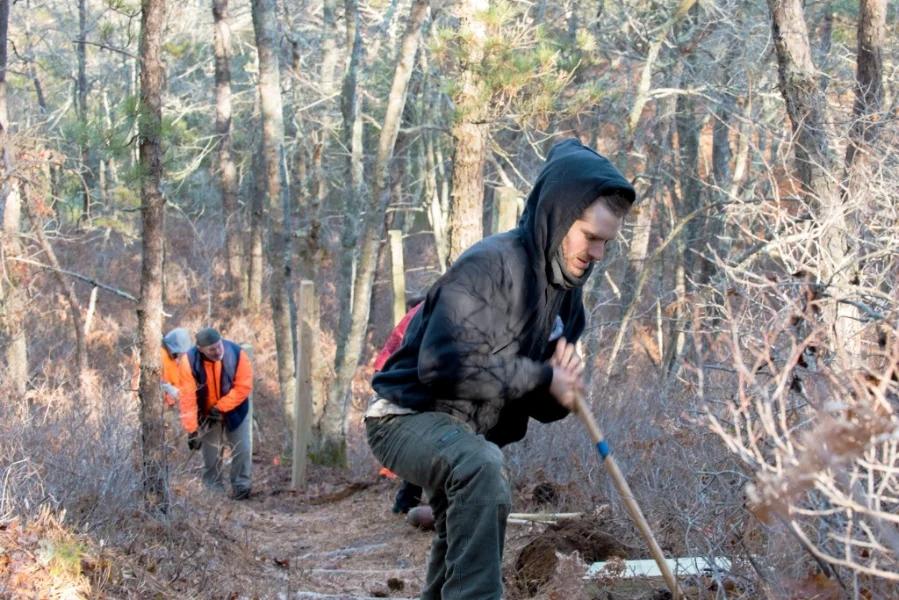
December Trailblazers get the job finished!
Round trip the trail is about 1.25 miles in length, but the steep hill makes one feel as though they’ve walked about 4 miles on level grade. Overall our Cotton Pond Trail at Emery East Preserve offers a more challenging walk then some of our other trails in Plymouth and it could not have been done without the help of the volunteers from Sierra Club and our Trailblazer team!
To hike the Cotton Pond Trail, park at the small trail head on the north side of Ship Pond Rd., east of Secretariat Drive. Trail map available here.
Land Trusts - Aren't They All The Same? (Well, yes and no)
By Scott MacFaden, Director of Land Protection
Since the end of World War II, America’s corporations have spent millions, probably billions, on advertising, in part to promote product differentiation. While it is unlikely that most land trusts will ever have the benefit of large advertising budgets, we at Wildlands Trust have come to learn that a little product differentiation in our profession is not a bad thing.
Although it is evident to those of us immersed in the field, it can be difficult to discern the differences between land trusts.
This confusion can also extend into day-to-day conversations and social interactions. From time to time, within various social settings this correspondent has explained what type of organization I work for, only to have my discussion partner reply: “Oh wait—you work for, what is it, The Nature Company?” (sic). My task then is to politely attempt an explanation in nonprofit product differentiation, and to note that while we have the utmost respect and admiration for our colleagues from The Nature Conservancy, and have collaborated with them on many projects of mutual interest, our organizations are very much separate and distinct entities.
So, while we all more or less are working toward achieving the same outcomes, the land trust community is not a monolithic entity, nor a single nonprofit superorganism. Indeed, the most obvious point of differentiation between land trusts is one of scale. For example:
The Nature Conservancy has chapters in most states but also works globally.
New England Forestry Foundation and the Northeast Wilderness Trust work within a multi-state region and service much of New England.
The Trustees of Reservations and the Massachusetts Audubon Society work only within the state of Massachusetts.
Wildlands Trust (our favorite) is a regional land trust. Our present coverage area encompasses parts of four counties in Massachusetts—Plymouth, Bristol, Norfolk, and Barnstable.
There are multiple regional land trusts across our state—a good example is the Essex County Greenbelt Association, which serves the northeastern part of the state and provided the model for Wildlands Trust’s founders back in the early 1970’s.
The smallest land trusts typically serve a single community, and in most cases are entirely dependent on volunteers. Examples of single-community land trusts in the Trust’s coverage area include the Rochester Land Trust and the Hingham Land Trust.
At whatever scale a land trust operates at, none of us would even exist, let alone thrive, without the generosity of donors big and small. So, a hearty thank you to all those who support our profession, and in particular those who make possible our work here at Wildlands Trust.
Middleboro Land Protection Project Receives State Funding
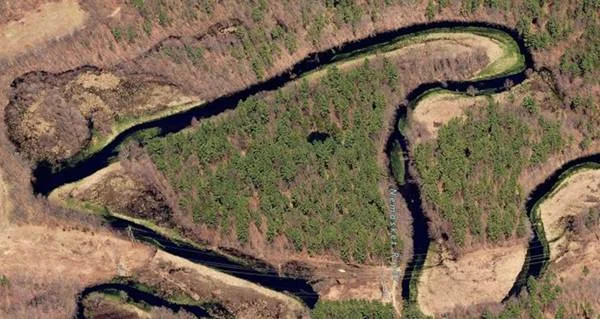
This week, we received some most welcome news: the Town of Middleboro Conservation Commission qualified for a Local Acquisitions for Natural Diversity (“LAND”) Grant award from the Commonwealth of Massachusetts for the Lions Head Peninsula land acquisition project.
The Lions Head Peninsula Project will preserve 81 acres of diverse woodland, floodplain, and frontage along the lower Nemasket River in Middleboro, just east of the Nemasket’s confluence with the federally-designated Wild and Scenic Taunton River. The Property is within areas designated by the Natural Heritage and Endangered Species Program as important habitat areas for two rare species, the Northern Red-Bellied Cooter and the Eastern Box Turtle, and also includes at least two potential vernal pools. It also includes the unique landscape feature known as the Lions Head, which viewed from above appears to many as resembling the head of a large feline (take a look at the above photo and judge for yourself).
The project will enable public access for a wide range of passive recreational pursuits. The Lions Head property contains an existing network of woods roads and footpaths that collectively comprise about one mile, and will link with trails on adjacent properties. These new linkages will create an expanded trail system near the confluence of the Nemasket and Taunton Rivers, and represent a true community resource.
Owned by the Jigerjian family for over 30 years, the Lions Head property has been a preservation priority for the Town, the Trust, and others for decades because of its extensive riparian frontage, rare species habitat, and proximity to protected open space parcels along the lower Nemasket River corridor. Representatives from the Trust and the Town maintained a dialogue over the years with the Jigerjians that eventually culminated in the deal negotiated by Middleboro Conservation Agent Tricia Cassady to preserve the property.
Around in various iterations since the early 1960’s, the LAND Grant Program provides funding to municipalities for land preservation projects, and is often an essential component of a project’s funding structure. For this project, the $400,000 LAND Grant award represents half of the $800,000 purchase price, with Middleboro Community Preservation Act open space funds and funding from the Massachusetts Department of Conservation and Recreation comprising the balance. The Nature Conservancy also contributed funds for due diligence.
As Tricia noted, “the Middleboro Conservation Commission is excited about receiving a LAND Grant award for the Jigerjian project, which will preserve extensive frontage along the Nemasket River and the distinctive Lions Head peninsula. The Jigerjian family long wished to see their property preserved, and the LAND Grant award is a critical catalyst toward this outcome.”
The Lions Head property will represent an outstanding and substantial addition to Middleboro’s open space portfolio, and on a larger scale, to the mosaic of conservation lands along the Wild and Scenic Taunton River corridor. The Trust is pleased to be collaborating with Tricia and the Conservation Commission on the project, and we look forward to co-holding a Conservation Restriction on the property with DCR.
- Scott MacFaden, Director of Land Protection at Wildlands Trust

Linking up Local Land Conservationists
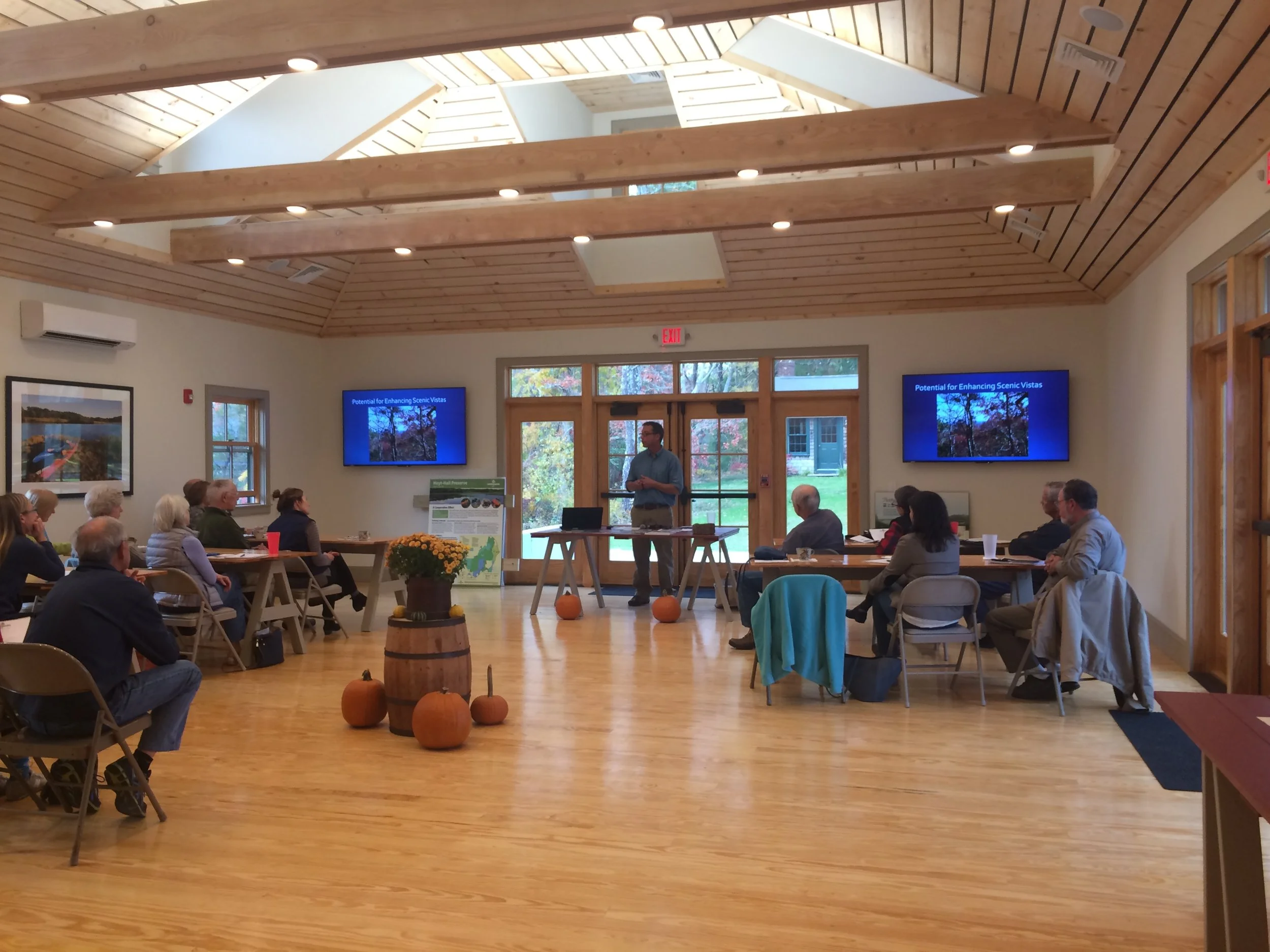
Why was forester Phil Benjamin presenting in the Trust's Community Conservation Barn earlier this month? And who was in the audience?
For the past few years, Wildlands Trust has brought together southeastern Massachusetts town open space committee members, conservation agents, conservation commissioners, and land trust committees together for quarterly Open Space Forums. These forums are held to help share information about how towns have handled challenges on managing their open space, how they have effectively utilized funding sources, how they have found success with public outreach, and much more.
Not only do Open Space Forums help facilitate open discussion, information sharing, and collaboration, but the Trust invites various professionals to present on relevant and interesting conservation topics. On November 9, over twenty local conservation workers gathered in the Community Conservation Barn to learn about forest stand health and active management, invasive species control, and wildlife habitat from Certified Forester and Director of the Mass Forest Alliance Phil Benjamin.
Previous Open Space Forum headlining topics have included: Forest Health Management, Trail Design, Signage & Amenities, Social media for Public Outreach, Conservation Partnerships & LAND Grants, Climate Adaptation, and GIS Habitat Mapping. At our next forum we will be presenting on the topic of building ADA Accessible Trails.
We'd like to thank Phil Benjamin and all of our past presenters and attendees for continuing to make these forums meaningful and useful for local conservation efforts.
If you are a conservation professional and would like to be included in the invites please contact Ryan Krapp, Community Conservation Program Manager at rkrapp@wildlandstrust.org.