


What’s New at Wildlands
Winter Resilience: Nature’s Diverse Adaptations to a Snowy Landscape
By Justin Cifello
One of the first epiphanies I recall having about the natural world was the revelation that trees don’t die in the fall. It’s an easy convenience of language to refer to the dead trees of winter, but they are, of course, very much alive. It was quite the paradigm shift to no longer think of winter as a time of death, but instead as a time of survival. The cold, seemingly inert wood bides its time, rations its water, and nurtures next year’s buds. The flowers and leaves that will raise our spirits this spring already exist, wrapped tightly in protective scales. As winter wanes, the careful eye can see their gradual transformation. A heartening sight well before the first daffodils emerge.
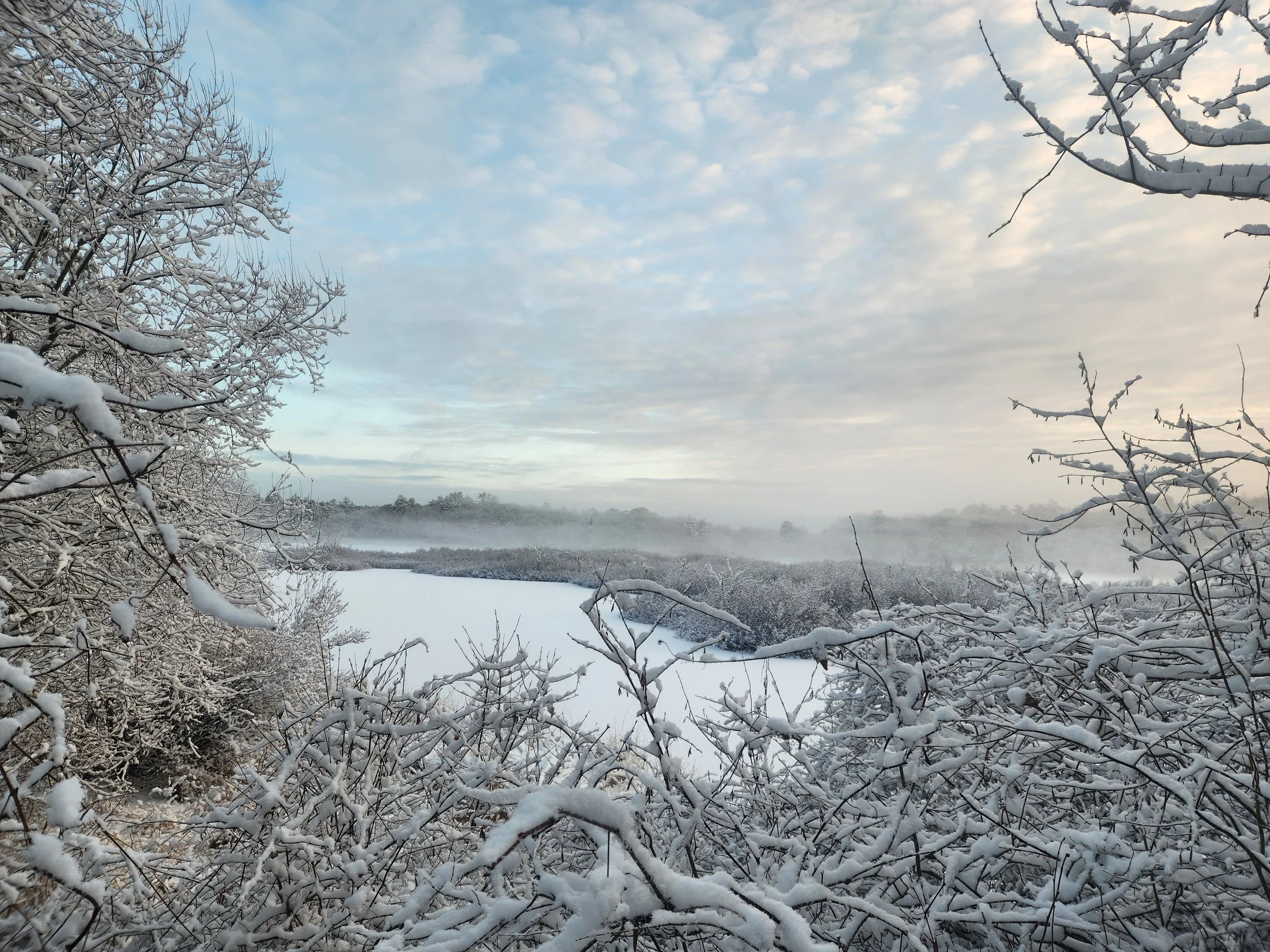
Goat Pasture Pond at Old Field Pond Preserve in Bourne. Photo by Justin Cifello.
By Justin Cifello
Justin is a farmer and naturalist at Bay End Farm in Bourne and a volunteer for Wildlands Trust. Get to know Justin (and all our Volunteer Hike Leaders) here.
One of the first epiphanies I recall having about the natural world was the revelation that trees don’t die in the fall. It’s an easy convenience of language to refer to the dead trees of winter, but they are, of course, very much alive. It was quite the paradigm shift to no longer think of winter as a time of death, but instead as a time of survival. The cold, seemingly inert wood bides its time, rations its water, and nurtures next year’s buds. The flowers and leaves that will raise our spirits this spring already exist, wrapped tightly in protective scales. As winter wanes, the careful eye can see their gradual transformation. A heartening sight well before the first daffodils emerge.
Despite all the difficulties that snow and ice present, nature is pretty good at finding utility in an obstacle. Under the snow, in the subnivean zone, small animals can forage, safely hidden from visual predators. Snow insulates the earth, keeping it around 32 degrees—still cold, but much warmer than exposed ground. Look for the tunnels made by mice, voles, and other creatures as the snow melts. [1]
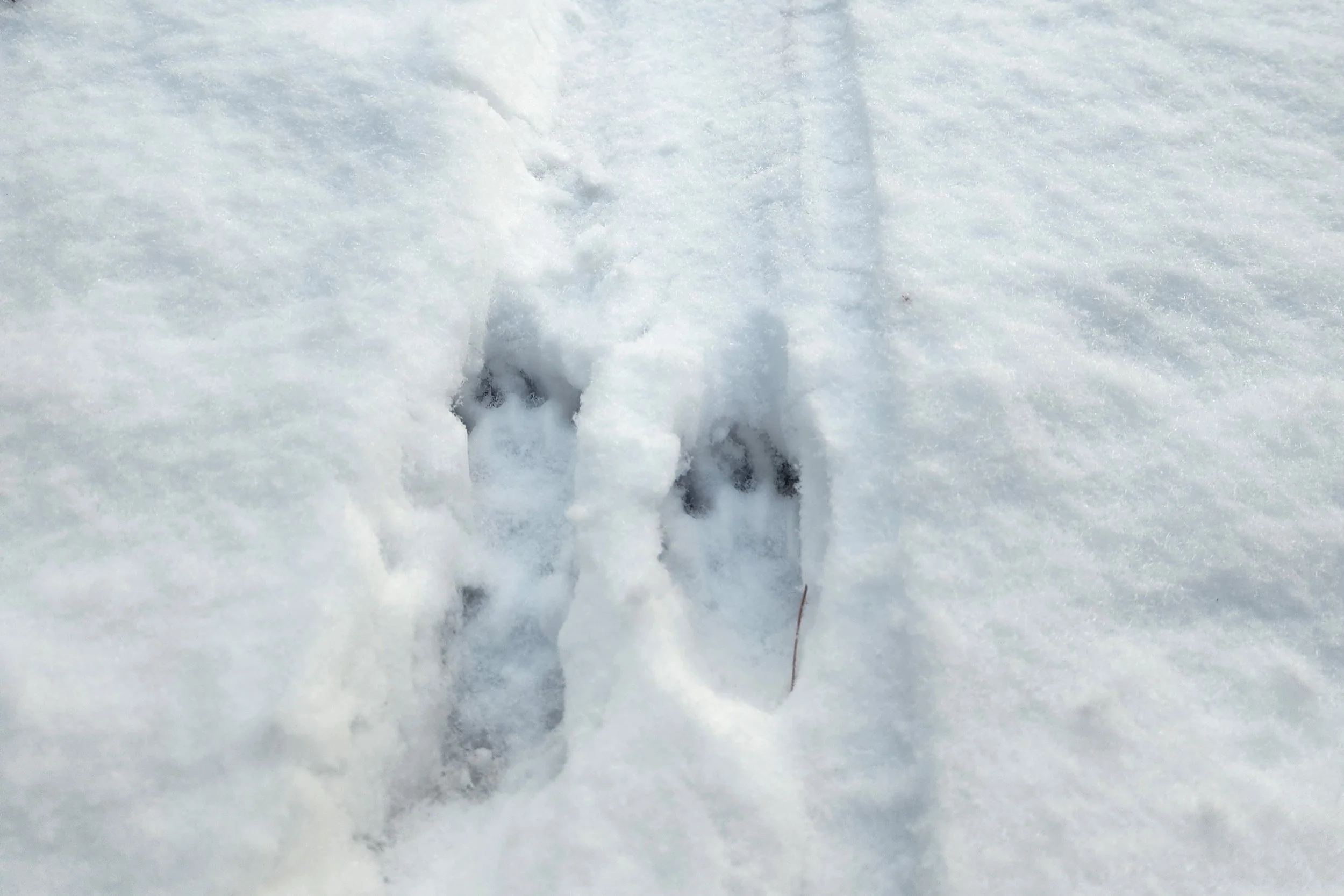
River otter tracks. Photo by Justin Cifello.
Similarly, sheets of ice help ponds retain their heat and protect fish from eagles and herons. It is even possible to see turtles swimming below the ice. Reptiles and amphibians have a more flexible form of hibernation called brumation, allowing them to wake, drink water, and bask occasionally in the winter. Unable to reach the surface for air, they extract oxygen from the water via cloacal breathing—that is, through their butts. This only works when water is rich in oxygen, far from guaranteed when ice seals off the water below from the atmosphere above. To circumvent this issue, some turtles forgo the need for fresh oxygen entirely by using the calcium from their shells to safely tap stored energy in their muscles. [2]
Under a foot of snow, the landscape becomes a whole new arena for predators and prey. Who survives depends on who adapts. Creatures of habit find themselves vulnerable to more flexible, opportunistic hunters. Foxes walking on top of the snow can reach bushes once out of reach. When branches are weighed down by snow, windows open in the canopy, giving small hawks better access in dense brush. Deer sink in deep snow and instead prefer to hunker down in sheltered places, making them vulnerable to the lighter coyotes who, with their wide paws, can walk on top of the snow. [3]
Snow facilitates movement for a typically sedentary group: plants. Some trees, like birches and pines, release their seeds in winter. Birch seeds look a bit like birds; look for these “flocks” scattered on the snow. The smooth surface grants windblown seeds easy travel, skimming across now buried obstacles. Protected from a watery grave by the ice, seeds that land on ponds are safely blown to the shore, a phenomenon observed by Thoreau in his “Faith in a Seed.” [4][5]
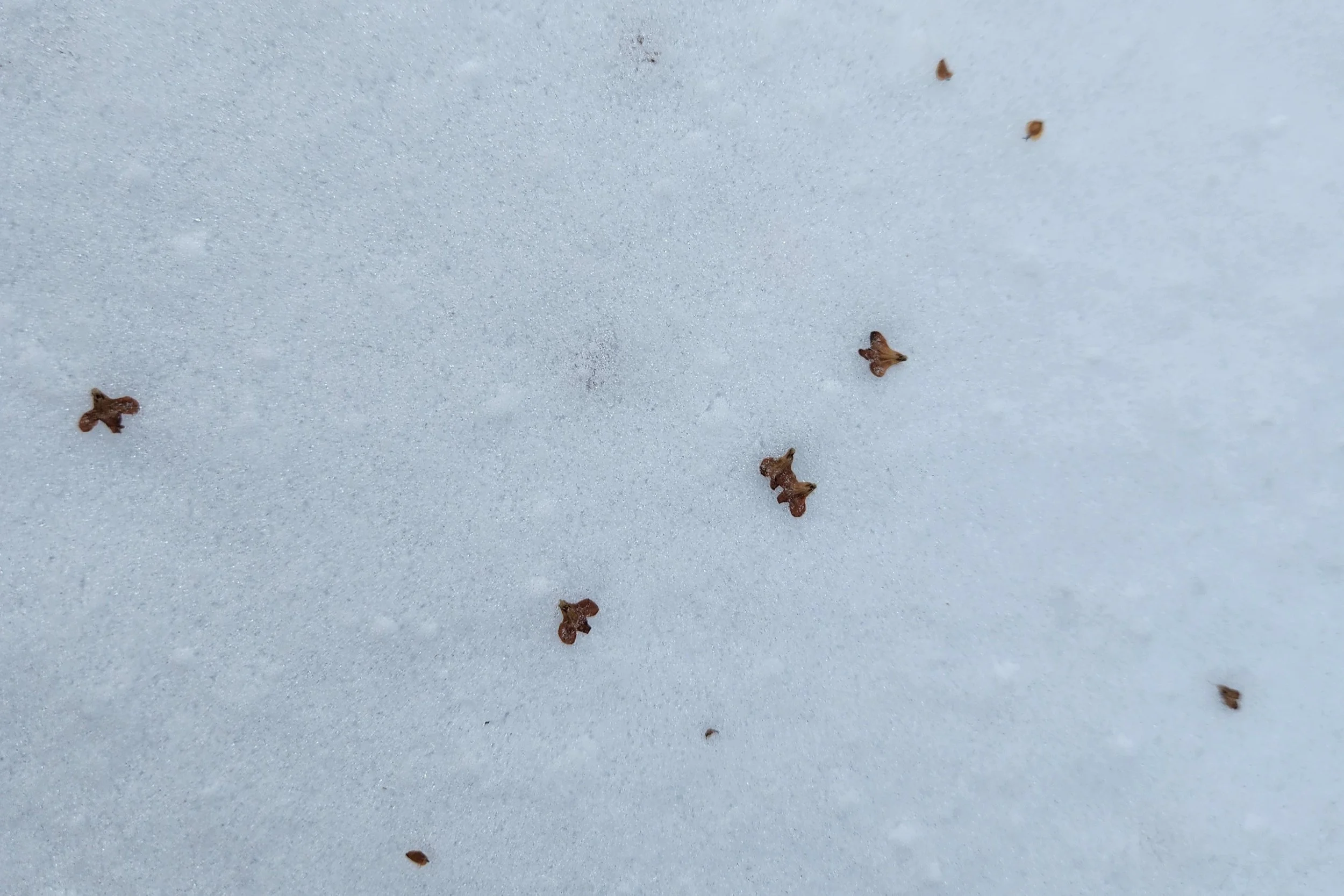
A “flock” of birch seeds on the snow. Photo by Justin Cifello.
Most substances condense when they freeze, but water expands. Just as this means trouble for the pipes in your home, it also puts trees at risk of damage during dramatic temperature swings in winter. Trees have various strategies to account for this expansion and contraction of water in their limbs. Dark-colored trees heat up faster, so they tend to have craggy bark that can safely shrink and swell without splitting. Lighter-colored trees, meanwhile, can afford thinner bark, as seen on beeches and maples. The high sugar content in sap lowers its freezing point, acting as a natural antifreeze. [6]
Winter is a time of paradoxes. Undoubtedly still a hardship for us and for wildlife, it is not without its benefits. With no mosquitoes and fewer ticks, we can access places out of reach in the summer, even if slowed by snow. Without foliage, we can see farther and better observe the glacial topography. As much as the snow conceals, it reveals the busyness of animals, their stealth betrayed by their roving tracks. Life quietly reveals its dazzling resilience, offering inspiration as we await the melting of ice.
Works Cited
1. The Subnivean Zone: dnr.illinois.gov/education/atoz/winterinillinois/subniveanzone.html
2. Turtles: www.oriannesociety.org/faces-of-the-forest/winterwoodturtles/?v=f69b47f43ce4
3. Deer and Coyotes: www.forestsociety.org/blog-post/something-wild-fragile-balance-deer-and-coyotes-late-winter
4. Thoreau, “Faith in a Seed”: archive.org/stream/FaithInASeed-English-Thoreau/thoreau_djvu.txt
5. Thoreau, “The Succession of Forest Trees”: monadnock.net/thoreau/trees.html
6. Trees: extension.psu.edu/silent-survivors-the-winter-life-of-tree