


What’s New at Wildlands
Human History of Wildlands: Pudding Hill Reservation
As with many of the properties featured in this “Human History of Wildlands” series, the present-day tranquility of the area belies the long human impact on the land in and around Pudding Hill Reservation. Like Hoyt-Hall Preserve and Phillips Farm Preserve, other Wildlands properties in Marshfield, this land has been in constant use for generations, including Native Americans for thousands of years and European settlers over the last four centuries. With human habitation comes change.
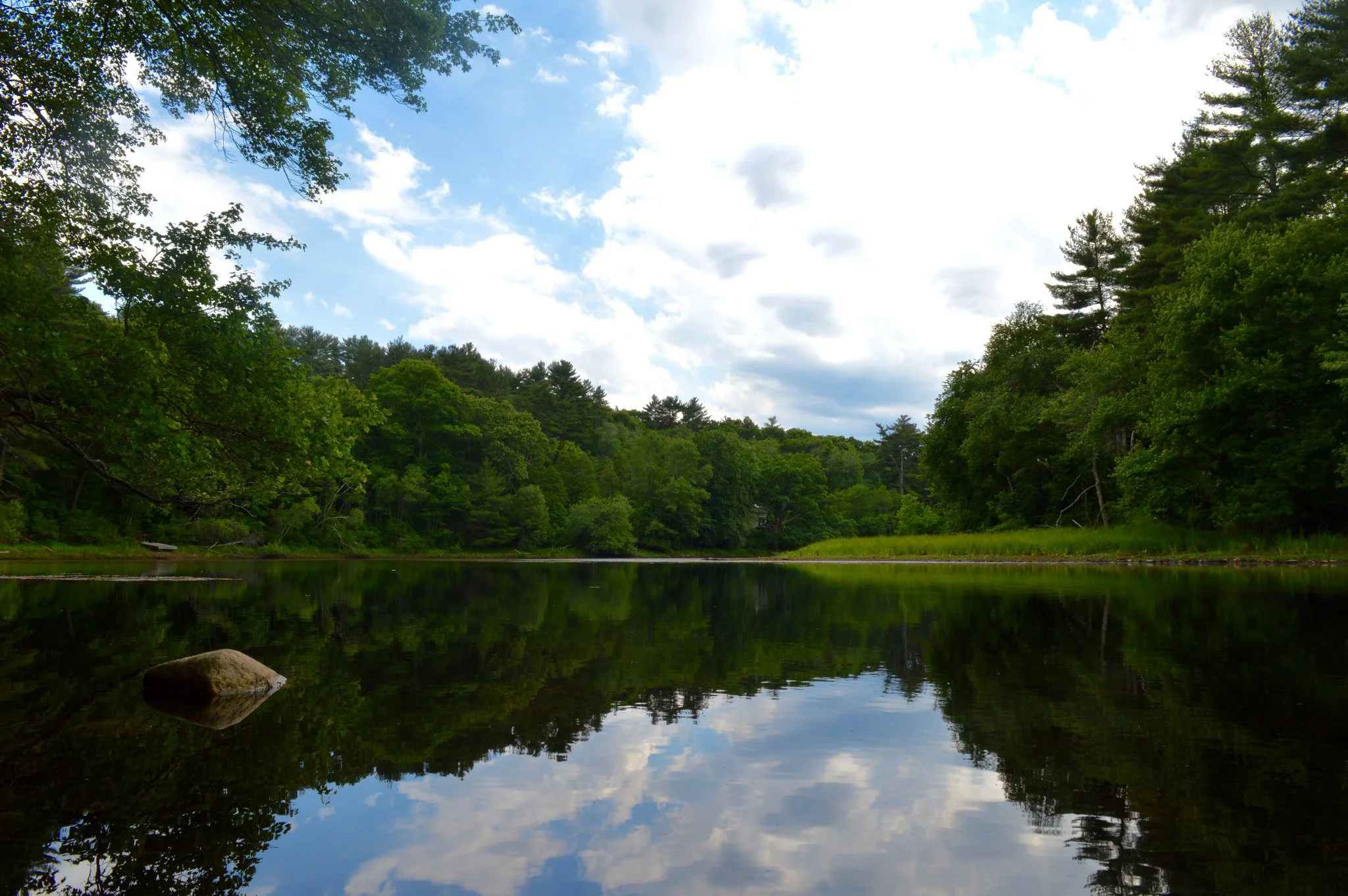
Chandler’s Pond at Pudding Hill Reservation in Marshfield.
By Skip Stuck, Key Volunteer
Pudding Hill Reservation in Marshfield was donated to Wildlands Trust in 1991 by Elizabeth Bradford. Though relatively small at 37 acres, the preserve has a varied terrain, including an upland ridge, frontage on Chandler’s Pond (from which a bubbling brook becomes the South River), and the 128-foot Pudding Hill itself. A mowed 0.4-mile trail provides easy access to the preserve from the parking area on Pudding Hill Lane. Today, Pudding Hill Reservation offers visitors a relaxing sanctuary just minutes from Marshfield Center.
As with many of the properties featured in this “Human History of Wildlands” series, the present-day tranquility of the area belies the long human impact on the land in and around Pudding Hill Reservation. Like Hoyt-Hall Preserve and Phillips Farm Preserve, other Wildlands properties in Marshfield, this land has been in constant use for generations, including Native Americans for thousands of years and European settlers over the last four centuries. With human habitation comes change.
The North and South Rivers have always been heavily utilized by Native people, including the Massachusett Tribe, for hunting, fishing, and shell fishing, and as water highways for transport and trade throughout Southeastern Massachusetts.
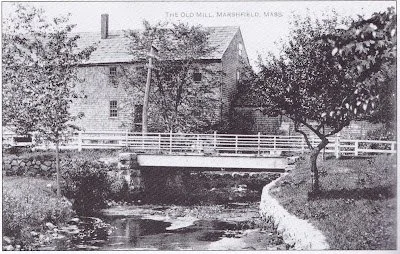
Marshfield’s first gristmill, founded in 1654 by William Ford and Josiah Winslow. Photo circa 1940. The site is now Veterans Memorial Park, directly adjacent to Pudding Hill Reservation. Via North and South Rivers Watershed Association.
After 1620, Pilgrims from the Plymouth Colony were quick to see these benefits. Settlers began to arrive in Marshfield before 1640. As you will remember from other installments of this series, one of the first orders of business in areas with flowing water was the building of mills—especially gristmills. With this goal in mind, Samuel Baker, John Adams, and James Pitney purchased the Pudding Hill property along the South River. By 1659, Samuel Baker's gristmill was up and running, made possible by the damming of the South River to create Chandler’s Pond. Other dams and mills followed in 1706 and 1771.
But bigger things were on the horizon. In 1810, as the Industrial Revolution was beginning, waterpower was once again instrumental in the establishment of the Marshfield Cotton and Woolen Manufacturing Company. A network of support enterprises helped the company thrive through the first half of the 19th century. Leavitt Delano's blacksmith shop and Elijah Ames' carpentry shop, among others, produced barrels, tools, and other necessities. Other factories produced textile dyes. Farming was largely replaced by factory work, which necessitated housing, boarding houses, a store, and a school.
However, the second half of the 19th century was the time of "Manifest Destiny," and throughout New England, the opening of the American West drove a significant emigration of local farmers to the Great Plains and beyond. In addition, larger manufacturing cities such as Brockton, Lowell, and Lawrence drew workers away from the smaller towns. The Cotton and Woolen Company closed in 1860, but later Gilbert West purchased the water rights to the property and ran a saw and gristmill until the 1920s.
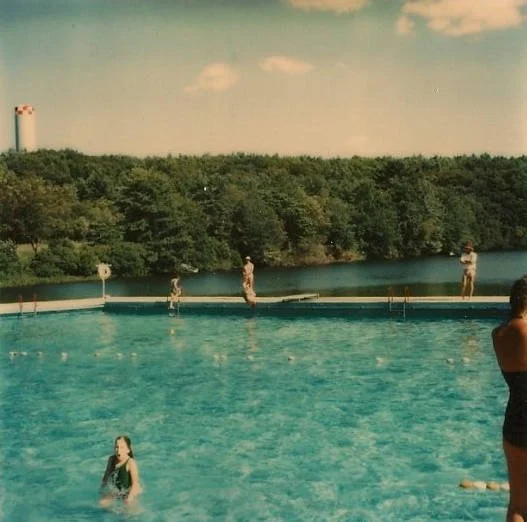
Camp Milbrook campers swimming in Chandler’s Pond in 1967. Via UMass Boston, Joseph P. Healey Library.
Marshfield was gradually becoming the seaside vacation and bedroom community of today. In the 1920s, Pudding Hill and Chandler’s Pond became the summer home of the Bradford family. In the 1950s, the Bradfords moved in full-time. In an interview, Elizabeth Bradford, a direct descendant of Plymouth Colony governor William Bradford, relates the history of Pudding Hill as a quiet, peaceful refuge—not just for her family, but for many others. From about 1938 to 1985, Pudding Hill was the location of Camp Milbrook, a summer camp that served hundreds of children over its lifetime. It also gained local fame as a training camp and teaching clinic for the Boston Celtics, where coach Red Auerbach and stars like Larry Bird, Kevin McHale, and Robert Parish taught basketball fundamentals to summer campers.
After the camp closed, the Bradfords started thinking about what would happen to the property they loved. Housing and other development was erasing much of the historic farmlands and woodlands in town, and Elizabeth Bradford was committed to saving Pudding Hill and preserving its beauty. In 1991, she donated it to Wildlands Trust. Today, it is a popular destination for hikers, bird watchers, and nature lovers who use its trails and open space for all the outdoor activities that Ms. Bradford intended. It will remain as such forever under Wildlands’ stewardship.
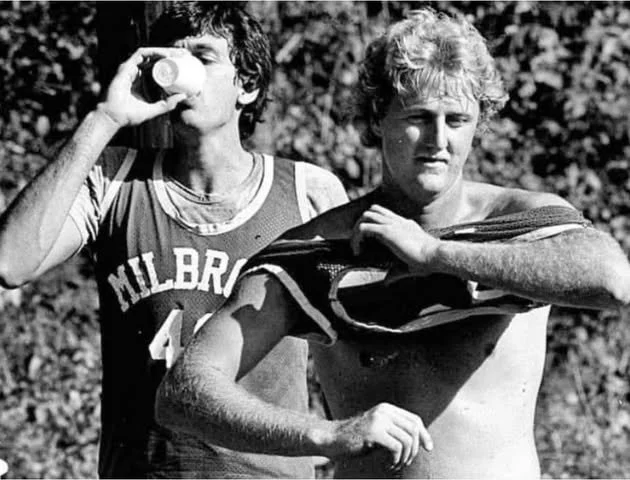
Kevin McHale and Larry Bird at Camp Milbrook. Video: Red Auerbach instructs kids at Camp Milbrook in Marshfield in 1974. Source: GBH Archives.
We hope you will take advantage of what Wildlands Trust offers in Marshfield and throughout Southeastern Massachusetts. Please come and visit. To learn more, look over the following resources used in researching this article:
The Power of Water: Milling and Manufacturing in the North River Valley by Kezia Bacon, NSRWA, April 2008.
An excellent piece that delves more deeply into the history and stories of the entire North and South River watershed, including several other areas that Wildlands preserves, such as Hoyt-Hall Preserve, Cushman, Preserve, Willow Brook Farm, Tucker Preserve/Indian Head River Trail, Phillips Farm Preserve, and Cow Tent Hill Preserve. I thank Ms. Bacon for writing it and hope you will enjoy reading it.
Marshfield: A Town of Villages 1640 - 1990, by Cynthia Hagar Krussel and Betty Magoun Bates, Historical Research Asociates,1990.
Interview of Elizabeth Bradford, by Kezia Baker, WaterWatch (the newsletter of the North and South Rivers Watershed Association), Sep. 1993.
North and South Rivers Watershed Association website: www.nsrwa.org.
Pudding Hill Reservation, Wildlands Trust: wildlandstrust.org/pudding-hill-reservation.
As always, a special thanks to Thomas Patti for editing this piece.
New Trail Configuration at Pudding Hill
Volunteers help create 0.4-mile connector trail at Pudding Hill Reservation in Marshfield.
By Stewardship Manager Erik Boyer

Mike Arsenault assists stewardship staff with raking debris from the trail.
This past September, with the help of nine Adopt-a-Preserve (AAP) volunteers, a new .4-mile trail was created at Pudding Hill Reservation in Marshfield. This project was the vision of AAP volunteer Dodie Frank who has been a steward at Pudding Hill for the past two years.
I met Dodie out at the preserve on a muggy, July morning to bushwhack and flag a new trail from the neighborhood trail entrance off Old Ocean Street to a dead-end trail on the west side of the property. We chose a route that consisted of rolling hills, old stone walls and thick stands of white pine saplings. This new connector turns the .5-mile cross-shaped trail into a 1.1-mile loop with varied topography. Over the course of three days in September, we cut through thick brush, established a rough trail tread, and then regraded sections of the trail to make for easier hiking. We then blazed the path and ensured it was ready for the first guided hike held at the property in mid-October.
Now, thanks to the hard work of many, a visit to Pudding Hill provides for a challenging, wooded, 30-minute hike on the north side of the property and a leisurely, short stroll through a meadow to an overlook spot on Chandlers Pond. I would like to give a special shout out to Dodie for her efforts and to Mike Arsenault, Stephen Connolly, Rob MacDonald, Janine Anderson, Bill Vickstrom, Roger Janson, Marilynn Atterbury and Kevin Walsh for helping out.