


What’s New at Wildlands
Human History of Wildlands: Pudding Hill Reservation
As with many of the properties featured in this “Human History of Wildlands” series, the present-day tranquility of the area belies the long human impact on the land in and around Pudding Hill Reservation. Like Hoyt-Hall Preserve and Phillips Farm Preserve, other Wildlands properties in Marshfield, this land has been in constant use for generations, including Native Americans for thousands of years and European settlers over the last four centuries. With human habitation comes change.
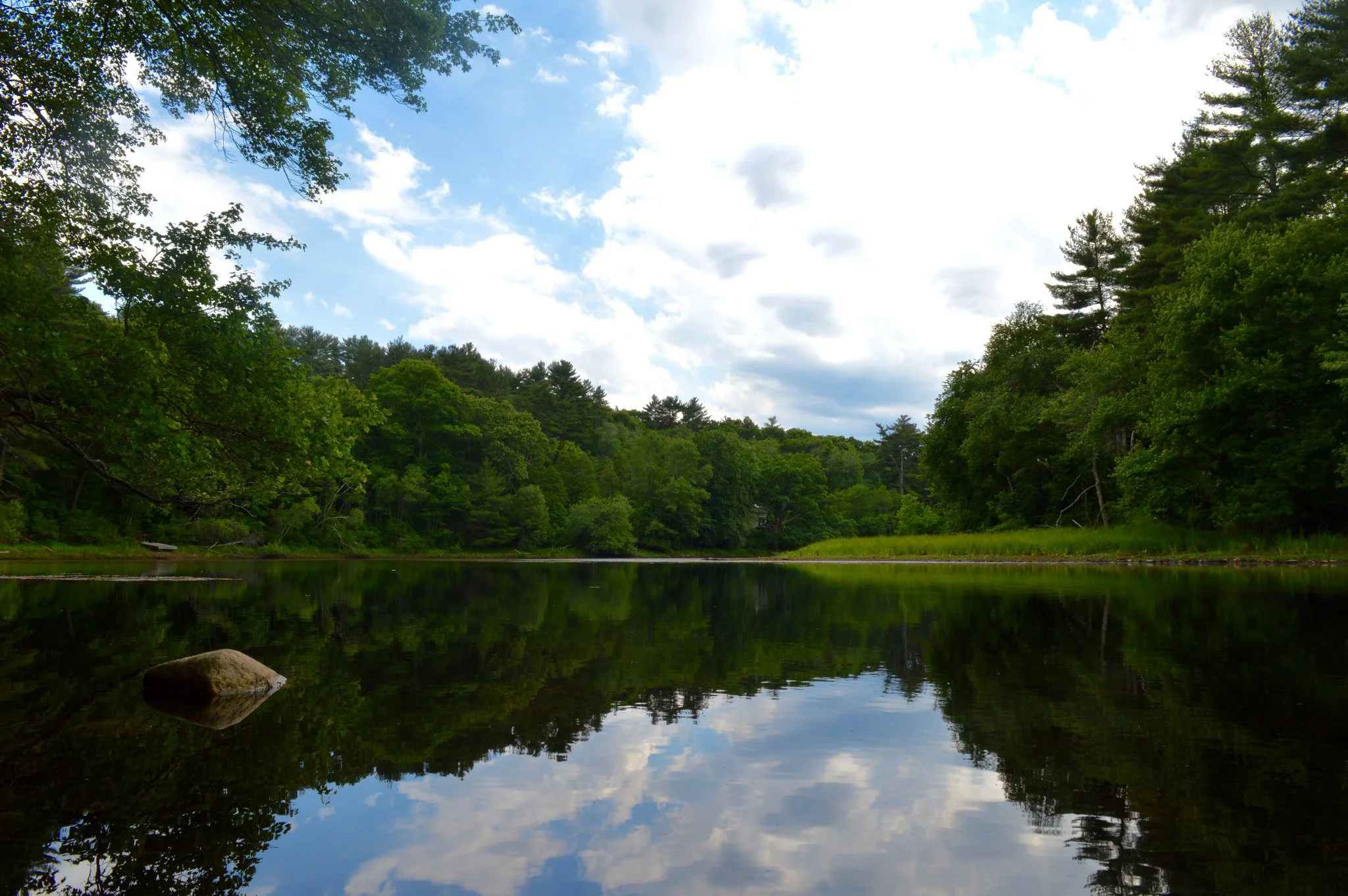
Chandler’s Pond at Pudding Hill Reservation in Marshfield.
By Skip Stuck, Key Volunteer
Pudding Hill Reservation in Marshfield was donated to Wildlands Trust in 1991 by Elizabeth Bradford. Though relatively small at 37 acres, the preserve has a varied terrain, including an upland ridge, frontage on Chandler’s Pond (from which a bubbling brook becomes the South River), and the 128-foot Pudding Hill itself. A mowed 0.4-mile trail provides easy access to the preserve from the parking area on Pudding Hill Lane. Today, Pudding Hill Reservation offers visitors a relaxing sanctuary just minutes from Marshfield Center.
As with many of the properties featured in this “Human History of Wildlands” series, the present-day tranquility of the area belies the long human impact on the land in and around Pudding Hill Reservation. Like Hoyt-Hall Preserve and Phillips Farm Preserve, other Wildlands properties in Marshfield, this land has been in constant use for generations, including Native Americans for thousands of years and European settlers over the last four centuries. With human habitation comes change.
The North and South Rivers have always been heavily utilized by Native people, including the Massachusett Tribe, for hunting, fishing, and shell fishing, and as water highways for transport and trade throughout Southeastern Massachusetts.
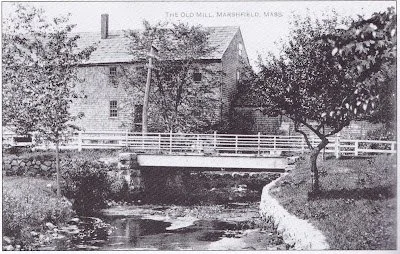
Marshfield’s first gristmill, founded in 1654 by William Ford and Josiah Winslow. Photo circa 1940. The site is now Veterans Memorial Park, directly adjacent to Pudding Hill Reservation. Via North and South Rivers Watershed Association.
After 1620, Pilgrims from the Plymouth Colony were quick to see these benefits. Settlers began to arrive in Marshfield before 1640. As you will remember from other installments of this series, one of the first orders of business in areas with flowing water was the building of mills—especially gristmills. With this goal in mind, Samuel Baker, John Adams, and James Pitney purchased the Pudding Hill property along the South River. By 1659, Samuel Baker's gristmill was up and running, made possible by the damming of the South River to create Chandler’s Pond. Other dams and mills followed in 1706 and 1771.
But bigger things were on the horizon. In 1810, as the Industrial Revolution was beginning, waterpower was once again instrumental in the establishment of the Marshfield Cotton and Woolen Manufacturing Company. A network of support enterprises helped the company thrive through the first half of the 19th century. Leavitt Delano's blacksmith shop and Elijah Ames' carpentry shop, among others, produced barrels, tools, and other necessities. Other factories produced textile dyes. Farming was largely replaced by factory work, which necessitated housing, boarding houses, a store, and a school.
However, the second half of the 19th century was the time of "Manifest Destiny," and throughout New England, the opening of the American West drove a significant emigration of local farmers to the Great Plains and beyond. In addition, larger manufacturing cities such as Brockton, Lowell, and Lawrence drew workers away from the smaller towns. The Cotton and Woolen Company closed in 1860, but later Gilbert West purchased the water rights to the property and ran a saw and gristmill until the 1920s.
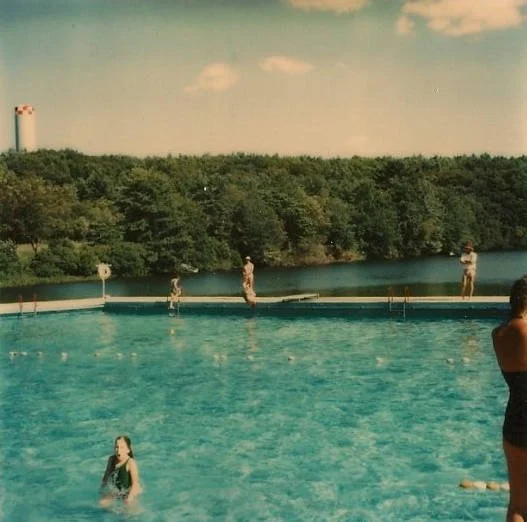
Camp Milbrook campers swimming in Chandler’s Pond in 1967. Via UMass Boston, Joseph P. Healey Library.
Marshfield was gradually becoming the seaside vacation and bedroom community of today. In the 1920s, Pudding Hill and Chandler’s Pond became the summer home of the Bradford family. In the 1950s, the Bradfords moved in full-time. In an interview, Elizabeth Bradford, a direct descendant of Plymouth Colony governor William Bradford, relates the history of Pudding Hill as a quiet, peaceful refuge—not just for her family, but for many others. From about 1938 to 1985, Pudding Hill was the location of Camp Milbrook, a summer camp that served hundreds of children over its lifetime. It also gained local fame as a training camp and teaching clinic for the Boston Celtics, where coach Red Auerbach and stars like Larry Bird, Kevin McHale, and Robert Parish taught basketball fundamentals to summer campers.
After the camp closed, the Bradfords started thinking about what would happen to the property they loved. Housing and other development was erasing much of the historic farmlands and woodlands in town, and Elizabeth Bradford was committed to saving Pudding Hill and preserving its beauty. In 1991, she donated it to Wildlands Trust. Today, it is a popular destination for hikers, bird watchers, and nature lovers who use its trails and open space for all the outdoor activities that Ms. Bradford intended. It will remain as such forever under Wildlands’ stewardship.
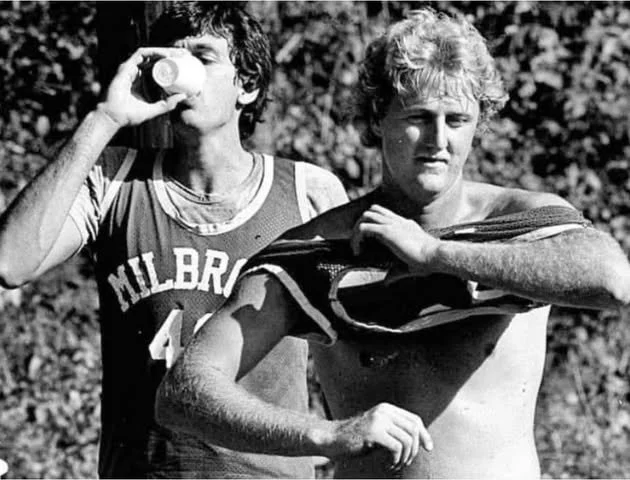
Kevin McHale and Larry Bird at Camp Milbrook. Video: Red Auerbach instructs kids at Camp Milbrook in Marshfield in 1974. Source: GBH Archives.
We hope you will take advantage of what Wildlands Trust offers in Marshfield and throughout Southeastern Massachusetts. Please come and visit. To learn more, look over the following resources used in researching this article:
The Power of Water: Milling and Manufacturing in the North River Valley by Kezia Bacon, NSRWA, April 2008.
An excellent piece that delves more deeply into the history and stories of the entire North and South River watershed, including several other areas that Wildlands preserves, such as Hoyt-Hall Preserve, Cushman, Preserve, Willow Brook Farm, Tucker Preserve/Indian Head River Trail, Phillips Farm Preserve, and Cow Tent Hill Preserve. I thank Ms. Bacon for writing it and hope you will enjoy reading it.
Marshfield: A Town of Villages 1640 - 1990, by Cynthia Hagar Krussel and Betty Magoun Bates, Historical Research Asociates,1990.
Interview of Elizabeth Bradford, by Kezia Baker, WaterWatch (the newsletter of the North and South Rivers Watershed Association), Sep. 1993.
North and South Rivers Watershed Association website: www.nsrwa.org.
Pudding Hill Reservation, Wildlands Trust: wildlandstrust.org/pudding-hill-reservation.
As always, a special thanks to Thomas Patti for editing this piece.
Human History of Wildlands: Hoyt-Hall Preserve, Marshfield
Hoyt-Hall Preserve in Marshfield is one of Wildlands Trust's most popular preserves. Acquired in 2000, the property was quickly designated as a "showcase" preserve owing to its diverse woodland and wetland habitats and associated wildlife. Containing 123 acres and bordering 82 acres of additional conservation land, Hoyt-Hall protects a significant assemblage of open space in a growing town.
Yet there is another story here. Hoyt-Hall's human history spans over 10,000 years of settlement and change.

By Skip Stuck, Key Volunteer
Hoyt-Hall Preserve in Marshfield is one of Wildlands Trust's most popular preserves. Acquired in 2000, the property was quickly designated as a "showcase" preserve owing to its diverse woodland and wetland habitats and associated wildlife. Containing 123 acres and bordering 82 acres of additional conservation land, Hoyt-Hall protects a significant assemblage of open space in a growing town.
Yet there is another story here. Hoyt-Hall's human history spans over 10,000 years of settlement and change. Archeological evidence shows that Native people followed the retreating Laurentide ice sheet north, first as nomadic hunters and soon as settlers. Remnants of permanent dwellings have been excavated in Marshfield, dating back at least 3,000 years. The area that now contains Hoyt-Hall Preserve was partly a saltwater marsh with access to the ocean, and shell deposits show that it was well utilized by the Natives for fishing. By 1600, it was used seasonally by the Wampanoag Tribe as a summer home to take advantage of these resources. They wintered on the lands known today as Lakeville and Middleborough. The Wampanoags called the present-day Marshfield area "Missacautucket," and Massasoit was their powerful sachem.
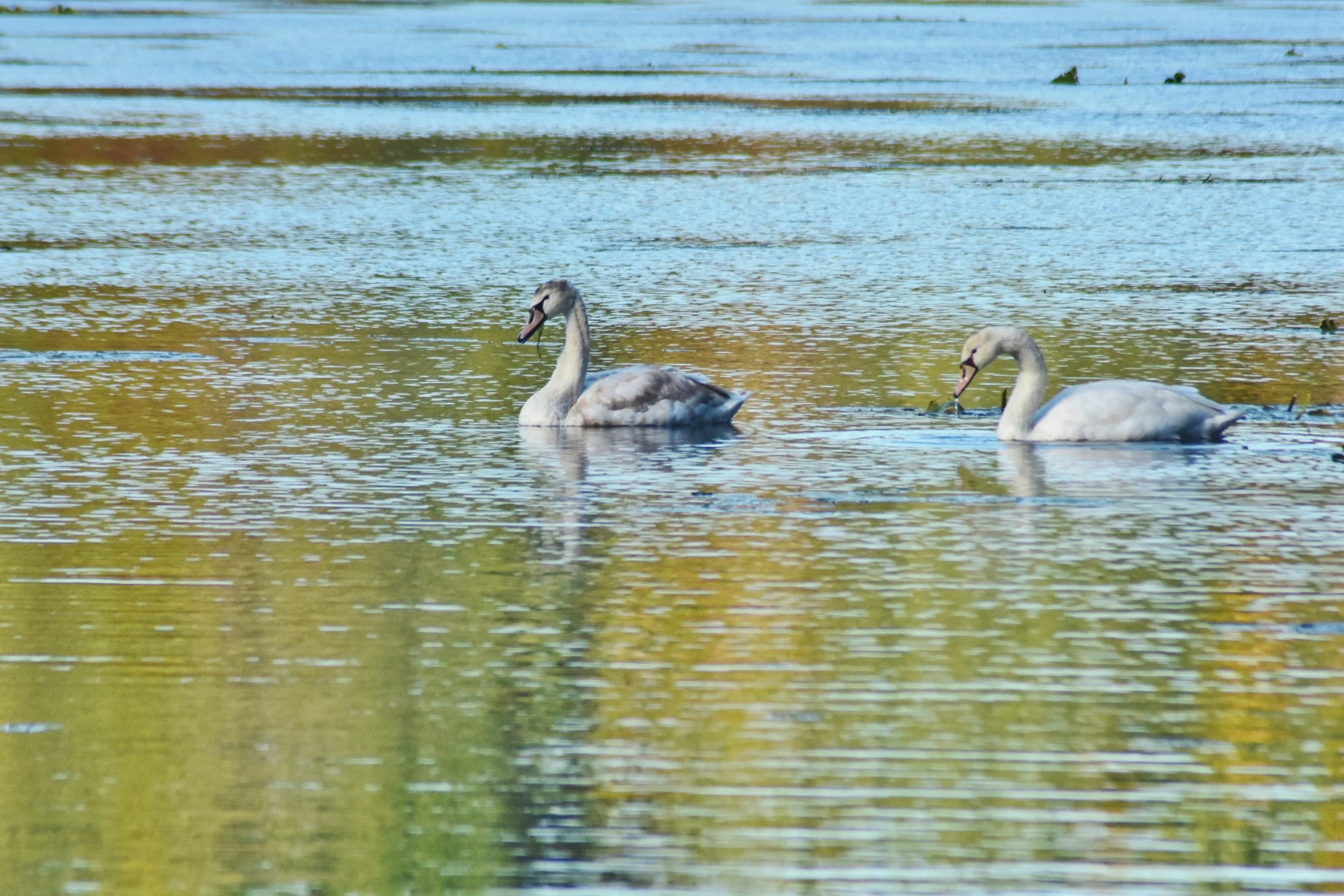
Swans on Long Tom Pond. Photo by Mike Arsenault.
The Value of Relationships
Upon the Pilgrims’ arrival to Plymouth Harbor, settling on lands outside the Colony's patent was prohibited. Early on, a few colonists managed to do so anyway. One was William Green in 1623, who established a commercial fishing post on what is now known as Green's Harbor. But general settlement was not permitted until 1632, when land grants began to be awarded. In 1636, Plymouth Colony governor Edward Winslow was granted a large tract of land, including the current Hoyt-Hall property. The Winslow family, along with the whole Plymouth Colony, was successful, due in large part to the strong relationship between Governor Winslow and the Wampanoag leader Massasoit, which endured for nearly half a century. More on the importance of relationships history later.
In 1637, the Pilgrim Trail, then called Green's Harbor Path, was the first general court-ordered road in the Colony. It passes along the border of Hoyt-Hall Preserve, as does King Philip’s path, an ancient and famous Native trail. Three Winslow family homesteads were built on the Hoyt-Hall property, much of which remained with the family until 1822. Two colonial governors, Edward and his son Josiah, lived and prospered on the land, as did Edward's adopted son, Peregrine White. White was born in 1620 on the Mayflower, becoming the first Englishman to be born in America.
In 1640, the Town of Marshfield (initially called Rexhame) was incorporated and grew quickly with new settlers. While many surrounding towns suffered much death and tragedy during King Philip's War in the 1670s, Marshfield remained relatively unscathed due to the Winslow family's strong relationship with the Wampanoag Tribe.
Hoyt-Hall Transformed
Because much of Hoyt-Hall was then tidal marshland, in 1675 a dam was built to create Long Tom Pond (named after a local Native who was killed in King Philip's War), providing a freshwater source first for general farming and later for cranberry growing.
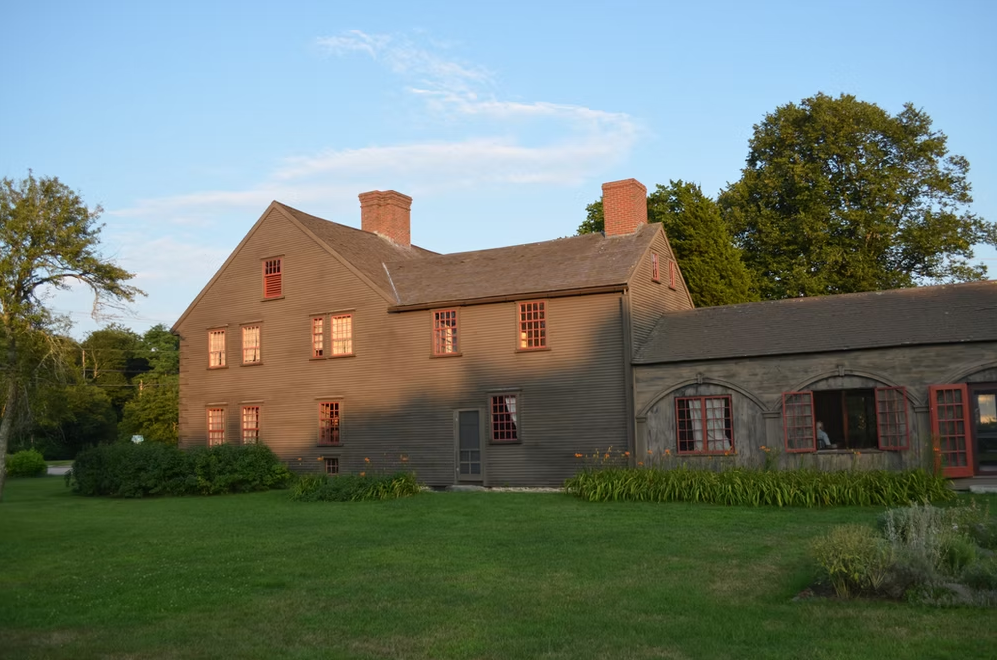
Historic Winslow House. historicwinslow.org
The Revolution
Directly adjacent to Hoyt-Hall Preserve is the Isaac Winslow house. Built circa 1699, it is the oldest home in Marshfield. Isaac was a well-known physician with a reputation for serving both settlers and Natives. He inoculated many against smallpox and other diseases in the early 1700s. However, as relationships between the colonists and the English crown deteriorated, the Winslow family became well-known Loyalists, and Isaac's house became a Loyalist meeting place. Relations between the Patriots and Loyalists were tense, and the Loyalists pressed for British troops to be brought in to protect them. A force of 114 troops landed, but fighting was eventually avoided, once again as a result of the Winslow family’s strong relationships with their neighbors.
Home of a Statesman
After the war ended, the Winslow family continued farming the property until 1822, when it was broken up and sold to a series of families. Some of the property returned to woodland, and some went to cranberry production. Some of it was sold to Daniel Webster, noted U.S. Congressman and Secretary of State, who lived in Marshfield from 1832 until his death in 1852. In 1884, Walton Hall purchased the Webster estate. In 1928, about 1,000 acres were purchased by Lincoln Hall, who converted some of the woodlands to cranberry bogs, which remained in production until the 1960s. During this time, the land began to take on the scenic character that we see today.
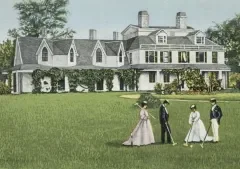
Daniel Webster Estate in 1859, as depicted on a 1909 postcard. From Patrick Browne, “The Almost-Battle of Marshfield.”
Protected Forever
In 2000, the land was sold to Wildlands with the assurance that it would be preserved in perpetuity, with beautiful trails for visitors to explore. In 2016, with funding from the Massachusetts Department of Conservation and Recreation’s Recreational Trails Program, a 1.75-mile trail loop was completed, with a parking lot on Careswell Street (Route 139). Today it is one of Wildlands’ most popular preserves, with many families enjoying this remarkable and historic property every year. Along with the adjacent Historic Winslow House, Hoyt-Hall Preserve's scenic beauty is forever linked to its rich history.
Back to Relationships...
So, you'll remember my earlier mention of the importance of relationships in the history of Hoyt-Hall Preserve. We too often think of the past in terms of events; i.e. wars, discoveries, and the like. We should not forget that nearly all historical events are either tempered or exacerbated by the human relationships that surround them. Had the Pilgrims not developed a strong relationship with Massasoit, Plymouth Colony would likely not have survived its first year. Fast forward 50 years, and it's clear that many lives were lost due to the souring of this relationship during King Philip's War. Be good to your friends.
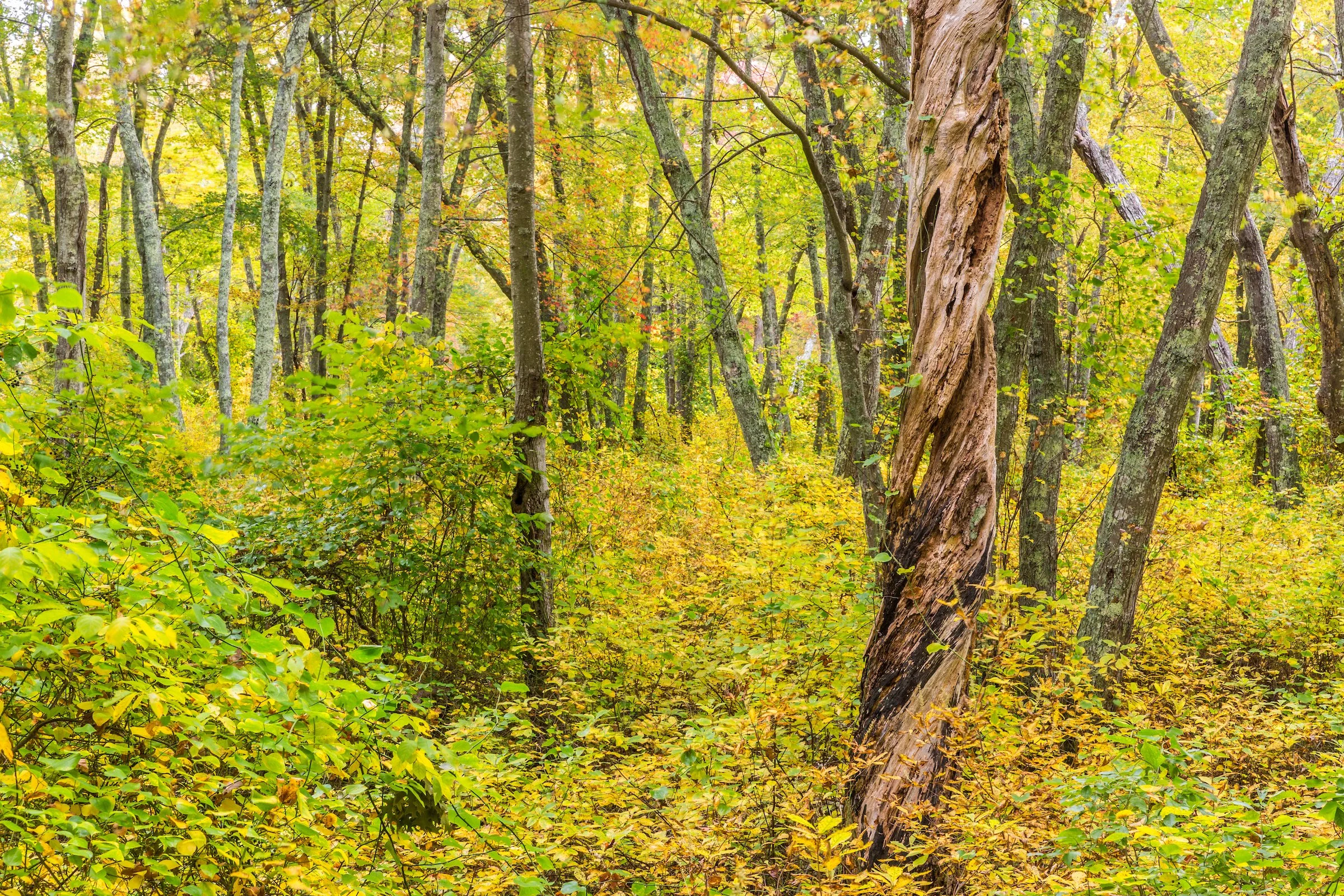
Hoyt-Hall Preserve. Photo by Jerry Monkman.
Learn More
To learn more and visit Hoyt-Hall Preserve, explore wildlandstrust.org/hoythall-preserve. The following resources were utilized in researching this history:
“Books and History Converge at Hoyt-Hall: Former Landowner Honored by Family” by Amy Markarian, Wildlands Trust, 2022.
The Historic Winslow House: winslowhouse.org.
History of Marshfield Massachusetts by Lysander Salmon Richards, 1901.
“The Almost-Battle of Marshfield” by Patrick Browne, 2011.
“History of Marshfield,” Kiddle Encyclopedia.
“Our Story Not Theirs” by the Mattakeeset Tribe.
A special thanks to Mike Arsenault, Amy Markarian, and Thomas Patti for their assistance with this piece.
Local College Student Conducts Natural Resource Inventory in Marshfield
By Tess Goldmann, Conservation Restriction Coordinator

Hoyt-Hall Preserve in Marshfield
Last fall, Wildlands Trust had the pleasure of partnering with Unity College student and Carver resident Nicole Huff. As part of her coursework, she completed a natural resource inventory of our Hoyt-Hall Preserve in Marshfield. A natural resource inventory (NRI) is a multifaceted survey of all the animals, plants, soils, waters, and geological features in an area. Hoyt-Hall, one of our showcase preserves, has a wide variety of environments, including pine forest, red maple swamp, and Long Tom Pond. We were excited for Nicole to conduct an NRI of Hoyt-Hall, as her findings would help us identify specific property conservation needs and future projects to address them.
Nicole used multiple methods to survey the property. When I met with Nicole at Hoyt-Hall in September, we walked the property and completed three quadrat sampling sessions. Nicole made five bird observation trips and hung two trail cameras to catch mammal activity. Finally, Nicole collected and analyzed 20 soil samples from around the preserve.
Nicole made several interesting discoveries about the preserve. She found that the upland soil is very acidic, with a pH of 3.62. This soil acidification could be responsible for the deaths of several Eastern red cedar trees around the preserve. In addition, Nicole identified two invasive plants—Oriental bittersweet and European buckthorn, both common in Southeastern Massachusetts—and recommended removal strategies for both.
Nicole also identified 31 birds, which is remarkable, especially during the late end of fall migration. In spring and summer, this number is sure to be higher, making Hoyt-Hall a premier birding location! (See eBird Hotspot data for the preserve here.) Be on the lookout for Downy Woodpeckers, Red-breasted Nuthatches, and many more!
Thank you, Nicole, for all of your hard work! Your project will be an invaluable resource as we continue to advance positive conservation outcomes at Hoyt-Hall Preserve and beyond.