What’s New at Wildlands
A Leaf Peeping Guide to Wildlands
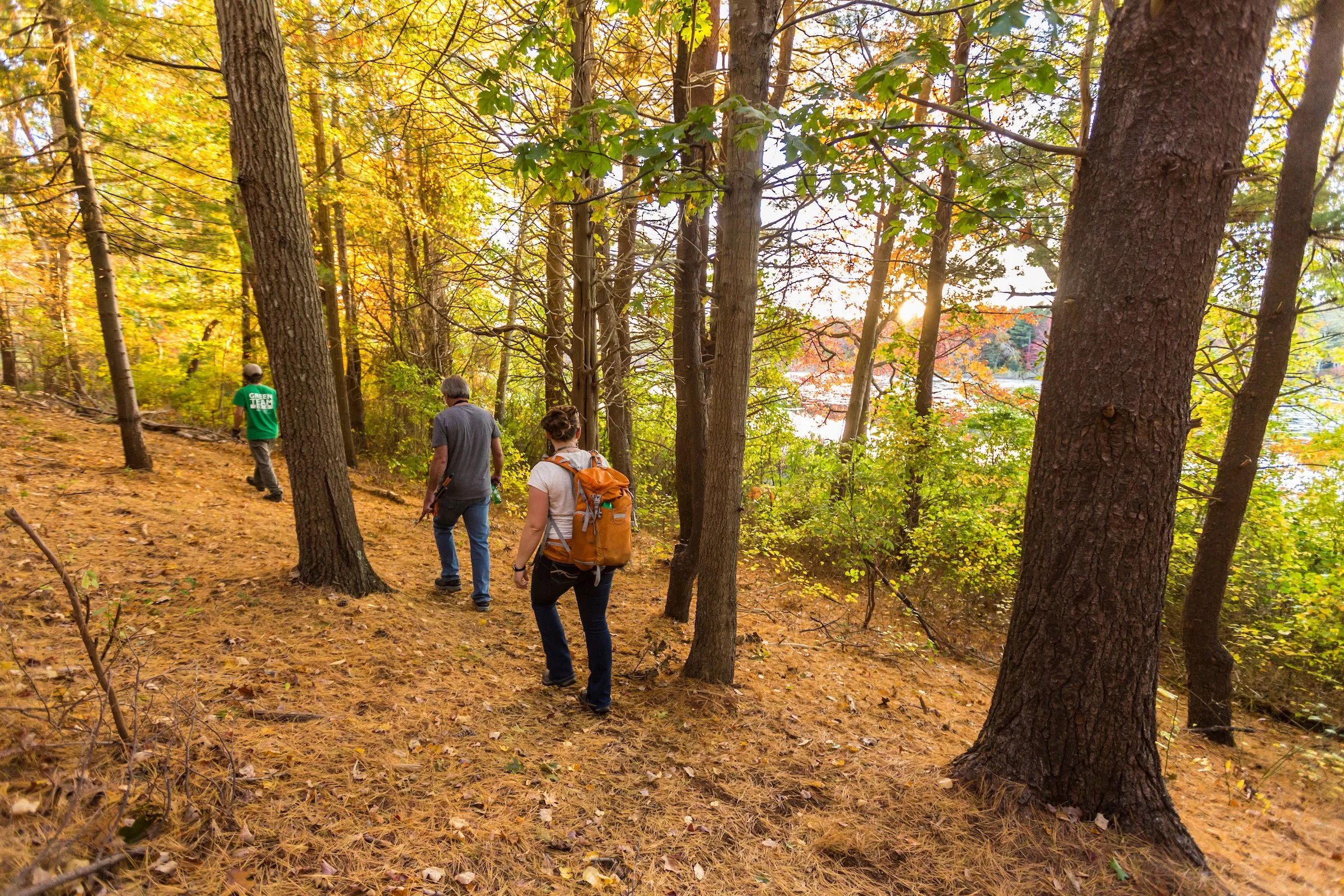
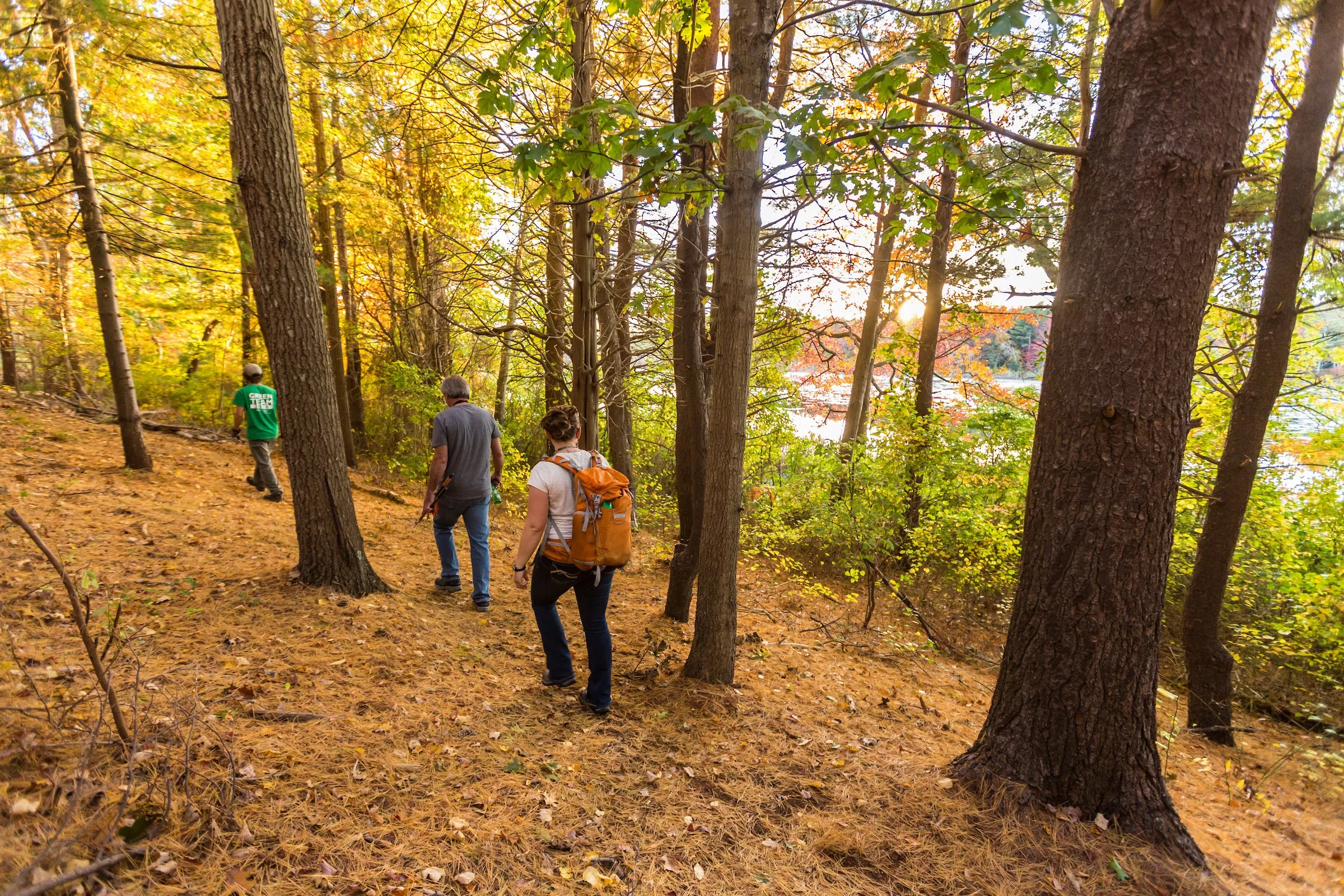
Hikers at Hoyt-Hall Preserve in Marshfield
By Mya Cusson, Communications Coordinator
While we may be biased, we believe that New England, and more specifically Massachusetts, is the best place to enjoy the fall season. From apple and pumpkin picking to trips to Salem and other spooky sites, there is so much to love about a Massachusetts autumn. At Wildlands, getting outside and appreciating nature in this time of transition is our favorite part of the season. In celebration of the changing leaves that will soon reach peak color, we wanted to give you a leaf peeper's guide to Southeastern Massachusetts.
First, a bit of biology: why do the leaves change color in the fall? Leaves get their green hue from chlorophyll, a molecule that allows plants to complete photosynthesis; turning sunlight into food. Chlorophyll is depleted consistently throughout the growing season, and in the fall, before a tree drops its leaves, almost all of its chlorophyll will be gone. When the green pigment from chlorophyll fades, other pigments in the leaf become visible, including carotenoid (yellow) and anthocyanin (red). The result of this chemical process? Forests full of vibrant, warm colors that draw visitors from all over the country. [1]
According to predictive maps, Southeastern Massachusetts will see its peak foliage colors between late October and early November, with inland towns reaching their peak before coastal areas. This means there's still ample time to plan and execute the perfect leaf peeping excursion at your local Wildlands preserve. [2]
To help you get started, here are some of our favorite spots to take in the foliage:
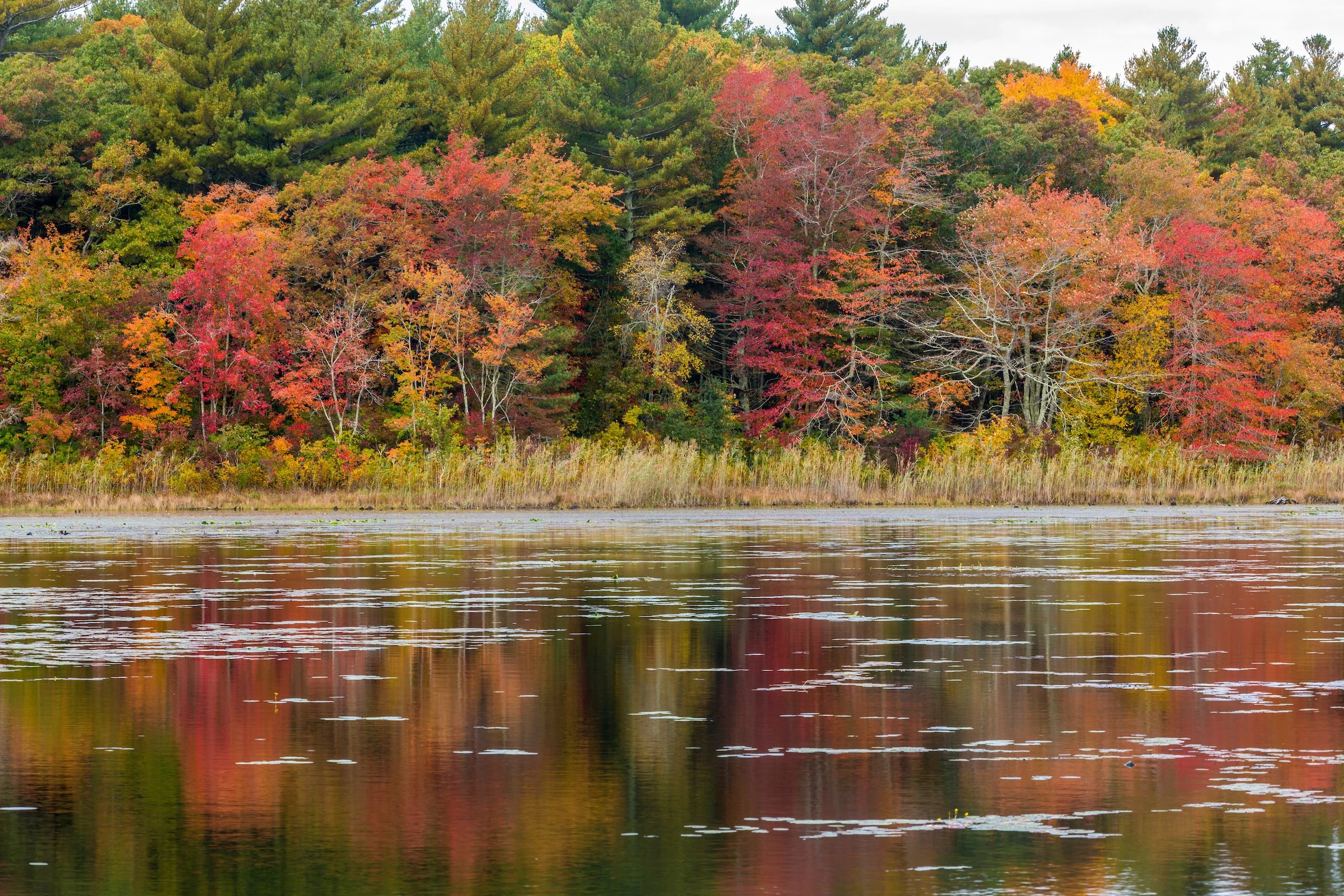
With an assortment of deciduous trees and a scenic loop around Long Tom Pond with plenty of lookout spots, Hoyt-Hall Preserve is the perfect place for a leaf peeping hike. While enjoying the fall colors, appreciate the history of the preserve as you walk a section of the original Pilgrim Trail.
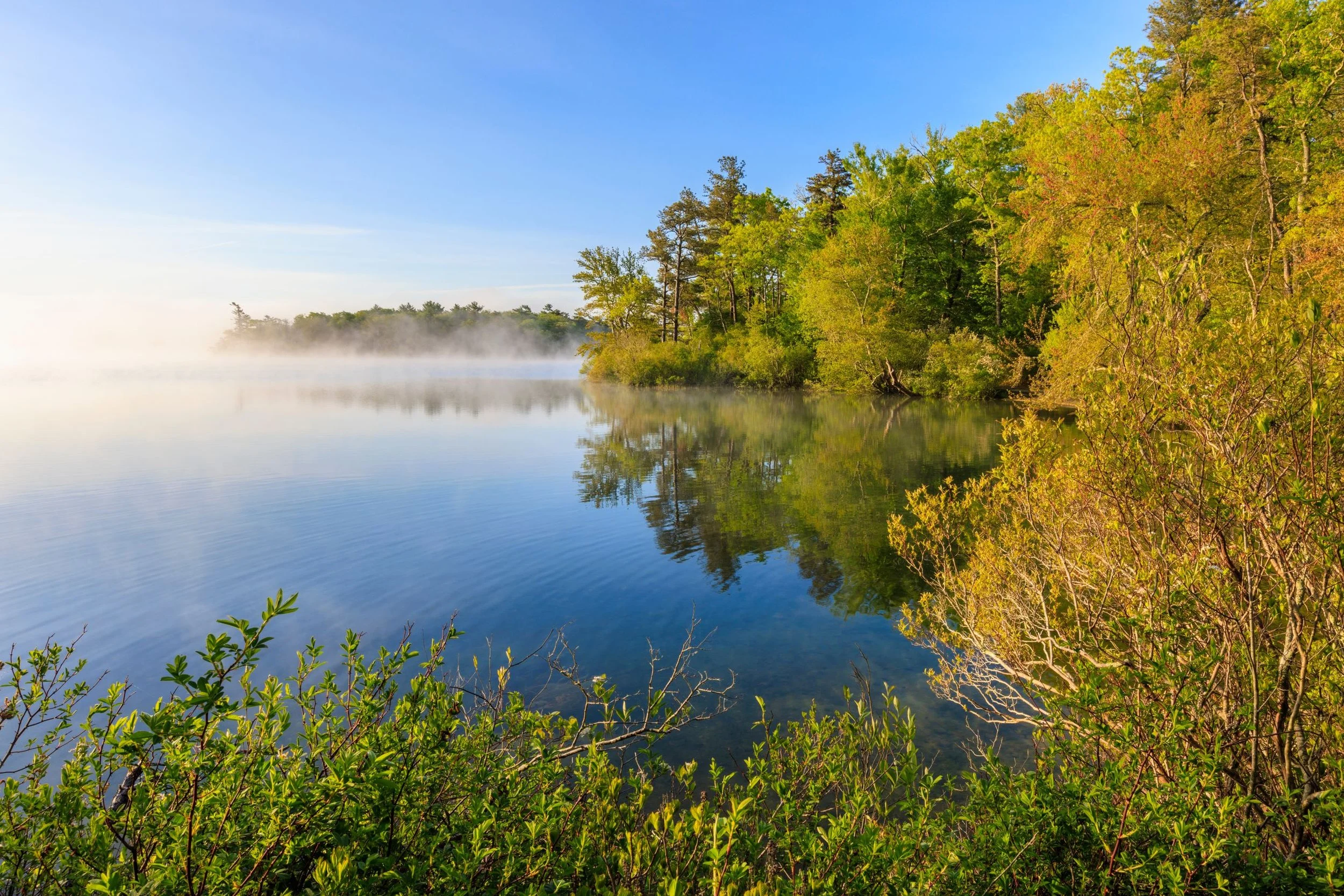
While Halfway Pond serves as a perfect outdoor haven year-round, it shines in the fall. Its beautiful oak and beech trees are already beginning to turn color, so now is the perfect time to visit. Keep an eye out for bald eagles during your hike, as they can often be spotted from the shores of the pond.
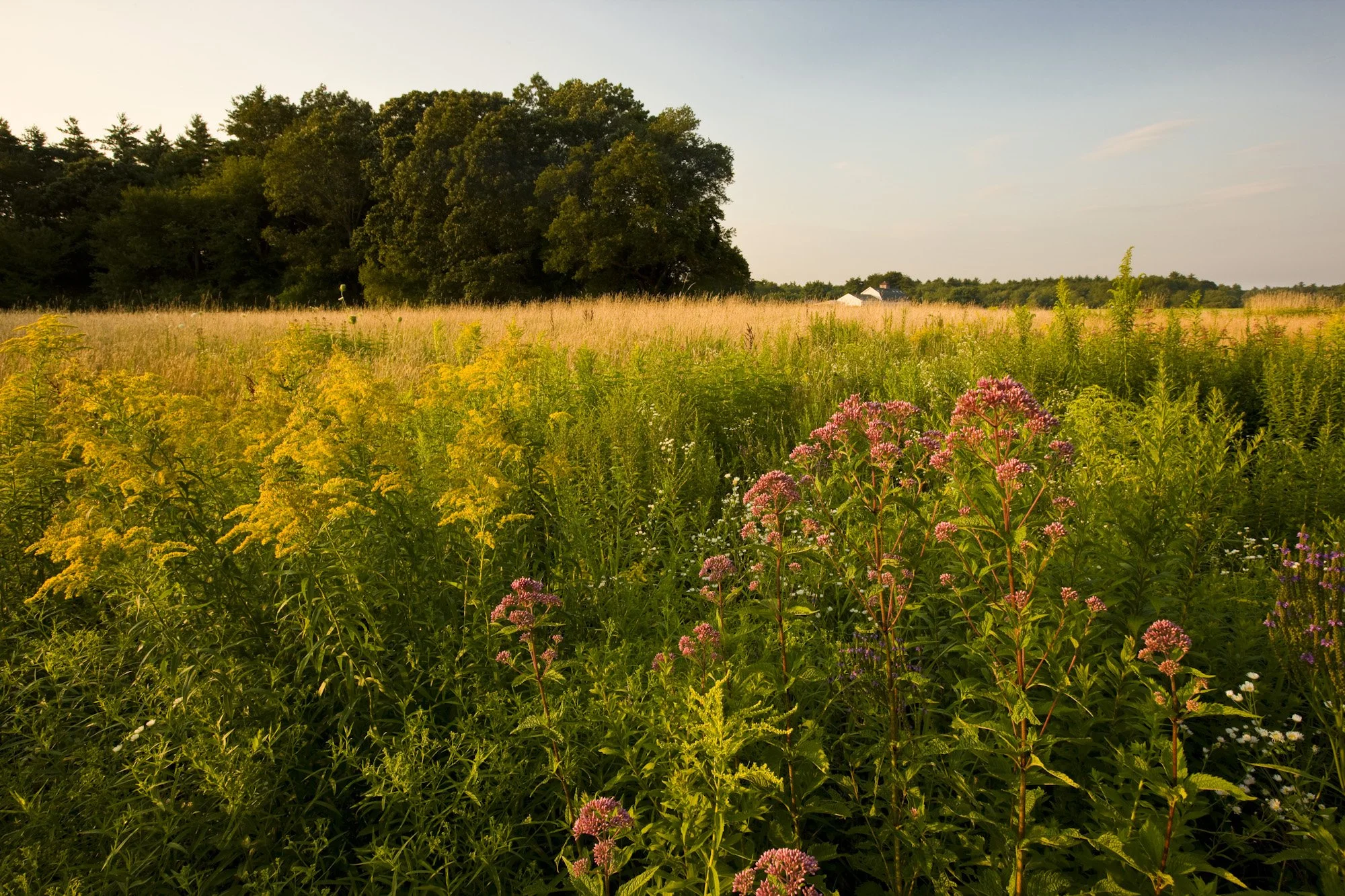
Great River Preserve’s variety of habitats make it a great destination for viewing nature at every scale and in every season. In the fall, its river access and sweeping fields allow for picturesque views of fall colors. Because hunting is permitted at Great River Preserve, visitors should stay safe by wearing bright orange or red and follow MassWildlife guidelines.
[1] The Science of Leaf Color Change - Harvard Forest
[2] Plymouth County, MA Fall Foliage Forecast 2026 | Peak Color Dates
Human History of Wildlands: Hoyt-Hall Preserve, Marshfield
Hoyt-Hall Preserve in Marshfield is one of Wildlands Trust's most popular preserves. Acquired in 2000, the property was quickly designated as a "showcase" preserve owing to its diverse woodland and wetland habitats and associated wildlife. Containing 123 acres and bordering 82 acres of additional conservation land, Hoyt-Hall protects a significant assemblage of open space in a growing town.
Yet there is another story here. Hoyt-Hall's human history spans over 10,000 years of settlement and change.

By Skip Stuck, Key Volunteer
Hoyt-Hall Preserve in Marshfield is one of Wildlands Trust's most popular preserves. Acquired in 2000, the property was quickly designated as a "showcase" preserve owing to its diverse woodland and wetland habitats and associated wildlife. Containing 123 acres and bordering 82 acres of additional conservation land, Hoyt-Hall protects a significant assemblage of open space in a growing town.
Yet there is another story here. Hoyt-Hall's human history spans over 10,000 years of settlement and change. Archeological evidence shows that Native people followed the retreating Laurentide ice sheet north, first as nomadic hunters and soon as settlers. Remnants of permanent dwellings have been excavated in Marshfield, dating back at least 3,000 years. The area that now contains Hoyt-Hall Preserve was partly a saltwater marsh with access to the ocean, and shell deposits show that it was well utilized by the Natives for fishing. By 1600, it was used seasonally by the Wampanoag Tribe as a summer home to take advantage of these resources. They wintered on the lands known today as Lakeville and Middleborough. The Wampanoags called the present-day Marshfield area "Missacautucket," and Massasoit was their powerful sachem.
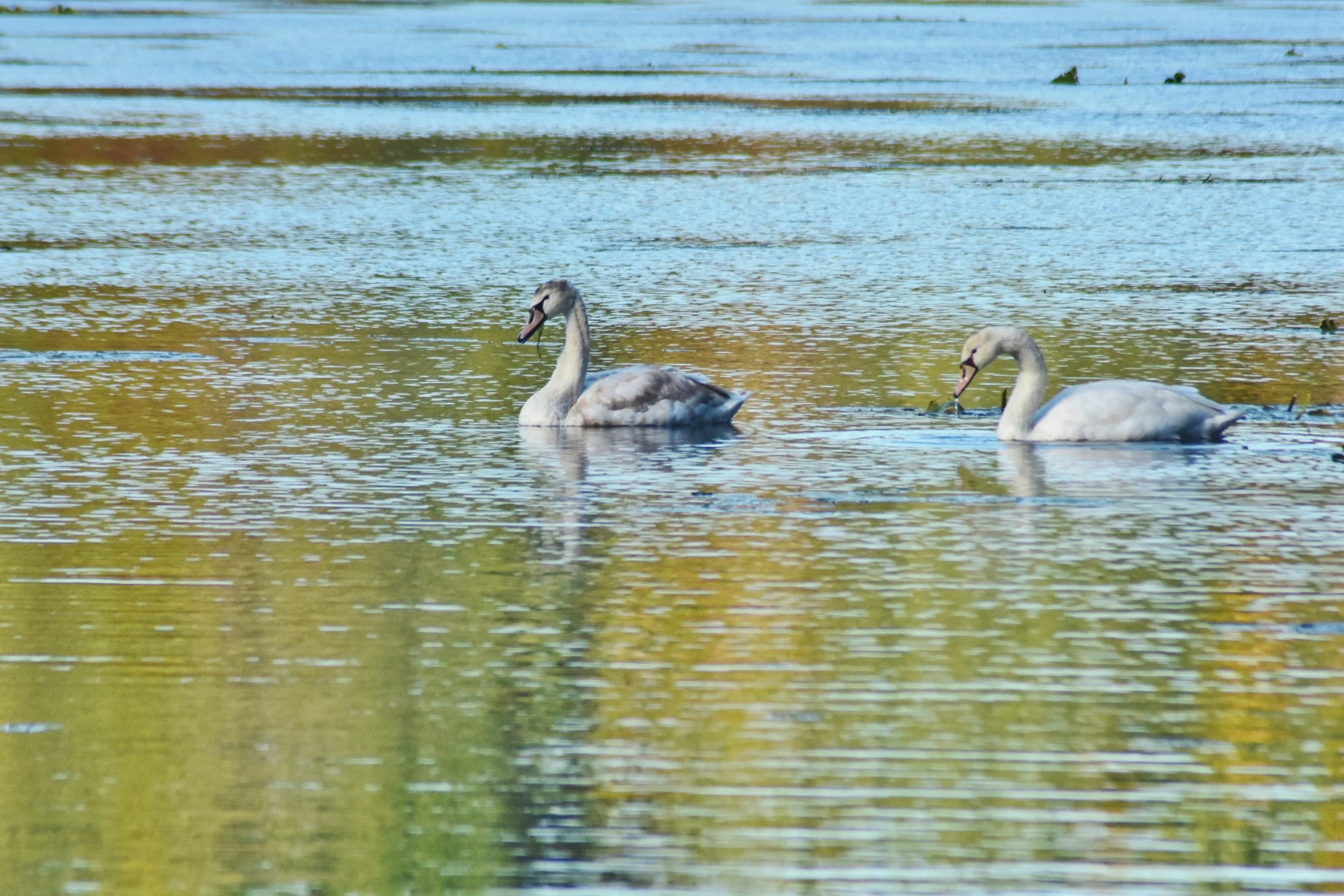
Swans on Long Tom Pond. Photo by Mike Arsenault.
The Value of Relationships
Upon the Pilgrims’ arrival to Plymouth Harbor, settling on lands outside the Colony's patent was prohibited. Early on, a few colonists managed to do so anyway. One was William Green in 1623, who established a commercial fishing post on what is now known as Green's Harbor. But general settlement was not permitted until 1632, when land grants began to be awarded. In 1636, Plymouth Colony governor Edward Winslow was granted a large tract of land, including the current Hoyt-Hall property. The Winslow family, along with the whole Plymouth Colony, was successful, due in large part to the strong relationship between Governor Winslow and the Wampanoag leader Massasoit, which endured for nearly half a century. More on the importance of relationships history later.
In 1637, the Pilgrim Trail, then called Green's Harbor Path, was the first general court-ordered road in the Colony. It passes along the border of Hoyt-Hall Preserve, as does King Philip’s path, an ancient and famous Native trail. Three Winslow family homesteads were built on the Hoyt-Hall property, much of which remained with the family until 1822. Two colonial governors, Edward and his son Josiah, lived and prospered on the land, as did Edward's adopted son, Peregrine White. White was born in 1620 on the Mayflower, becoming the first Englishman to be born in America.
In 1640, the Town of Marshfield (initially called Rexhame) was incorporated and grew quickly with new settlers. While many surrounding towns suffered much death and tragedy during King Philip's War in the 1670s, Marshfield remained relatively unscathed due to the Winslow family's strong relationship with the Wampanoag Tribe.
Hoyt-Hall Transformed
Because much of Hoyt-Hall was then tidal marshland, in 1675 a dam was built to create Long Tom Pond (named after a local Native who was killed in King Philip's War), providing a freshwater source first for general farming and later for cranberry growing.
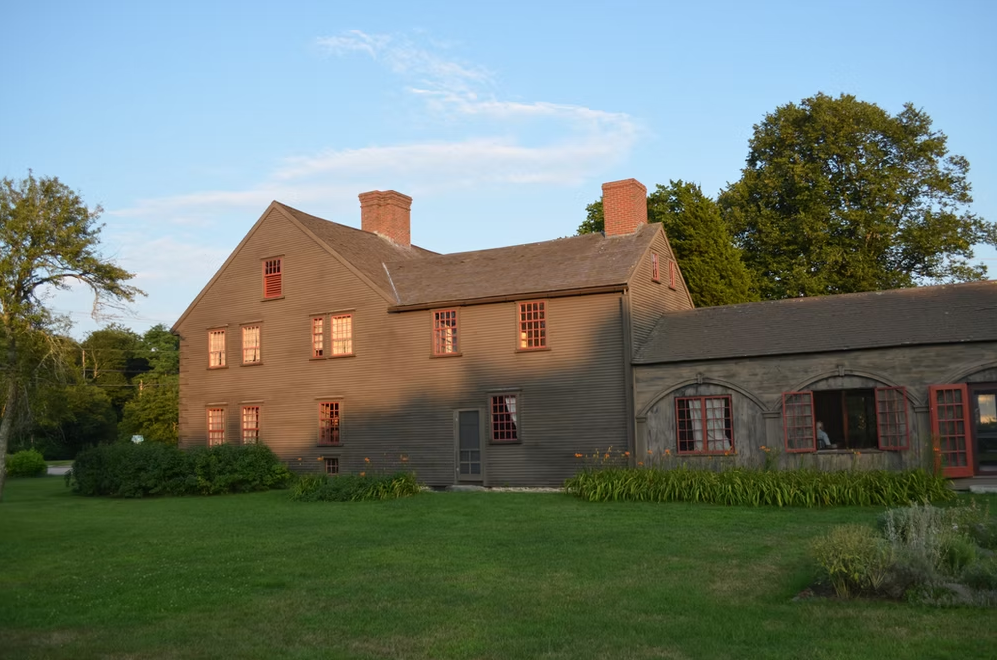
Historic Winslow House. historicwinslow.org
The Revolution
Directly adjacent to Hoyt-Hall Preserve is the Isaac Winslow house. Built circa 1699, it is the oldest home in Marshfield. Isaac was a well-known physician with a reputation for serving both settlers and Natives. He inoculated many against smallpox and other diseases in the early 1700s. However, as relationships between the colonists and the English crown deteriorated, the Winslow family became well-known Loyalists, and Isaac's house became a Loyalist meeting place. Relations between the Patriots and Loyalists were tense, and the Loyalists pressed for British troops to be brought in to protect them. A force of 114 troops landed, but fighting was eventually avoided, once again as a result of the Winslow family’s strong relationships with their neighbors.
Home of a Statesman
After the war ended, the Winslow family continued farming the property until 1822, when it was broken up and sold to a series of families. Some of the property returned to woodland, and some went to cranberry production. Some of it was sold to Daniel Webster, noted U.S. Congressman and Secretary of State, who lived in Marshfield from 1832 until his death in 1852. In 1884, Walton Hall purchased the Webster estate. In 1928, about 1,000 acres were purchased by Lincoln Hall, who converted some of the woodlands to cranberry bogs, which remained in production until the 1960s. During this time, the land began to take on the scenic character that we see today.
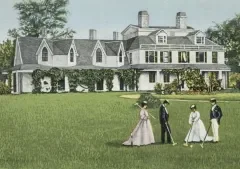
Daniel Webster Estate in 1859, as depicted on a 1909 postcard. From Patrick Browne, “The Almost-Battle of Marshfield.”
Protected Forever
In 2000, the land was sold to Wildlands with the assurance that it would be preserved in perpetuity, with beautiful trails for visitors to explore. In 2016, with funding from the Massachusetts Department of Conservation and Recreation’s Recreational Trails Program, a 1.75-mile trail loop was completed, with a parking lot on Careswell Street (Route 139). Today it is one of Wildlands’ most popular preserves, with many families enjoying this remarkable and historic property every year. Along with the adjacent Historic Winslow House, Hoyt-Hall Preserve's scenic beauty is forever linked to its rich history.
Back to Relationships...
So, you'll remember my earlier mention of the importance of relationships in the history of Hoyt-Hall Preserve. We too often think of the past in terms of events; i.e. wars, discoveries, and the like. We should not forget that nearly all historical events are either tempered or exacerbated by the human relationships that surround them. Had the Pilgrims not developed a strong relationship with Massasoit, Plymouth Colony would likely not have survived its first year. Fast forward 50 years, and it's clear that many lives were lost due to the souring of this relationship during King Philip's War. Be good to your friends.
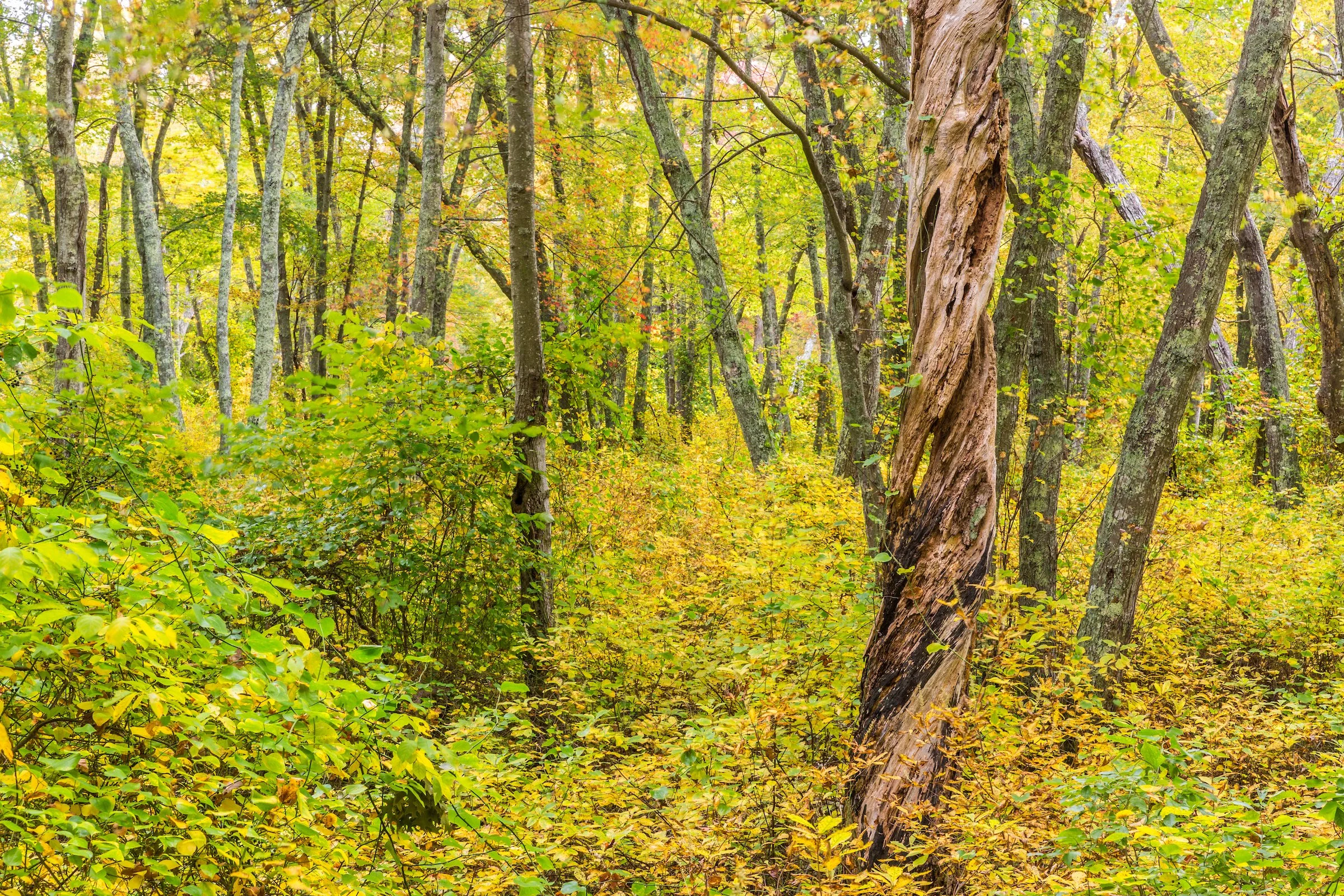
Hoyt-Hall Preserve. Photo by Jerry Monkman.
Learn More
To learn more and visit Hoyt-Hall Preserve, explore wildlandstrust.org/hoythall-preserve. The following resources were utilized in researching this history:
“Books and History Converge at Hoyt-Hall: Former Landowner Honored by Family” by Amy Markarian, Wildlands Trust, 2022.
The Historic Winslow House: winslowhouse.org.
History of Marshfield Massachusetts by Lysander Salmon Richards, 1901.
“The Almost-Battle of Marshfield” by Patrick Browne, 2011.
“History of Marshfield,” Kiddle Encyclopedia.
“Our Story Not Theirs” by the Mattakeeset Tribe.
A special thanks to Mike Arsenault, Amy Markarian, and Thomas Patti for their assistance with this piece.
Staff Picks: Where to Explore This Fall
If the arrival of September in Southeastern Massachusetts has you dreaming of brisk mornings, cozy sweaters, and leaves crunching underfoot, you’re not alone. We at Wildlands Trust are already planning our autumn hikes, paddles, rides, and picnics.
Are you looking for new places to explore this fall? Our staff and volunteers have you covered! Read on for a selection of our favorite autumnal landscapes, where you just might find us leaf peeping, migratory bird watching, or spooky story telling this season.
A note on safety: hunting season begins in the fall, so please take care to protect yourself, your loved ones, and your pets while on the trails. Consult our hunting safety guidelines before you head out. (Spoiler alert: wear blaze orange!)
Happy fall from all of us at Wildlands! Please share your fall nature photos with us at communications@wildlandstrust.org. Explore our trails across Southeastern Massachusetts at wildlandstrust.org/trails.
Hoyt-Hall Preserve, Marshfield
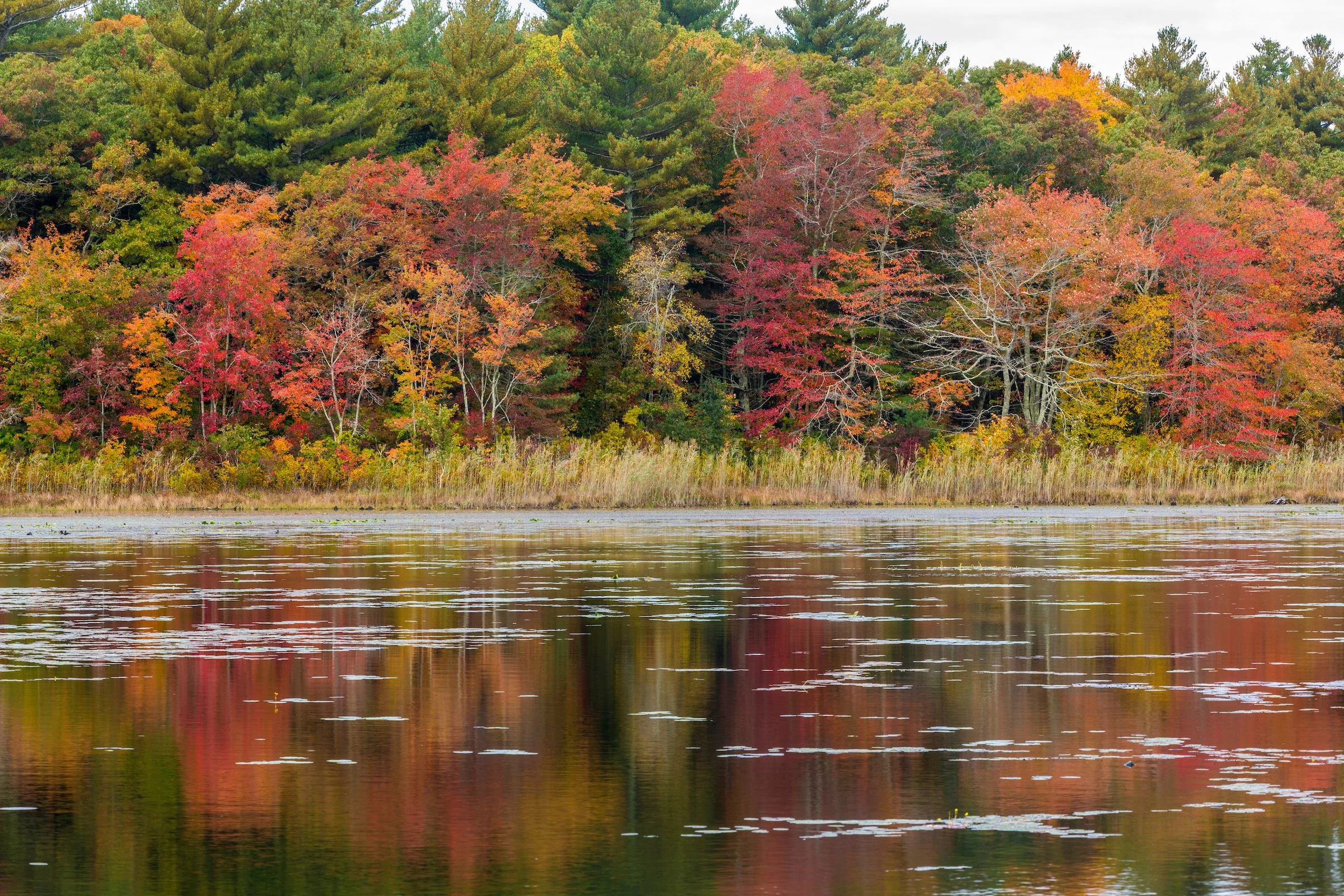
Photo by Jerry Monkman.
Trail map & property description: click here.
Rachel Bruce, Chief of Staff: The many deciduous trees show off their fall colors around Long Tom Pond, and a two-mile hike is perfect for a fall afternoon.
Tess Goldmann, Land Protection Assistant: I really enjoy Hoyt-Hall for its beautiful views of Long Tom Pond and its variety of different ecosystems you get to walk through. Plus, you can see all the red maples changing colors in October.
Great River Preserve, Bridgewater
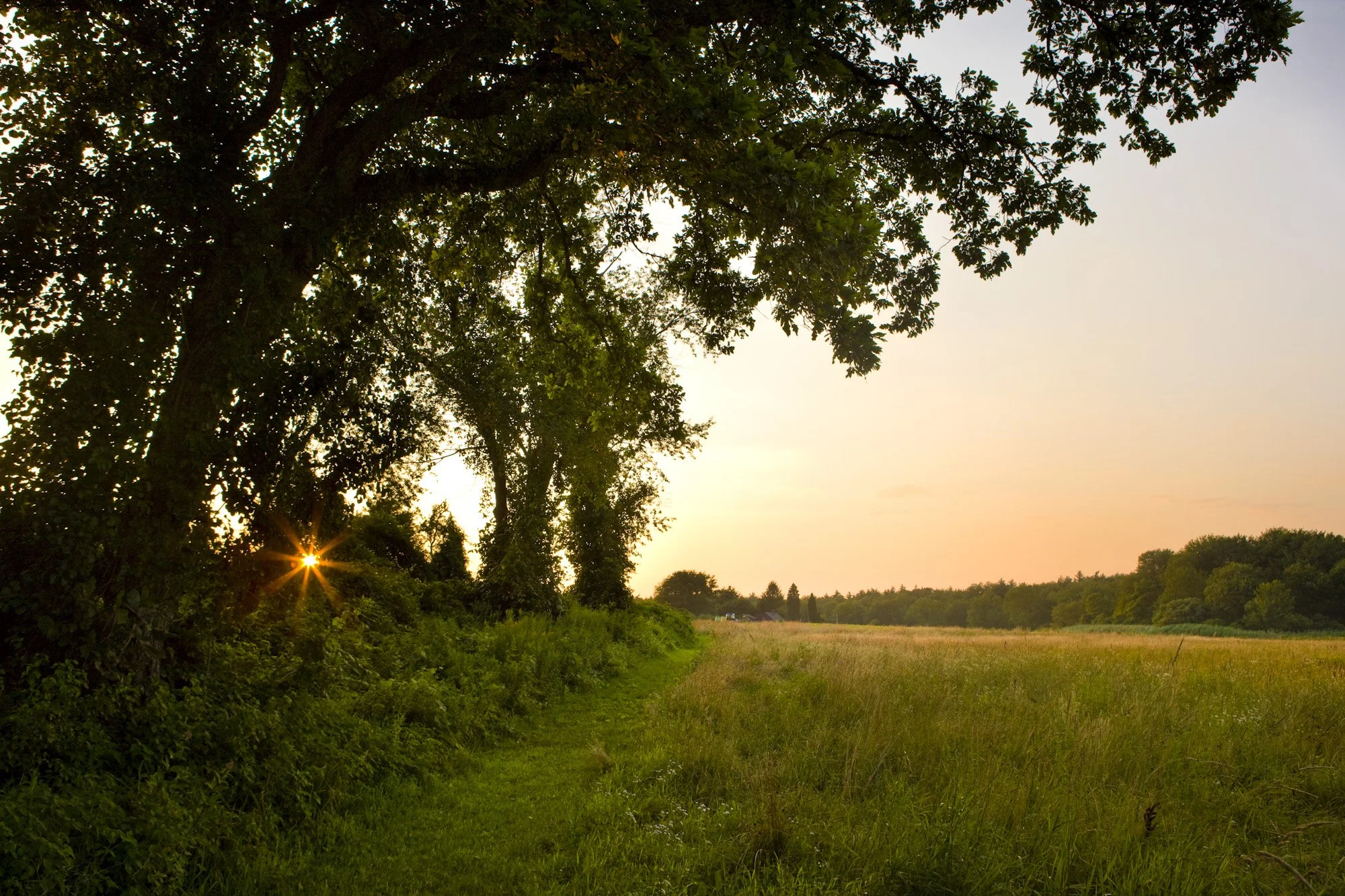
Photo by Jerry Monkman.
Trail map & property description: click here.
Marilynn Atterbury, Key Volunteer: As the leaves begin to turn, there’s no place I’d rather be than Great River Preserve. In the fall, the landscape transforms into a landscape of color. The meadows are dotted with Joe-Pye weed, jewel plants, and goldenrod, creating a stunning display. The meadows also become a haven for monarch butterflies, which lay their eggs on the milkweed that thrives there. Meanwhile, the maples and oaks along the Taunton River put on a breathtaking show of scarlet and gold. It’s this vibrant tapestry of nature that makes Great River Preserve my favorite fall destination.
Scott MacFaden, Director of Land Protection: The Great River Preserve is a fall favorite of mine. While it shines at any time of year, it is particularly luminous in autumn because of its juxtaposition of open fields, woods, and the Taunton River. I like to leisurely hike along the edge of the fields before spending some time at the viewing platform overlooking the river—one of the most peaceful and contemplative locations in all of Southeastern Massachusetts.
Indian Head River Trail – Pembroke, Hanover, Hanson

Photo by Andrew Lederman.
Trail map & property description: click here.
Amy Burt, Programming Coordinator: My favorite preserve is the Indian Head River Trail, a four-mile loop that encompasses Wildlands' Tucker Preserve. This time of year, you can get a great view of the river with the leaves falling while walking down a cathedral of color. Year-round, I enjoy channeling my inner goat and climbing the rocks.
Great Neck Conservation Area, Wareham

Photo by Rob MacDonald.
Trail map & property description: click here.
Skip Stuck, Key Volunteer: I like Great Neck because it has a little of everything. Uplands, ocean, marshlands, a pond full of waterfowl in the fall, and vernal pools surrounded by red swamp maples.
Kyla Isakson, Membership Manager: I love the diversity of the landscapes at Great Neck. You get a little bit of everything: ponds, farmland, pine forests, and ocean views. An underrated showcase preserve that is great year-round.
Wyman North Fork Conservation Area, Bridgewater

Photo by Rob MacDonald.
Trail map & property description: click here.
Thomas Patti, Communications Coordinator: As one of our newest public preserves, Wyman North Fork Conservation Area (a partnership between Wildlands and the Town of Bridgewater) remains a hidden gem… for now. This fall, visitors will hear bluebirds and goldfinches rustling in the meadow’s native grasses and gaze at the secluded woodlands’ vibrant foliage, hanging from the branches and reflecting off the glassy surface of the Taunton River.
Local College Student Conducts Natural Resource Inventory in Marshfield
By Tess Goldmann, Conservation Restriction Coordinator

Hoyt-Hall Preserve in Marshfield
Last fall, Wildlands Trust had the pleasure of partnering with Unity College student and Carver resident Nicole Huff. As part of her coursework, she completed a natural resource inventory of our Hoyt-Hall Preserve in Marshfield. A natural resource inventory (NRI) is a multifaceted survey of all the animals, plants, soils, waters, and geological features in an area. Hoyt-Hall, one of our showcase preserves, has a wide variety of environments, including pine forest, red maple swamp, and Long Tom Pond. We were excited for Nicole to conduct an NRI of Hoyt-Hall, as her findings would help us identify specific property conservation needs and future projects to address them.
Nicole used multiple methods to survey the property. When I met with Nicole at Hoyt-Hall in September, we walked the property and completed three quadrat sampling sessions. Nicole made five bird observation trips and hung two trail cameras to catch mammal activity. Finally, Nicole collected and analyzed 20 soil samples from around the preserve.
Nicole made several interesting discoveries about the preserve. She found that the upland soil is very acidic, with a pH of 3.62. This soil acidification could be responsible for the deaths of several Eastern red cedar trees around the preserve. In addition, Nicole identified two invasive plants—Oriental bittersweet and European buckthorn, both common in Southeastern Massachusetts—and recommended removal strategies for both.
Nicole also identified 31 birds, which is remarkable, especially during the late end of fall migration. In spring and summer, this number is sure to be higher, making Hoyt-Hall a premier birding location! (See eBird Hotspot data for the preserve here.) Be on the lookout for Downy Woodpeckers, Red-breasted Nuthatches, and many more!
Thank you, Nicole, for all of your hard work! Your project will be an invaluable resource as we continue to advance positive conservation outcomes at Hoyt-Hall Preserve and beyond.
Books and History Converge at Hoyt-Hall: Former Landowner Honored By Family
By Amy Markarian, Senior Copywriter
Read Time: 5 min
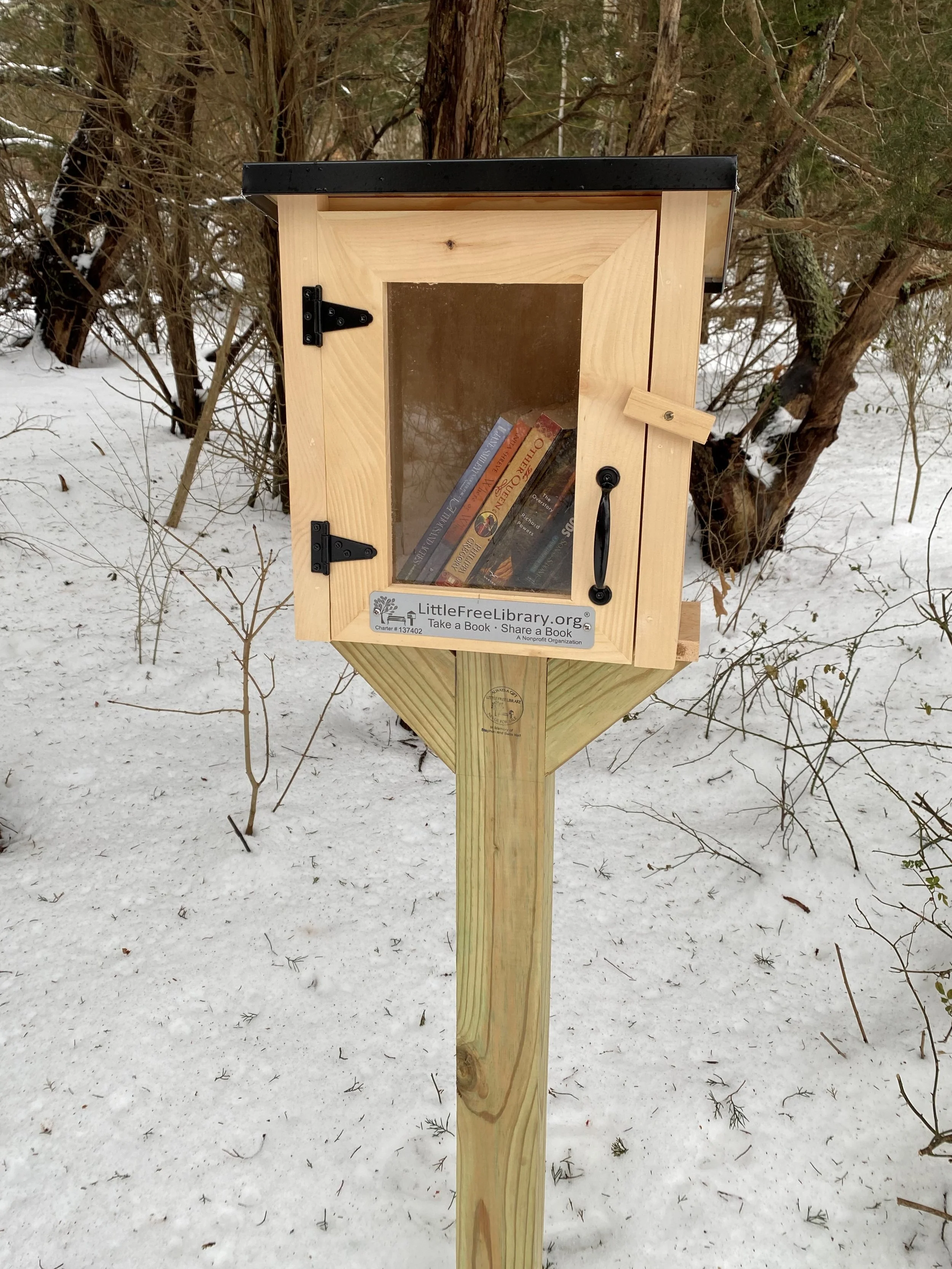
On January 23, just before a winter storm buried Hoyt-Hall Preserve under nearly two feet of snow, ground was broken for the installation of a new Little Free Library at the Careswell Street trailhead. The project was the brainchild of Steve Wood, who grew up spending time with family on the property once owned by his grandfather, Stephen Hall. To understand the significance of this meaningful gift, we traced back over 100 years to the Hall family’s early presence in the Marshfield community. Several family members shared their memories, creating a beautiful mosaic of memory, place, and kin.
In 1884, Walton Hall purchased the renowned Daniel Webster Estate (then called the Daniel Webster Farm) from Webster’s family. As its owner, Walton became a gentleman farmer, developing approximately 1000 acres of bogs and orchards along Webster Street and extending down to Green Harbor. According to his great-granddaughter, Michele Armour, when Walton died in 1928, his sons Lincoln and Lewis managed the farm and bogs. Later, Lincoln Hall bought the nearby property that is now known as Hoyt-Hall Preserve, where he lived and developed cranberry bogs that were utilized until the late 1960s. While the bogs that were once located on the Webster Street side of the property have since reverted to a natural state and the pond is no longer used for irrigation, evidence of the land’s agricultural history can be seen in the remnants of an old windmill on the property.
Michele remembers early childhood visits to this home – her grandfather piling the kids in the back of his truck and bumping down the unpaved road to the bog so they could help with the dry harvest of cranberries. After her grandfather’s death in 1969, Lincoln Hall’s son Stephen moved from Lexington to the Marshfield home, where he lived for many years with his wife Bella and daughter Michele. The couple’s older daughter Jackie was living on her own by then, but visited often with her young family–including sons Steve and Marc.
Stephen Hall had met his wife Bella in Paris, France, while serving in World War II. When the war ended and Bella emigrated to the United States with him, Stephen understood the challenges she may face and promised that her family would always be welcome to visit. Throughout their life together, Bella’s family members came to stay with them in Marshfield every year, often for extended visits, and once with as many as 14 people. Jackie and Michele got to know their distant relatives through these annual visits, and have profound recollections of time spent in the company of family on the spacious estate. Jackie’s sons, too, developed a close bond with their grandparents and other relatives there, spending holidays and vacations at the family home. With plenty of room for all, it offered a place for gathering and building connections with nature.
Both of Stephen Hall’s daughters have fond memories of their family’s outdoor adventures on the property – exploring the cranberry bog, the woods, and the pond that they used for fishing and boating. They remember, too, their father’s appreciation for the osprey that nested on the property. Stephen was a nature lover who spent a lot of time outdoors, clearing trails and observing wildlife. At the same time, according to Jackie, her father was also “enamored with, and knew just about everything there was to know about, Daniel Webster.” Having lived in the historic Daniel Webster House as a child, Stephen developed an interest that led him to become an avid Daniel Webster and Marshfield historian.
In his later years, Stephen Hall knew that the Careswell Street property meant too much to his family to risk being lost to development. When the family sold the land to Wildlands in 2000, he was comforted by the knowledge that it would be protected and beautified, with trails added for visitors to explore. According to Jackie, it meant a lot to her father to think that the land would be preserved and enjoyed by many. Michele considers it her father’s legacy to have the land protected in perpetuity, adding that the family couldn’t have asked for more than what it has become under Wildlands’ care today.
It is this sentiment that led Stephen Hall’s grandson, Steve Wood, to plan the donation of the Little Free Library at Hoyt-Hall Preserve this winter. He wanted to give back to Wildlands Trust for caring for the land his family loves, and the library is a gift that is both beneficial to visitors and meaningful for his family. Filled with intentionally selected books contributed by family members – about Marshfield, Daniel Webster, and wildlife – it honors his grandfather’s love of books and local history. Steve hopes the new little library will also foster a sense of community among preserve visitors through book sharing.
Little Free Library is a non-profit organization that supports the creation of small, weatherproof kiosks for donating and borrowing books. Steve Wood first saw a Little Free Library at a cafe near his home in Dorchester. After learning more about the initiative to promote reading, he installed well-utilized Little Free Libraries at both his home and the hospital where he works. This winter, Steve contacted Wildlands with his idea to install another one at Hoyt-Hall. Wildlands currently has Little Free Libraries on two other preserves - Willow Brook Farm, in Pembroke, and Brockton Audubon Preserve, in Brockton - and stewardship manager Owen Grey knew this addition would reach many people who come from all over the South Shore to hike at Hoyt-Hall Preserve.
We are thrilled that visitors will benefit from this meaningful gift, and we are equally grateful to have the opportunity to build lasting relationships with families through the preservation of land. Land conservation truly is about so much more than the number of acres on a map. Wildlands Trust serves individuals, families, and communities in order to help landowners fulfill the wishes they have for the natural spaces they care about. This process lays the foundation for relationships that last through generations. We are grateful to Steve Wood and the family of Stephen Hall for being a part of the Wildlands community!